





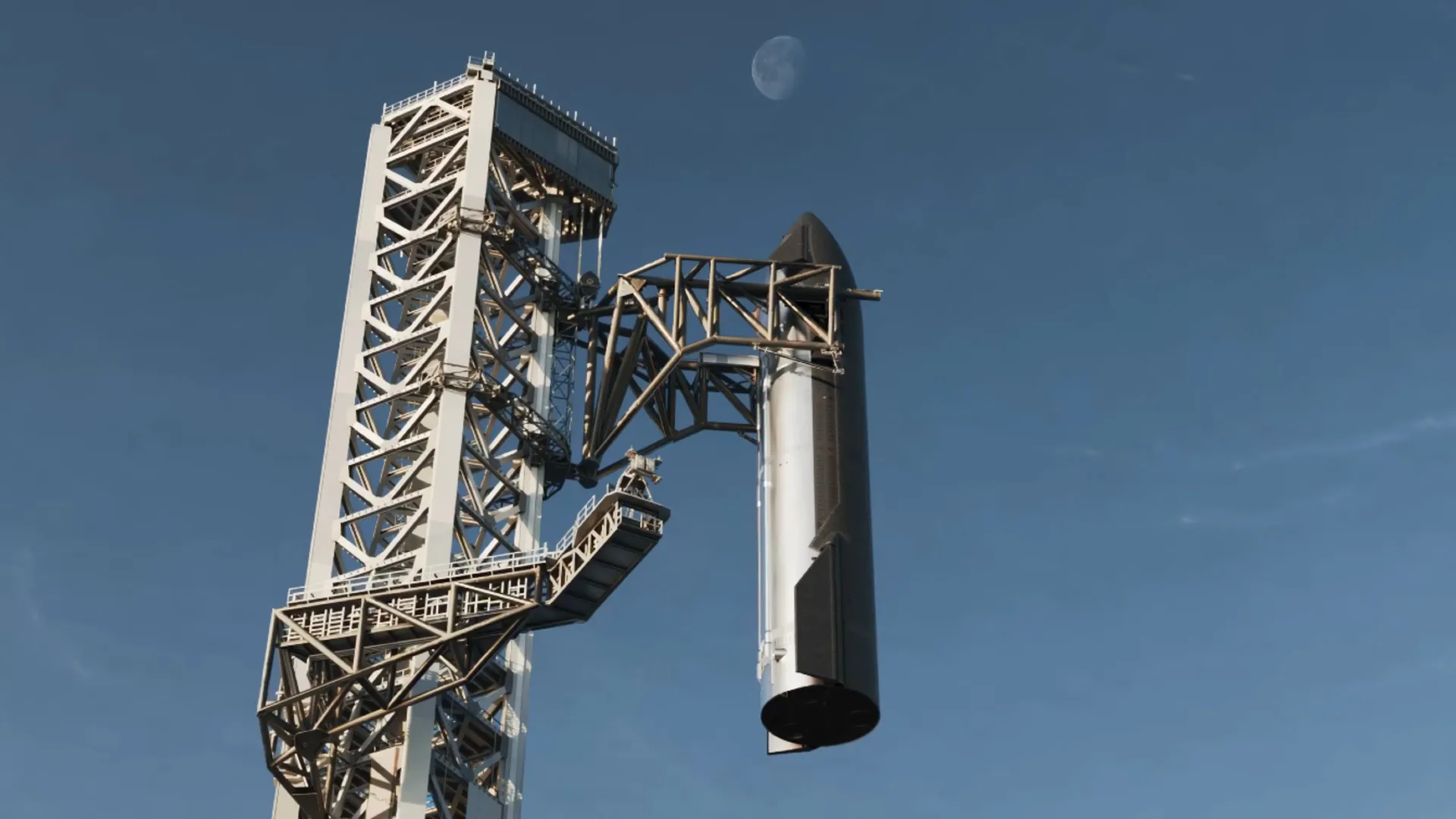
SpaceX's Starship megarocket is slated to launch on its ambitious 15th flight test as soon as this Friday (Nov. 13). Will you be able to spot its leviathan upper stage, known as Ship, or its Starlink satellite passengers as they circle Earth during the historic orbital jaunt?
Flight 15's 75-minute launch window opens at 5:45 p.m. EST (2245 GMT) on Nov. 13. Starship will fly from SpaceX's Starbase site in South Texas, where it will be 4:45 p.m. at the opening of the window — about an hour before sunset. The launch could therefore be especially dramatic for folks in the area.
"As it launches towards the southeast, and it will be daylight, then the prospects for viewing from the U.S. are going to be in Texas and the states along the Gulf of Mexico," Robert Massey, deputy executive director at the Royal Astronomical Society, told Space.com. "They could see the exhaust plume (the 'jellyfish') with the sky darker for observers further east."
If all goes to plan, Starship's Super Heavy booster will propel the Ship upper stage through the densest part of Earth's atmosphere before returning to Starbase for a powered landing and capture via the "chopstick" arms of the "Mechazilla" tower system. Ship, meanwhile, will go on to orbit Earth approximately 14 times over the following 22 hours, during which time it will deploy 26 Starlink V3 satellites before returning to Starbase for its own ambitious catch attempt.
When should I look for Starship and its Starlink train?
Satellite visibility in the night sky depends on a cocktail of factors, from the size of the spacecraft to its reflectivity, orbital inclination and position relative to the Earth and sun.
Ship is big — about 171 feet (52 meters) tall — so it will be a viable target for skywatchers, experts say.
"It certainly will be visible in twilight hours. It should be very bright, considerably brighter than the Starlink satellites due to its size," professor James Osborn of Durham University told Space.com. "Where and when is a bit more tricky."

Ship and its Starlink satellites may be seen in the 90 minutes directly after sunset on Nov. 13 and before sunrise on Nov. 14, as the probes catch the sunlight on either side of Earth's colossal shadow as they drift through the twilight sky.
The spacecraft will initially appear as a string of bright, evenly spaced lights, with Ship most likely appearing significantly brighter than the Starlink satellites. However, Osborn noted that the lack of publicly available data makes it challenging to forecast exactly when the spacecraft will appear.
"During its 14 orbits over 22 hours, the spacecraft is between inclinations of 30.5 [degrees] N and S of the equator," explained Massey. "So it will be best viewed between those latitudes, and then lower in the sky up to latitudes of 40 N and 40 S. That's pretty much the whole of the contiguous U.S."
Space.com skywatching columnist and veteran meteorologist Joe Rao shared further details on what stargazers may see with the naked eye as Ship drifts silently through the autumn sky.
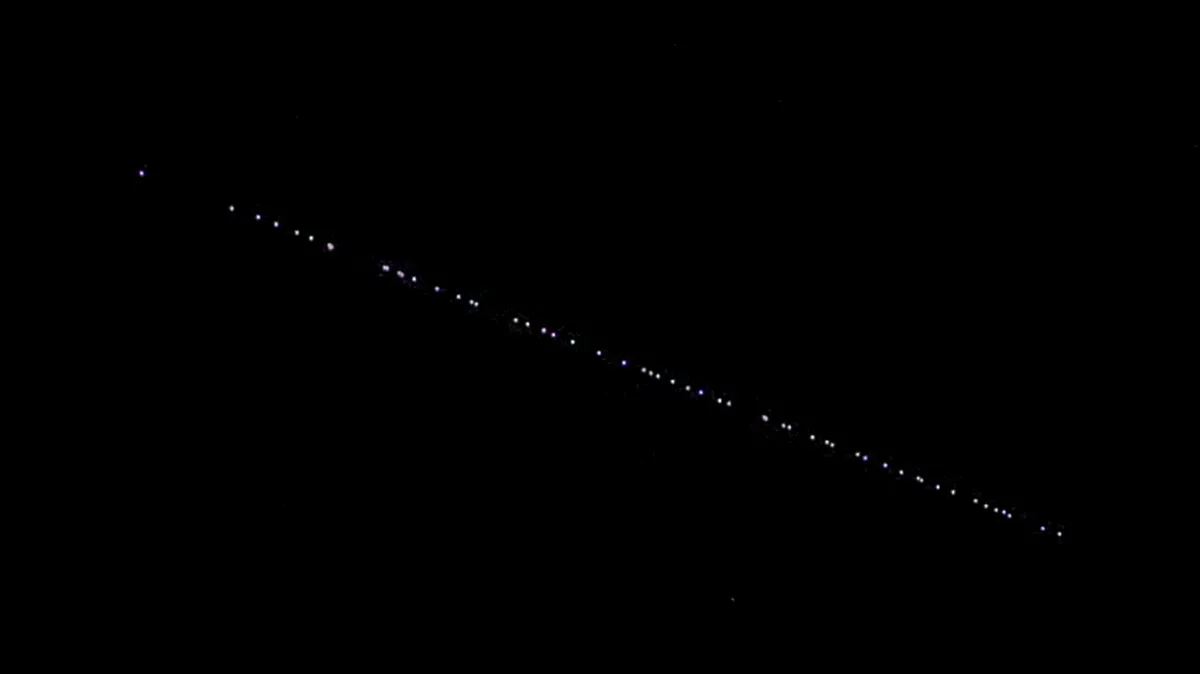
"When it passes overhead, it will look like a bright, fast-moving star crossing the sky — similar to the International Space Station, but potentially even brighter depending on its orientation," explained Rao. "The Starlink V3 satellites are much smaller, so not as bright, perhaps ranging anywhere from 2nd to 4th magnitude, depending on the angle of illumination with reflected light from the sun."
Magnitude is the scale used by astronomers to measure the brightness of objects in the night sky. The lower the magnitude, the brighter the object! The unaided eye can make out objects with a magnitude of around +6.5 under ideal dark sky conditions, while the planet Venus currently shines at magnitude -4.41.
The Starlink train will likely fall further behind Starship as the 22-hour mission progresses, while the train itself will become more elongated, according to Rao. "For locations where it will make a high arc across the sky, the Starship should be visible for at least a few minutes, although because it is orbiting at a lower altitude (170 miles/275 km) compared to the ISS, it probably will appear to move somewhat faster. "
How can I track Starship after launch?
There are multiple handy resources that should allow you to track Ship and the newly deployed batch of V3 Starlink satellites following their scheduled launch on Nov. 13, including the websites Heavens-Above, Star Dash, Orbital Radar and Find Starlink.
Be sure to keep an eye on our Starship Flight 15 live blog for all the latest news along with our launch timings article containing details on how to watch SpaceX's potentially historic orbital launch attempt.
Editor's Note: If you capture a photo of Starship and want to share it with Space.com's readers, then please send your photo(s), comments, and your name and location to spacephotos@space.com.