


Space Verdict
The Viltrox AF 35mm f/1.8 II EVO FE (APO) is an impressive lens for the price and certainly won’t break the bank. Image quality is impressive but imperfect, yet it's still an attractive lens.
Reasons to buy
- +
Enticing price
- +
Manual aperture ring
- +
Impressive image quality
Reasons to avoid
- -
Vignetting wide open
- -
Some astigmatism at the frame edges
- -
Only available in two lens mounts
Why you can trust Space.com Our expert reviewers spend hours testing and comparing products and services so you can choose the best for you. Find out more about how we test and review products.
Type: Full-frame prime lens
Focal length: 35 mm
Maximum aperture: f/1.8
Lens mount: Sony FE & Nikon Z
Weight: 12.52 oz / 355 g
Dimensions: 3.33 x 4.37 in / 69 x 76 mm
Filter thread: 58 mm
Release date: April 2026
Budget primes can be, surprisingly, excellent choices for photographers shooting all subjects. It’s all too easy to get carried away with the best specs, such as a large maximum aperture and impressive optical design often seen in more expensive options. But affordable lenses like the Viltrox AF 35mm f/1.8 II FE (APO) have the potential to impress and delight in equal measure.
The 35mm f/1.8 is a compact and lightweight lens offering a reasonably fast maximum aperture, making it a prime candidate for astrophotography. It’s also the same size and almost the same weight as the Viltrox AF 55mm f/1.8 FE (APO), another lens that could potentially grace your camera bag.
With a highly attractive price tag of just $399 / £385, and mount options for Nikon Z and Sony FE, many astrophotographers will be wondering if this is a lens worth considering. It features 13 elements in 10 groups, as well as featuring an apochromatic (APO) design for reducing chromatic aberration as much as possible. As much as possible is key here because not all lenses are as successful as the manufacturer claims, although that’s not a comment on the 35mm f/1.8. Read on to discover if this could be one of the best lenses for astrophotography.
Viltrox AF 35mm f/1.8 II EVO FE (APO) lens review
Viltrox AF 35mm f/1.8 II EVO FE (APO): Performance
- Sharp images for the price
- Sweet spot at f/8-f/11, not ideal for astro
- Some astigmatism at the edges of the frame
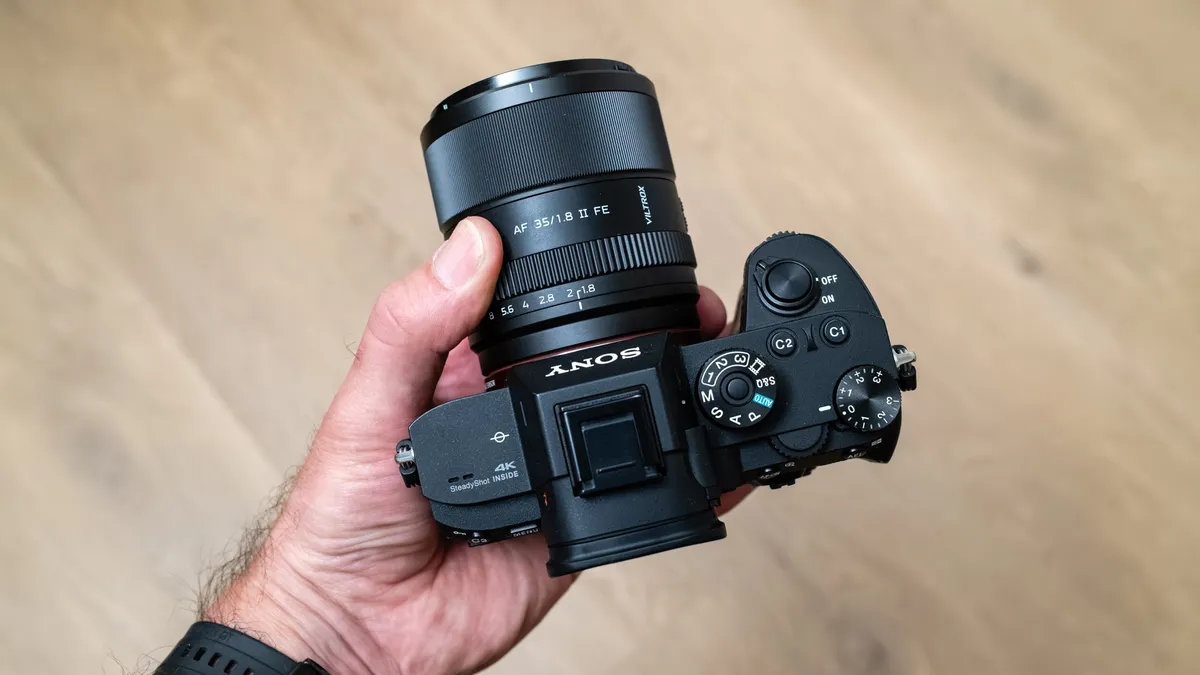
For a budget lens, the 35mm f/1.8 produces great, yet not perfect, image quality. On the plus side, images are nice and sharp, particularly in the centre, even when shooting wide open at f/1.8. At this aperture setting, though, there is some astigmatism at the left edges of the frame. This is where stars appear as crosses. This is a surprise since it’s an APO lens, and, equally surprising, it’s isolated, but it is something you have to consider.
You do have to zoom into the image to see it, so it may not be a dealbreaker. Photos shot at f/1.8 are sharpest in the centre, with some fall-off towards the edges, with the corners exhibiting the least sharpness. There’s also the strongest vignetting at f/1.8. At the time of writing, there’s no Adobe Lightroom lens profile for the lens, but you can manually remove the vignetting and even create a preset of your own.



The vignette disappears as soon as f/4, with a gradual increase in sharpness across the frame between f/2.8 and f/5.6. f/8 and f/11 appear identical in terms of sharpness and occupy the sweet spot, while diffraction is clearly at work when you stop down to f/16. In reality, it’s unlikely you’d shoot beyond f/11 with this lens, even if you were shooting landscapes.
Overall, image quality is impressive despite not being perfect and stopping down to f/2.8 when shooting astro does provide greater clarity across the frame. This is, as you know, at the expense of having to shoot at a slightly higher ISO setting to compensate.
Viltrox AF 35mm f/1.8 II EVO FE (APO): Design
- Compact and lightweight
- Manual aperture ring
- Weather sealed
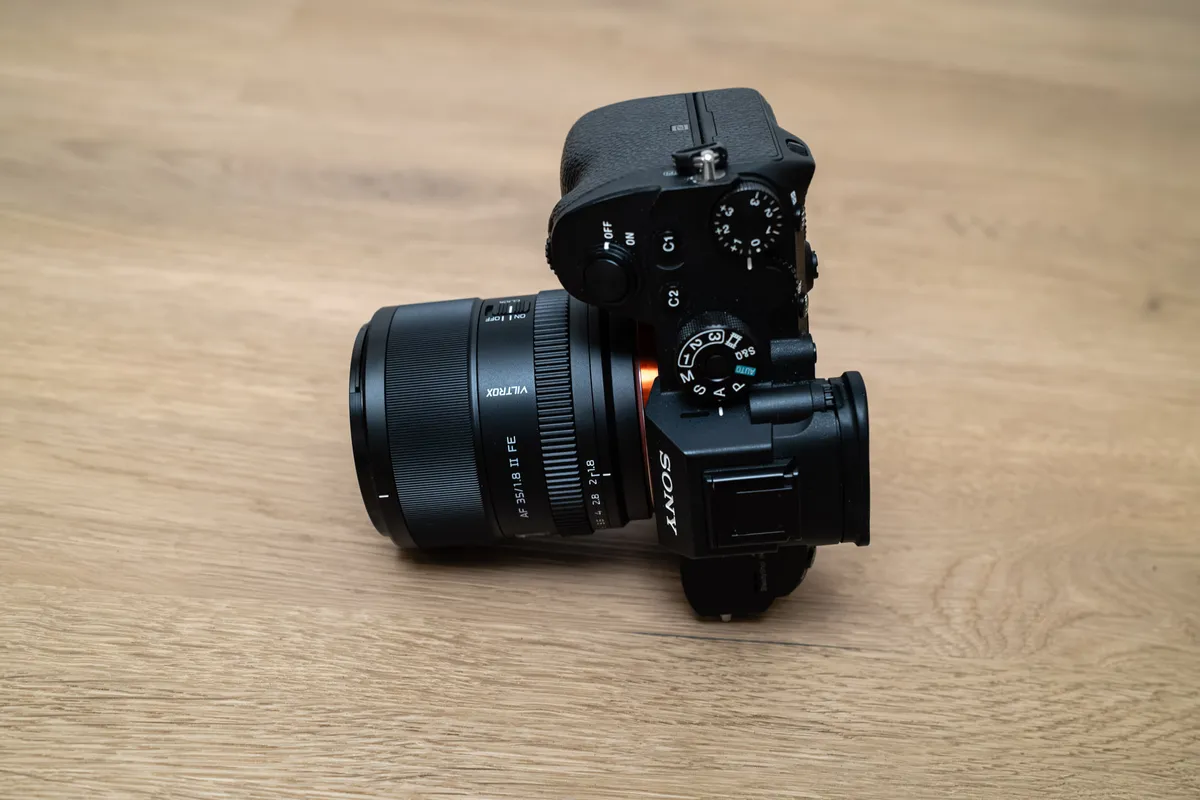
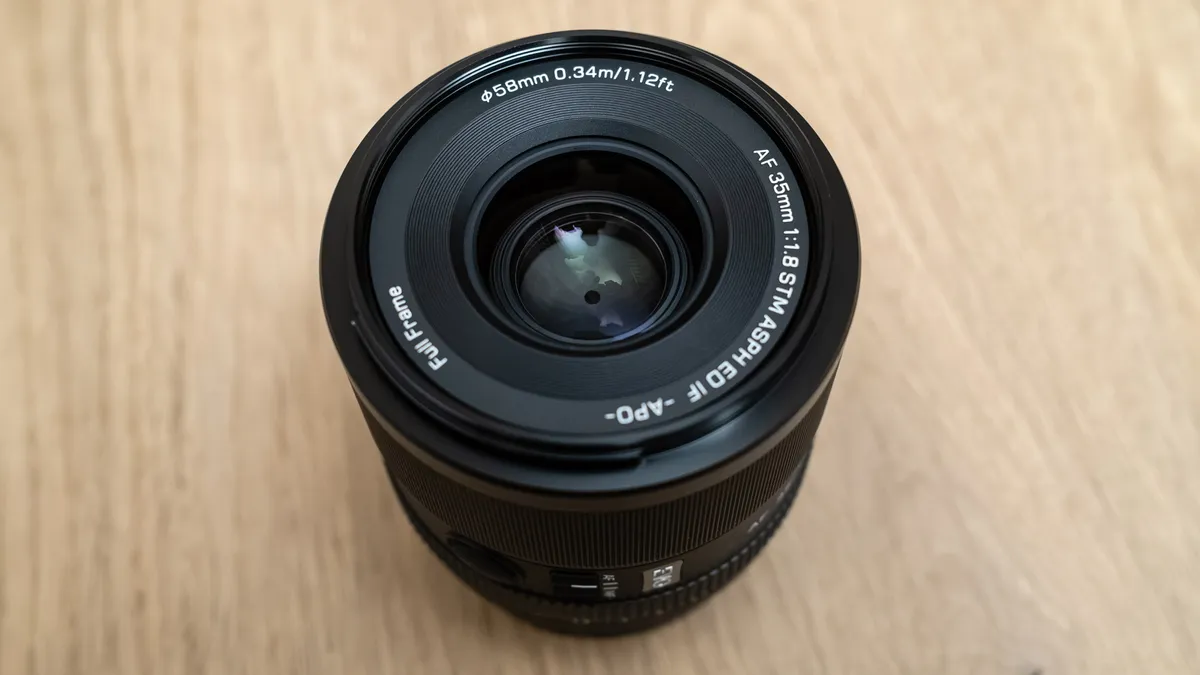
While f/1.8 lenses may not have the speed and light-gathering capabilities of faster f/1.4 and f/1.2 lenses, they’re considerably smaller and lighter. The lens only has a 58mm filter thread, so if you use any night filters, they will be at the less expensive end of the price scale.
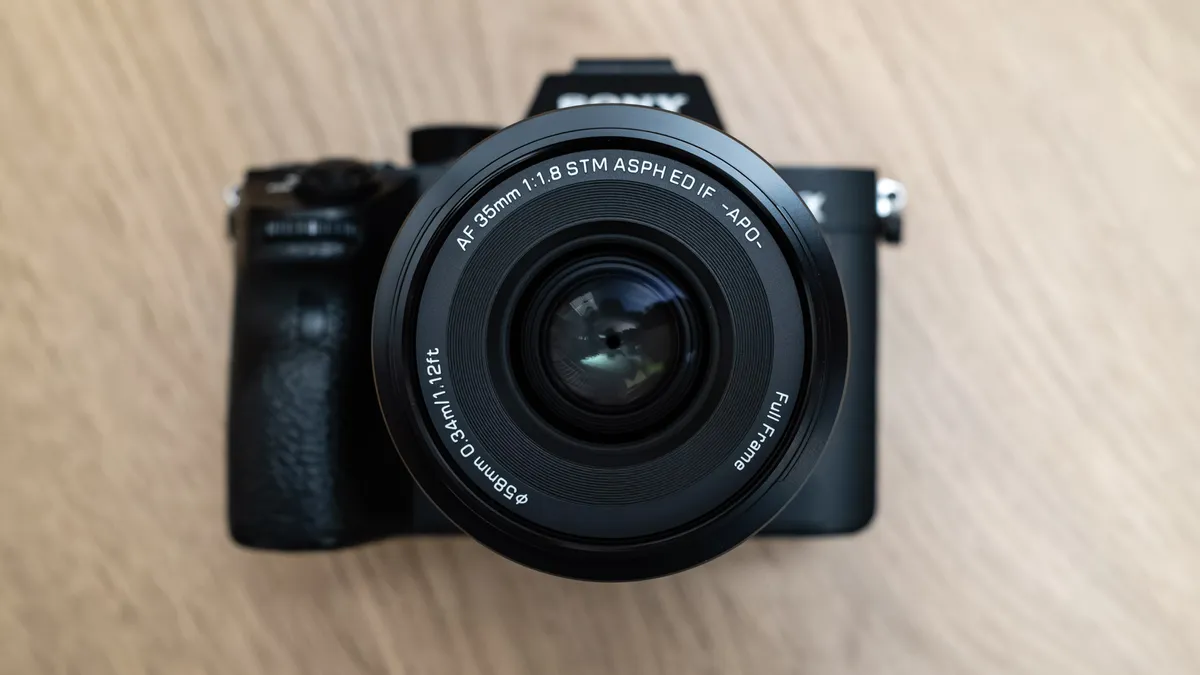
For some photographers, the slight speed reduction of f/1.8 is a worthy compromise, and at 3.33 x 4.37 in / 69 x 76 mm with a weight of 12.52 oz / 355 g, the 35mm f/1.8 is beautifully compact and balances well with camera bodies.
Build quality is excellent, and it’s fair to say the lens belies its budget price tag. The metal build alongside the manual aperture ring gives the 35mm f/1.8 a much more premium look and feel.
The aperture ring can also be set to A for in-body aperture adjustments, as well as offering the ability to switch the aperture click on and off. The latter is most popular with videographers. There’s also a customizable Fn button on the side.
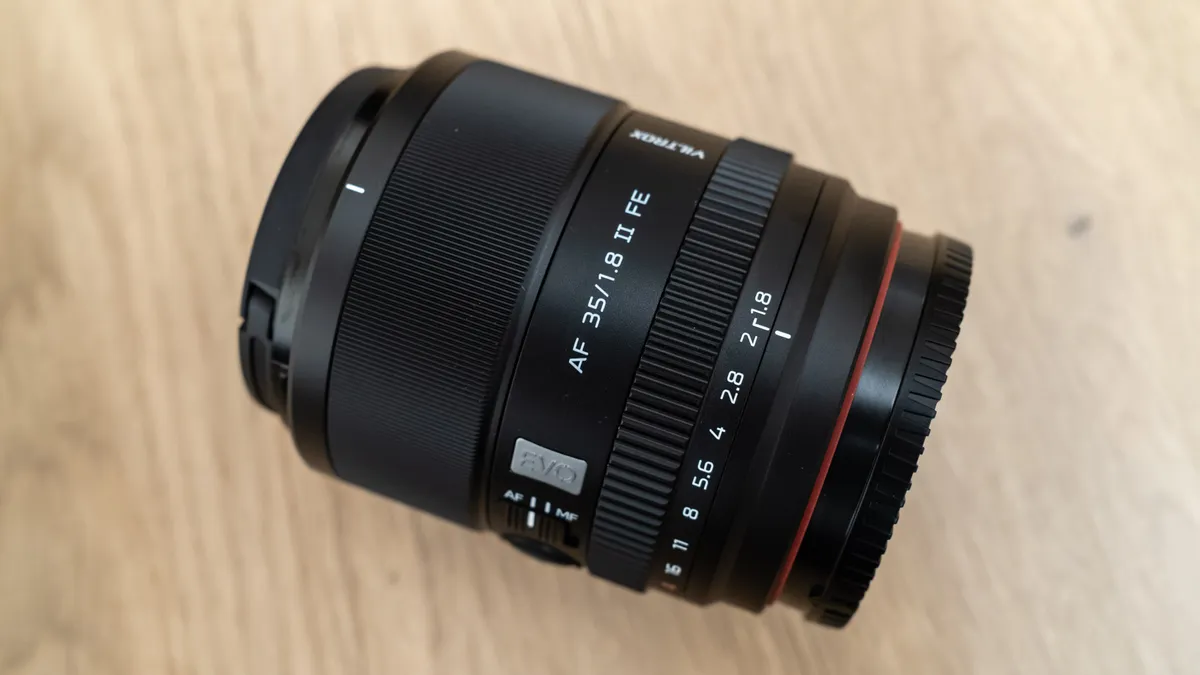


The lens is weather-sealed against light rain and dust, with a rubber gasket on the lens mount. The front element also features a water and smudge-resistant coating, which is certainly useful for outdoor photography. Plus, there’s a minimum focusing distance of just 13.4 in / 34 cm, which is useful for daylight photography but of no consequence for astrophotography.
The 35mm f/1.8 is made up of 13 elements in 10 groups, and as previously mentioned, features an APO design, which is intended to eliminate chromatic aberration in high-contrast scenes.
The elements include two extra-low dispersion (ED), three high refractive index (HR) and one ultra aspherical (UA). The UA lens is claimed to be Viltrox’s LAB Series quality, which matches the Viltrox flagship line-up.
Viltrox AF 35mm f/1.8 II EVO FE (APO): Functionality
- Smooth manual focus
- Internal focusing
- Stepping motor-powered AF
When it comes to features, prime lenses are always pretty basic, with few features to shout about. The 35mm f/1.8 is certainly no exception, but its build quality and overall design hold up alongside its image quality and reasonably fast maximum aperture. It does, however, have a few points worth mentioning.
One feature that many Viltrox lenses have, including the 35mm f/1.8, is a USB-C Port on the lens mount. This allows you to use a smartphone app or a desktop app to quickly and easily update firmware. This is so much easier than having to download a file to your memory card and installing lens updates via the camera, which is how most native lenses have to be updated.
The manual aperture ring features click and clickless operation via a switch on the side, so you can easily see what aperture you’re using at a glance. The focusing ring is smooth and offers comfortable resistance, making manual focus a breeze. It’s also wide enough to rotate using gloves, although, being a compact lens, it’s narrower than what you’d expect on a larger and faster prime lens.
Autofocus (AF) is reasonably fast and silent, being powered by an stepping motor (STM). The AF performance seemed to improve after the firmware update that was installed via the desktop app before testing fully commenced.
This functionality isn’t, of course, relevant to astrophotography, but it’s still a useful point to mention in case you intend to use the lens with autofocus in the day. Focusing is also internal, so the front element doesn’t rotate during focusing like cheap and cheerful kit lenses.
How we tested the Viltrox AF 35mm f/1.8 II EVO FE (APO)
The Viltrox AF 35mm f/1.8 FE (APO) was tested with the Sony A7R V, which offers an unforgivingly high resolution. The lens was tested at night with a focus on astrophotography, and in daylight to assess sharpness, distortion and general functionality for an all-round approach to testing.
Viltrox AF 35mm f/1.8 II EVO FE (APO): User reviews
Online reviews echo one another, praising the AF 35mm f/1.8 for its sharpness and cost. Users appreciate that while it’s certainly not in the league of Sony’s premium G Master lenses, it represents great value for money. Some reviewers mention great build quality and looking good when paired with their Sony camera.
Should you buy the Viltrox AF 35mm f/1.8 FE (APO)?
✅ You’re on a tight budget: The price of this lens is extremely attractive given the specs and performance.
✅ You want portability: This is a compact and lightweight lens that's much less bulky than faster primes.
❌ You want the best: This is a great little lens in many ways, but its image quality isn't the best that money can buy.
❌ You shoot APS-C: Unless this is what you want, the equivalent focal length on a crop sensor is 52.5mm
Prime lenses can be expensive, especially if you’re looking at those with an f/1.4 or f/1.2 maximum aperture. The Viltrox AF 35mm f/1.8 FE (APO) is a budget option in the Viltrox line-up, but with decent overall performance alongside impressive image quality for the price, this is a great 35mm lens for those on a budget. It’s also compact and lightweight, which could be useful if you often head out shooting with several lenses in your kit bag.
Just going back to image quality, images are sharp, but when shooting astrophotography at f/1.8, there was some astigmatism at the left edges of the frame. This is where stars appear as crosses. You can only really see this when you zoom in to 100%, but it’s worth bearing in mind if you’re looking for the closest to optical perfection you can find.
When a weather-sealed prime lens with a manual aperture ring costs just $399 / £385, you can’t help but take notice. Build quality is excellent and the lens undoubtedly looks and feels like it would be more expensive than it is.
Considering all of this and the image quality, the lens is fairly priced and is still at the release price, so it could become more affordable in the future. Just like other Viltrox lenses, in the box you get the lens, a lens hood, front and rear lens caps and a soft lens case.
If this lens isn't for you
The Viltrox AF 35mm f/1.2 LAB FE is part of Viltrox’s flagship lens series and offers a much faster maximum aperture, as the name suggests. It’s also more expensive, larger and heavier.
If you’d like a wider lens, the Sony FE 20mm f/1.8 G is a fantastic option offering exceptional image quality alongside a compact build and light weight. A potential must-have for Sony users.
If you’d like to go wider still, the Sigma 14mm f/1.4 DG DN Art is an absolute beast of a lens, offering an ultra-wide light-gathering field of view alongside a fast f/1.4 maximum aperture.