Aurora chasers, this is one to watch.
The sun unleashed a powerful M1.4-class solar flare early this morning (Oct. 6), and it appears to have launched a coronal mass ejection (CME) — a huge cloud of magnetized plasma — into space.
Early observations have certainly caught the aurora-chasing community's attention.
The flare erupted from sunspot region AR4549, which is currently sitting close to the center of the Earth-facing side of the sun. Early imagery shows widespread coronal dimming around the eruption site, a telltale sign that material has been expelled from the solar atmosphere. Given AR4549's location, that's a promising sign that the CME could be heading our way.
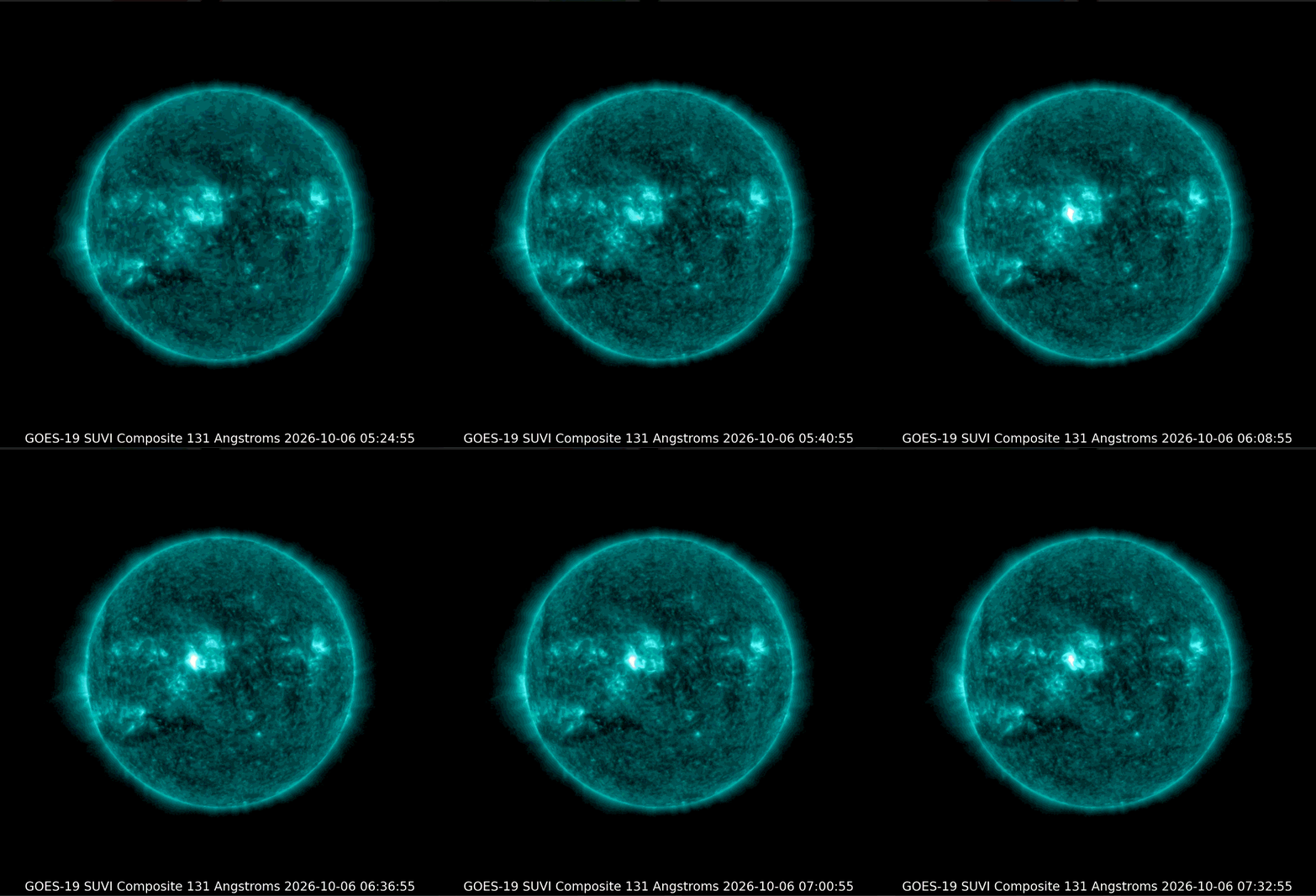
But it's still early days.
"As these images I am posting here are literally the latest views of this eruption, it is still too early to say how much of the CME has escaped the solar atmosphere and how much it is directed at Earth," space physicist and aurora photographer Vincent Ledvina wrote on X shortly after the eruption.
An M1.4 flare and likely Earth-directed CME have occurred moments ago, originating from the vicinity of AR 4549. This is a relatively new active region with a lot of instability and life, and we may see more CMEs and flares our way in the near future. https://t.co/Q5ftGYHRh5October 6, 2026
"The initial look is promising, but we need more data to have any sort of confidence," Ledvina added.
Space weather forecasters are busy analyzing coronagraph observations and models to determine the CME's trajectory, speed, and possible arrival time at Earth. That's when we'll have a much better idea of what this eruption could mean for the northern lights.
If a substantial part of the CME is Earth-directed, it could trigger a geomagnetic storm and send auroras into lower latitudes than usual. Just how impressive the display could be will also depend heavily on the magnetic orientation of the CME when it reaches Earth.
What we know so far
This is a developing story, and we'll be updating it as the latest CME modelling and official space weather forecasts come in.
Right now, early observations suggest the Oct. 6 eruption produced a CME with a possible Earth-directed component, but we're still waiting for detailed modelling to determine its speed, trajectory and likely arrival time.
The early signs are promising for aurora chasers but we don't know how strong any resulting geomagnetic storm could be, or how far south the northern lights will reach.
More solar activity could be on the way
And this might not be all the sun has in store for us.
At the time of writing AR4549 produced another M-class solar flare, an M1.9, just hours after the eruption we're currently keeping a close eye on.
Two prominent sunspot regions, AR4549 and AR4545, are currently facing Earth and have shown increasing flare activity. Any additional eruptions from these regions over the next few days could affect Earth. Meanwhile, coronal holes rotating across the Earth-facing side of the sun are expected to send further streams of fast solar wind our way, with another enhanced period of geomagnetic activity predicted around Oct. 11.
In other words, make sure those camera batteries are charged, your aurora alerts switched on and the coffee pot is full!