Astronomers have discovered the most distant Fast Radio Burst (FRB) ever detected. Not only could this help untangle the mystery of what causes these powerful but brief explosions of radio waves, but because FRBs are incredible celestial messengers, it could also reveal details of 11 billion years of cosmic evolution.
This FRB, designated FRB 20240304B, was first observed by astronomers using the MeerKAT radio telescope in South Africa. Then, using the James Webb Space Telescope (JWST), astronomers tracked it back to its home galaxy, located around 11 billion light-years away. This revealed that FRB 20240304B has been travelling to Earth since the universe was just 3 billion years old or so.
That doesn't just make this FRB 20240304B the most distant and earliest FRB ever detected; it more than doubles the distance of the previous record holder!
"This is an extraordinary glimpse into the distant universe," team co-leader Manisha Caleb from the Sydney Institute for Astronomy said in a statement sent to Space.com. "We have caught a fast radio burst from a time when the universe was only about three billion years old, and we have used that brief flash of radio light to learn about the matter it has travelled through over billions of years."
The team's research was published on Thursday (Oct. 8) in the journal Science.
A record breaking cosmic messenger
Fast Radio Bursts are mysterious blasts of radio waves that usually flare just once, and in the mere milliseconds they last, emit many times more energy than the sun can radiate in a year.
As these powerful millisecond-long blasts of radio waves travel billions of light-years to reach Earth, they pass through gas and dust in galaxies and through the "cosmic fog" lying between these galaxies, the so-called intergalactic medium. By measuring how much the signal slows down, scientists can effectively weigh this fog of gas to map the distribution of matter in galaxies.
That makes them crucial tools for understanding how galaxies use gas and dust to form stars and grow. Thus, FRBs are a metaphorical cosmic 'fossil record' blasting through space at light speed with the energy of a multitude of stars.
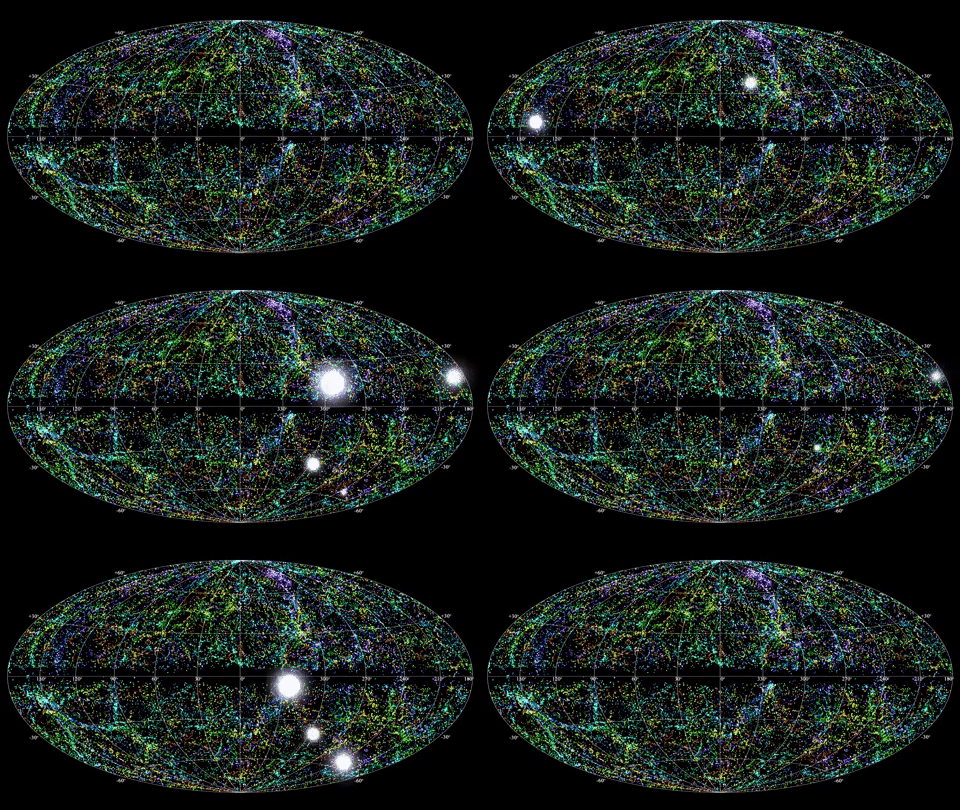
With that in mind, it is little wonder that as a record-breaking example of a fast radio burst, FRB 20240304B has already shocked astronomers. It did this by delivering a surprise about its home galaxy.
"The galaxy hosting this burst is surprisingly small, metal-poor and undergoing a very active episode of star formation," team member Laura Driessen, of the University of Sydney, said. "That gives us an important clue about the environments in which FRBs are born and shows that these brief radio flashes can tell us not only about the distant universe, but also about how galaxies and their stellar populations evolve."
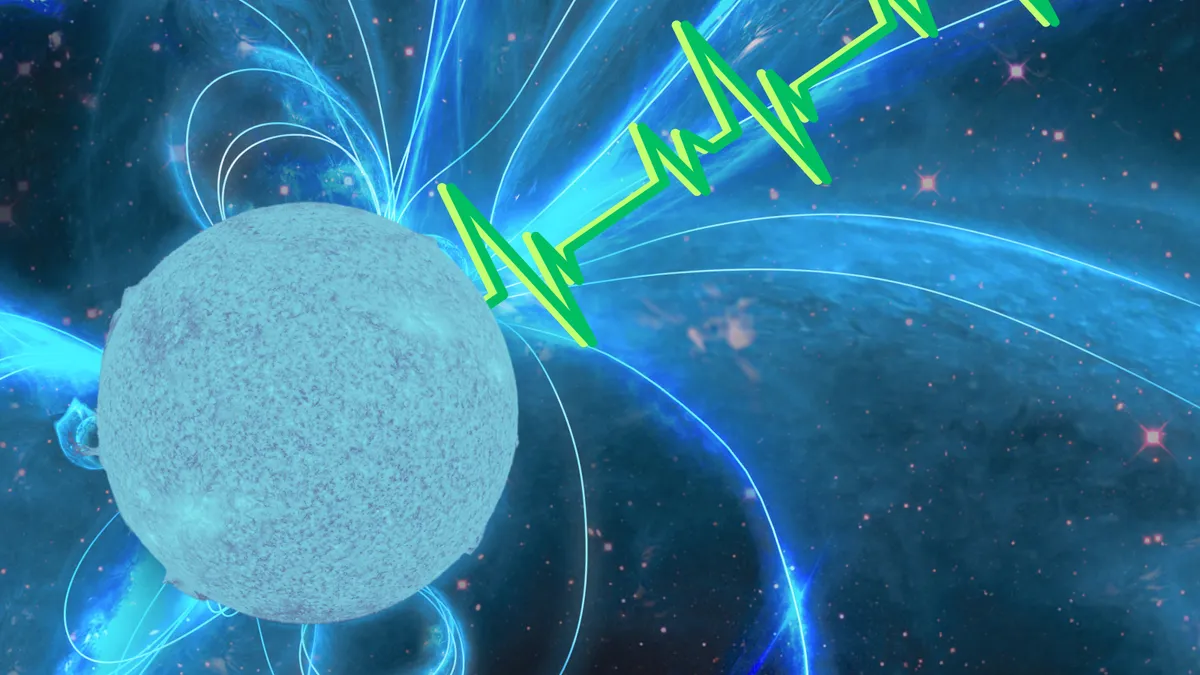
One of the leading suspects in the creation of FRBs are magnetars, a type of neutron star created when a massive star collapses and dies in a supernova explosion. Unlike "standard" neutron stars, magnetars have fearsomely strong magnetic fields — the strongest magnetic fields in the known universe, in fact.
There are different theories about how magnetars are born: one involving existing older neutron stars colliding and merging, the other involving environments with burgeoning star formation.
The galaxy from which FRB 20240304B originates seems to support that latter formation route, as it is young in the midst of "starburst," a period of extreme star formation.

Scientists will work on the mystery of the FRB/magnetar connection. In the meantime, this newly detected and tracked blast of radio waves definitely has expanded the boundaries of the cosmos that can be probed with FRBs.
"In principle, sufficiently powerful bursts could be detectable from the very early universe," team member Kavya Shaji said.
That means that FRBs are emerging as a promising way to study the first stars and galaxies in the universe. This is even more exciting considering that this research validates teaming the JWST with radio telescopes to detect and track FRBs back to their points of origin.
"Our results further show the amazing capability of the JWST, where we can push boundaries beyond what was previously possible," team member Themiya Nanayakkara of the University of Sydney said.