New research suggests that mysterious Little Red Dots discovered in the early universe may actually be overfeeding supermassive black holes, killing two metaphorical birds with one stone.
While the James Webb Space Telescope (JWST) has undoubtedly improved our understanding of the cosmos immensely in its four years of operation, the $10 billion NASA instrument has also delivered some problems with our understanding of the universe.
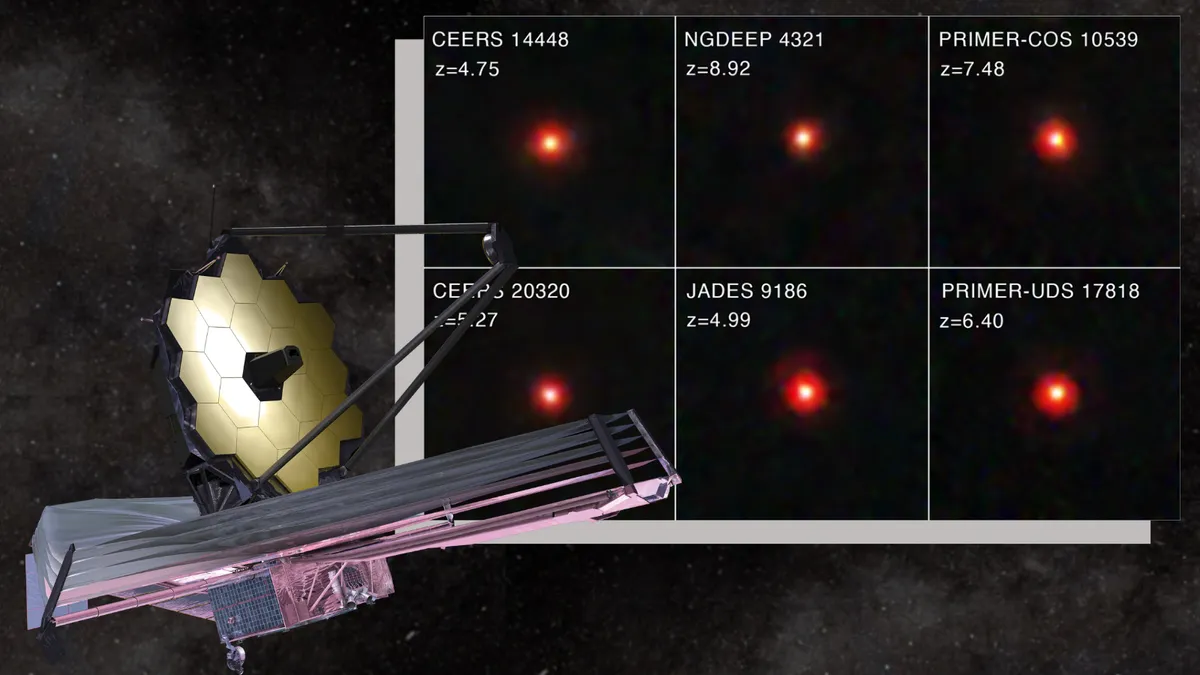
Primary among these quirks in our understanding of the cosmos is the discovery of supermassive black holes with masses billions of times that of the sun that exist in the universe before it was 1 billion years old. That is before any black hole should have had a chance to grow to such monstrous masses via mergers or ordinary feeding. Arguably even more perplexing is the observation of so-called "Little Red Dots", objects that are found 600 million to 1 billion years after the Big Bang but disappear before the universe is 1.5 billion years old.
Among the scientists tackling the nature of so-called Little Red Dots and the presence of supermassive black holes in the early universe is a team that has found both objects emerge naturally from simulations of the conditions found in the early universe. The team also found a connection between these two mysteries.
"The most exciting result is that objects resembling Little Red Dots emerge naturally in our cosmological simulations," team leader Sunmyon Chon of the Max Planck Institute for Astrophysics, Germany, told Space.com. "Massive black holes form and grow extremely rapidly, and during this growth they become surrounded by a very dense and optically thick gas envelope. This naturally produces several of the characteristic properties of observed Little Red Dots."
The team's research was published on Sept. 16 in the journal Nature.
How do overfeeding black holes connect to Little Red Dots
Running their cosmological simulation, Chon and colleagues uncovered a connection between Little Red Dots and massive black holes that relates to how the latter feed on matter.
"When a black hole is supplied with gas at an extremely high rate, the gas cannot simply disappear into the black hole immediately. A large amount accumulates around it and forms a dense, optically thick structure due to the angular momentum," Chon explained. "In a sense, we are seeing an extremely overfed black hole wrapped in its own fuel."
The researcher added that the glow of Little Red Dots comes from the fact that electromagnetic radiation produced near the black hole has to pass through this envelope of black hole fuel. This leads to the wavelengths of that radiation being changed, with the result being a compact object with a very red spectrum and broad hydrogen emission lines — key characteristics of Little Red Dots.

This overfeeding could explain how black holes reached such huge masses before ordinary feeding and merger processes should have allowed such growth. As for why this could happen in the early universe but doesn't happen today, the team also has a solution.
"The early universe provided an extraordinary supply of gas. Galaxies were growing very rapidly, and large amounts of dense gas were continuously flowing into their centers," Chon said. "In our simulations, strong radiation from nearby star-forming galaxies also plays an important role. It suppresses star formation in neighboring clouds, allowing a large amount of gas to accumulate before it finally collapses. This first creates supermassive stars, which then collapse into massive black-hole seeds.
"These black holes are therefore born in environments with an enormous reservoir of dense gas already available to feed them."
Answering the question of how supermassive black holes grew so big so fast is satisfying for the team. After all, it was the primary reason for the simulation being created.
"In our simulation, the process begins with supermassive stars reaching several hundred thousand solar masses. They collapse after roughly two million years and leave behind massive black-hole seeds. Because these seeds are already very massive and are born in gas-rich environments, they can then grow extremely rapidly," Chon said. "So Little Red Dots may actually be showing us some of the missing stages in the formation of the first supermassive black holes."
As satisfying as this is, the team's research doesn't answer every puzzle surrounding the JWST's observations of the early universe or Little Red Dots.
Why did these cosmic dinosars go extinct?
As mentioned above, one of the biggest puzzles surrounding Little Red Dots is the question of why they are absent in the last 11 billion or so years of cosmic history. And that remains an open question.
"Our simulations do not yet explain why Little Red Dots seem to disappear at later cosmic times. This is still a big mystery," Chon said. "I think understanding this cosmic evolution will be an important next step for both simulations and observations."
The fact that the simulation didn't answer all questions about Little Red Dots isn't too surprising to the team. In fact, they weren't expecting these curious objects to emerge in simulations at all.
"We originally designed these simulations to investigate the formation of massive black-hole seeds in the early universe," Chon explained. "We did not design them to produce Little Red Dots. But once the black holes formed and began growing, we found that they naturally became surrounded by dense gas and developed properties remarkably similar to Little Red Dots."
That wasn't the only surprise the simulation delivered. The team found that something that had previously been considered a rather exotic theoretical possibility emerged naturally from the evolution of the simulated universe.
"Another surprising result was that what forms around these rapidly growing black holes can be regarded as a type of quasi-star — a black hole embedded in a massive, optically thick gaseous envelope," Chon continued. "Our simulations showed for the first time that such a quasi-star-like system can form naturally in a cosmological simulation."
The next step for the team is to determine if the formation of overmassive black holes and Little Red Dots occurs in the simulation when environmental conditions of the early universe are varied. The researchers also intend to make more detailed predictions that can be compared to observations made by the JWST.
"Observations of Little Red Dots are progressing extremely quickly," Chon concluded. "As theorists, our challenge now is to make predictions at the same pace so that we can use these new observations to determine what these remarkable objects really are."