Most people never forget their first home, carrying their memories with them as they travel. New research suggests that this adage may be true for wandering black holes too. That's because it seems that rogue black holes that break away from their cosmic homes may carry with them the histories of the galaxies they may eventually escape.
These rogue black holes can be displaced when their home galaxies collide and merge. This begins journeys of billions of years that carry these black holes far from the point at which they formed. This process can be even more pronounced in smaller galaxies in which the gravitational influence is weaker, and the black holes are less likely to be strongly bound to the galactic center.
Scientists have known that the activity of supermassive black holes at the heart of galaxies strongly influences the evolution of their host galaxies, but these findings indicate that though rogue black holes may be less influential, they may be important witnesses to the processes that shape galaxies.
"Our results show that considering wandering black holes, in addition to centered black holes, is essential for understanding the origins and dynamics of massive black holes and the histories of their host galaxies," team leader Emma Jane Weller of Yale University said in a statement.
Evidence of 'heavy seeds' in the early universe
There is currently some debate regarding how black holes first started growing in the infant cosmos. Some scientists suggest that the first massive stars died and collapsed to create smaller black holes or "light seeds." Others theorize that black hole growth gets a head start when dense patches in vast clouds of gas and dust directly collapse to create much more massive black holes, or so-called "heavy seeds."
If wandering black holes carry with them a record of their birth, then they could help settle the light seed vs. heavy seed debate.
"What is exciting about our findings is that black holes seem to remember more than the circumstances of their birth," team member Priyamvada Natarajan of Yale said. "Their present-day locations carry the imprint of everything that has happened to their host galaxies. By separating black holes at galactic centers from those that are wandering, we can begin to disentangle these two histories."
To do this, the team turned to a cosmological simulation called ASTRID, which is capable of tracing roughly 13.5 billion years of cosmic history, modeling the interplay between dark matter scaffolding, gas dynamics, and star formation right back to just 300 million years after the Big Bang.
Using ASTRID, the team modelled galaxies with masses between 10 million and 1 billion times that of the sun tracking their evolution over around 12.6 billion years. ASTRID has a strength that was important to this particular investigation. It doesn't pin black holes down to the heart of their galaxies; instead, it allows them the leeway to roam.
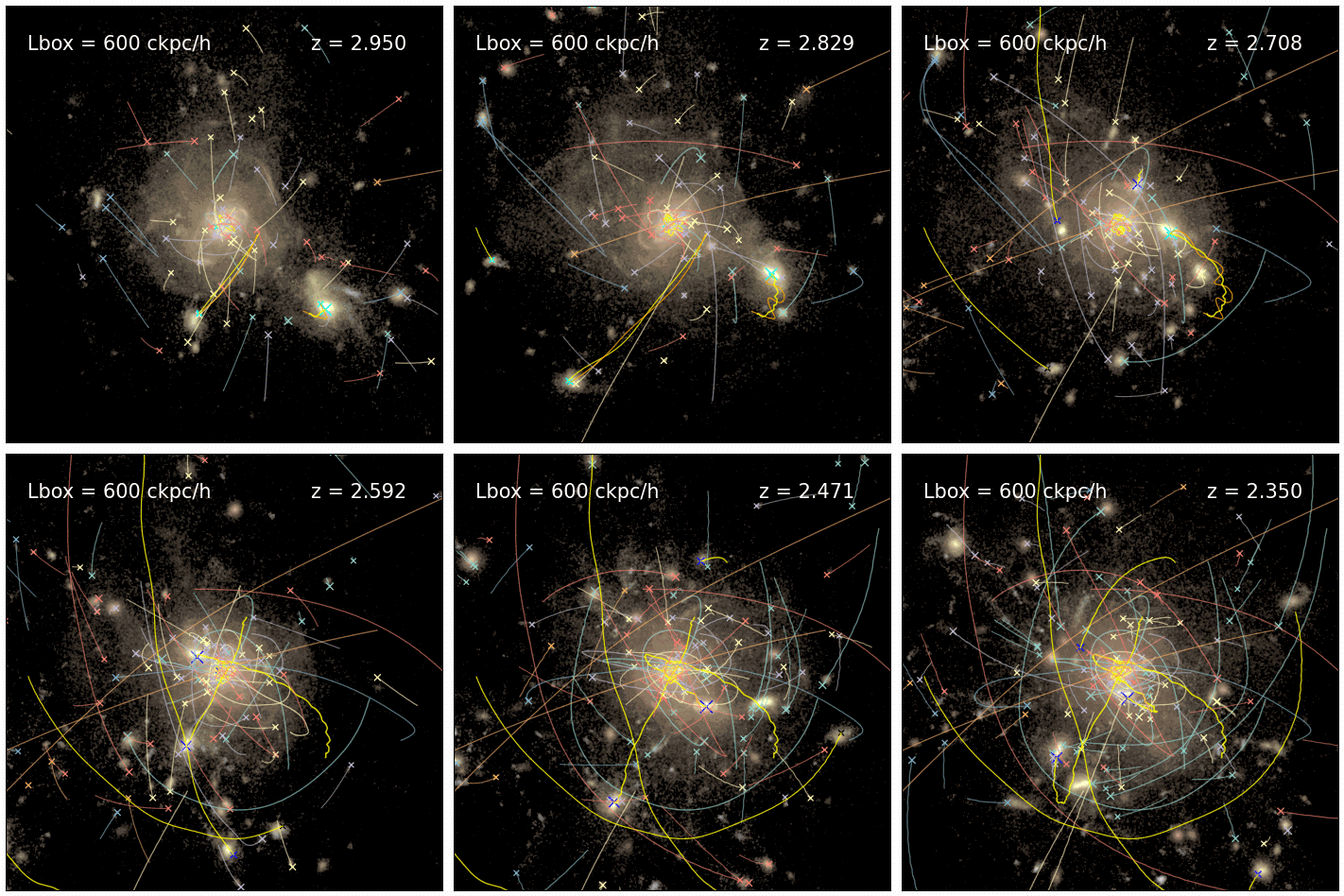
The team confirmed that black holes were more likely to wander in low-mass galaxies, also finding that such galaxies seem to retain information about their initial seed population even after billions of years of growth and collisions and mergers with other galaxies. They also found that low-mass galaxies with a central black hole stopped forming stars before those with wandering black holes.
"Some of the universe's most revealing black holes may be the ones that have wandered away. Black holes are remarkable cosmic archivists," Natarajan said. "Their abundance tells us something about how they were born, while their locations preserve a record of how their galaxies were assembled."
By teaming this approach with X-ray, radio, optical, and infrared astronomical observations, scientists could get closer than ever before to understanding the origins of black holes.
"Each of these methods can probe different parts of the population," Weller concluded. "By combining observations with the results from simulations, we may be able to identify the imprints of black hole formation and galaxy evolution."
The team's research was published on Sept. 7 in The Astrophysical Journal Letters.