Astronomers have studied nine local galaxies to discover how shock waves from the galaxies' central supermassive black holes sculpt star formation.
The team of researchers studied galaxies with active galactic nuclei (AGNs) at their hearts. These are bright and turbulent regions powered by central engine supermassive black holes with masses of millions or even billions of times that of the sun that are feeding on copious amounts of gas and dust. As energy flows out of these regions and strikes surrounding gas clouds, called the interstellar medium, it generates powerful and fast-moving "shocks."
These shocks are also known as "AGN feedback," and they pump vast amounts of energy into their surroundings, shunting around gas and dust that is the raw material for star formation. While this feedback has often been attributed with ending star formation in galaxies, scientists have long suspected that this process can also drive star formation and therefore the growth and evolution of galaxies. This new research maps out how that happens.
"We're seeing that black holes are not just consuming material at the centers of galaxies, but they're actively reshaping their surroundings," team member Lisa Kewley of the Center for Astrophysics | Harvard & Smithsonian said in a statement. "This work helps us understand a complex feedback cycle that plays an important role in galaxy evolution."
Supermassive black holes as stellar sculptors
All large galaxies are thought to have supermassive black holes residing at their cores. But not all of these black holes are active. For instance, Sagittarius A* (Sgr A*), at the heart of the Milky Way, is relatively dormant. Its feeding habits are the equivalent of a human being eating one grain of rice every million years.
Other supermassive black holes are surrounded by large amounts of gas and dust and swirling flattened clouds called "accretion disks" that feed them. The immense gravitational influence of these black holes generates incredible amounts of friction in the accretion disk, causing the objects to glow brightly as AGNs.
These AGN emissions are bolstered by the fact that supermassive black holes are notoriously messy eaters, channeling matter they don't eat toward their poles. From there, this matter is blasted out as powerful "burps" consisting of twin jets of plasma that can stretch out for thousands of light-years. This means supermassive black holes and AGNs have a considerable influence on their surroundings.
The team used the Very Large Telescope (VLT) and its Multi Unit Spectroscopic Explorer (MUSE) to study AGNs in which supermassive black holes are actively accreting matter.
"Once we resolved them, we could see that they not only accrete things, but they also eject things," Peixin Zhu of the Center for Astrophysics said in the statement. "The injection and accretion are linked with each other."
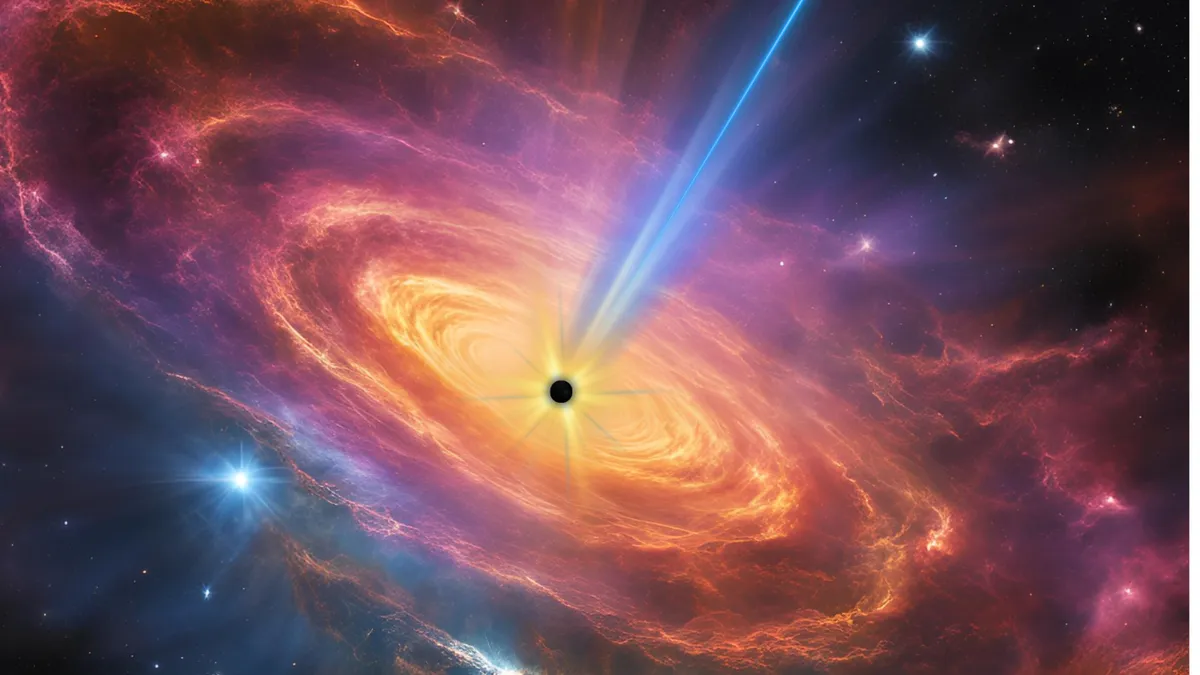
The team performed a 3-dimensional analysis to identify three different aspects of AGNs and their surroundings: the radiation flowing from the AGN, the excitation of the surrounding interstellar medium by shocks, and star formation.
They found that arcs and rings of star formation tended to appear at distances between 2,600 and 20,000 light-years from the centers of galaxies. The researchers also observed cones of radiation extending out from the accretion disks of AGNs, where fast shocks both rippled through central regions and traveled perpendicular to the radiation cones.
This shock behavior is consistent with models of interactions between AGN jets and the interstellar medium. The team thinks that in galaxies with less powerful jets, black hole winds also contribute to shock generation.
"The most interesting phenomenon about shocks is that they always go perpendicular to where the black hole's injected outflows go," Peixin said. "It is very common, and we see it consistently appearing across the whole nine galaxies."

The research demonstrates that actively feeding black holes are engaged in a complex cycle of accretion and outflow that drives their interaction with their host galaxies.
By separating the different aspects of this process, the scientists behind these findings have provided a clearer picture than ever before of this cycle and how it influences star formation.
The team's research was published on Monday (Sept. 14) in The Astrophysical Journal.