Scientists have created a 27-year-long video reconstruction of the high-energy jets of a blazar, which is a supermassive black hole blasting plasma straight at Earth. The findings delivered some surprises.
The team primarily used data collected via a radio imaging technique called very long baseline interferometry (VLBI). It's the same technique the Event Horizon Telescope (EHT) used to obtain humanity's first image of a black hole. Scientists have long been using VLBI to study jets erupting from the central regions of galaxies called active galactic nuclei (AGN), which are dominated by an engine consisting of a supermassive black hole that is greedily feasting on surrounding gas and dust. When AGNs are viewed from a distance, they are referred to as quasars; when the jets they blast are directed straight down our line of sight, they are called blazars.
Thus far, observations of blazars using VLBI have been limited because they have consisted of separate "snapshots" in time. That limits scientists' understanding of how the plasma in these jets flows.
"Blazar jets travel at nearly the speed of light, far beyond the galaxy from which they come. They are accelerated by the strong magnetic fields surrounding the black hole and its accretion disk, but the exact mechanism that produces them is still unclear," team member and research lead author Marianna Foschi of the California Institute of Technology (Caltech) told Space.com. "In general, I'm interested in black holes and the processes that surround them, such as jets, because that is the most extreme regime in which we can test general relativity, the best and most elegant theory we have so far to describe gravity and spacetime."
Reconstructing a blazar jet delievers a shock
This new "video" of blazar 3C 345, located around 5.5 billion light-years away, was created using a sophisticated video reconstruction algorithm called Kine, which employs a deep learning model to map the brightness distribution of the blazar in space and time.
"This model consists of a simple neural network which learns and enforces spatial and temporal correlations in the video, finding the right amount of 'smoothness' of the figure," Foschi said. "Using Kine and recovering a full video instead of individual frames, we were able to achieve two orders of magnitude better dynamic range and four times better resolution compared to previous images."
In addition to having better image quality, Foschi explained that the team's video reconstruction is also continuous in time, allowing for the use of standard video processing tools to track the motion of every point in the jet.
"This is a significant step forward compared to any previous analysis of jet dynamics because past methods could only approximate the jet to a collection of large discrete features and then track the position of such features," Foschi said.
As you might imagine for such a significant step forward in the study of blazars, this video reconstruction delivered some significant surprises for the researchers.
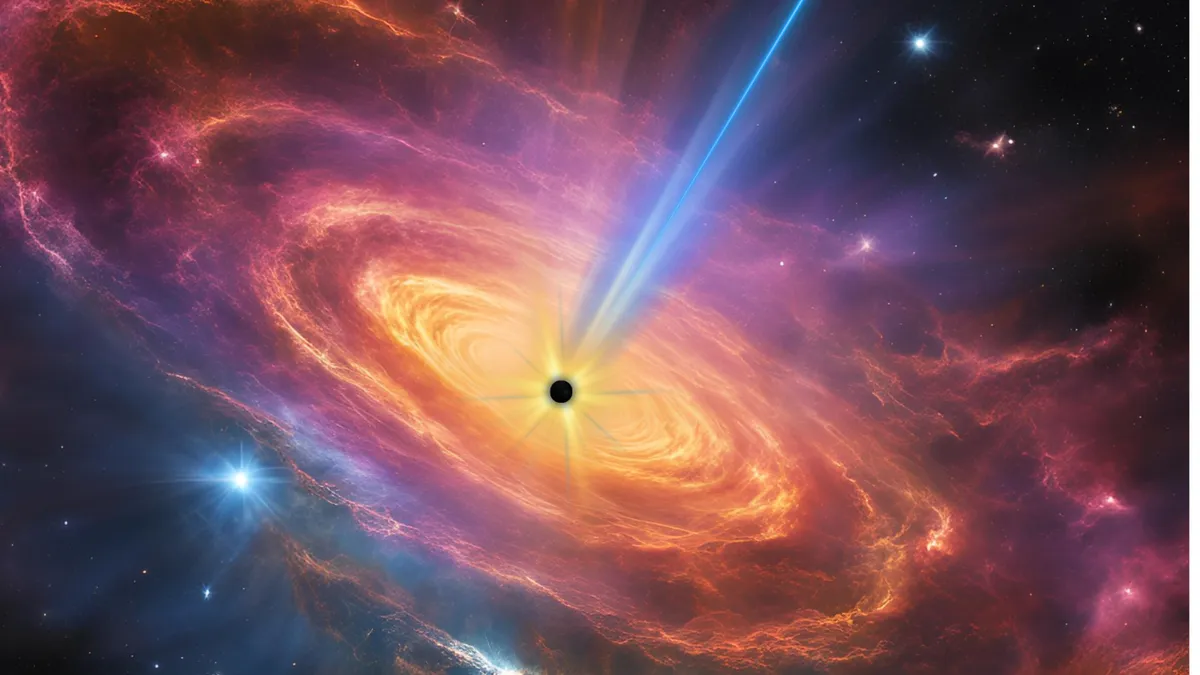
Thus far, the general consensus about jets flowing from supermassive black holes is that the bright regions are caused by a traveling shock front and that the speed of the shock front would be noticeably greater than the speed of the rest of the jet's plasma. However, this doesn't seem to be the case with the jets erupting from blazar 3C 345.
"It was surprising for us to find that the speed at which the bright compact components travel along the jet is almost the same as the speed of the bulk flow of the rest of the plasma in the jet," Foschi said. "We analyzed only one blazar, though, so our results don't put into question the shock interpretation in general but only in the specific case of 3C 345."
The team now intends to apply Kine to observations of other blazars, hoping that this may shed light on the shock model and on how plasma moves through the jet, and what mechanisms are causing that motion.
"It is the first and only imaging method that can produce reliable and high-quality videos from such a high number of observations in a short time," Foschi said, "so it can be applied systematically to many sources for which we have decades of observations."
The team's research was published in August in the journal Nature.