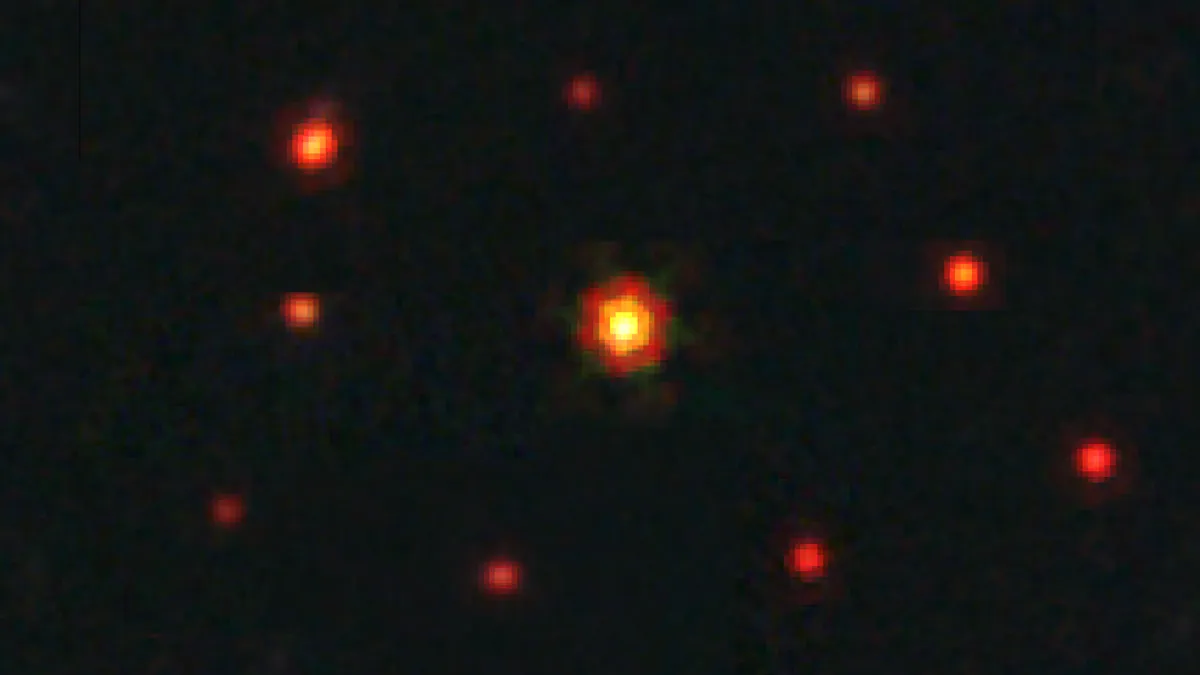
Since it began sending observations back to Earth in summer 2022, the James Webb Space Telescope (JWST) has helped scientists create a much clearer picture of the universe, but it has also delivered some frustrating mysteries. Among these is the puzzle of the "Little Red Dots (LRDs)," strange compact cosmic objects that appear in the early universe but disappear before the cosmos is around 2 billion years old.
To solve the mystery of the LRDs, a team of astronomers has looked at the bigger picture, not focusing on the objects themselves, but instead investigating the nature of the galaxies that surround them.
"We hadn't seen anything like LRDs in the local universe," team member Jorge Zavala of the University of Massachusetts Amherst told Space.com. "This is a phase that we missed before. The question is: Is this an evolutionary phase related to the growth of galaxies and star formation activity or black hole growth? Do all galaxies [or] black holes go through this phase? We are not sure yet."
The team set about answering these questions by studying JWST images of 217 LRDs. They found faint light surrounding the objects and theorized that these emissions represent dense, star-forming galaxies.
"Most of the previous studies, and most of our current knowledge about LRDs, focus on the 'central engine' or the central, compact component that dominates the total energy output and total luminosity," Zavala said. "This is because the nature of this central engine is still unknown, so it is natural to focus on this; and because it dominates most of the light we see, which means that studying the hosts is actually very difficult."
However, Zavala argues that this may have been an oversight in our approach to LRDs. A wider approach may be key to answering questions like: Is this phenomenon unique to galaxies with some specific physical properties? Is the LRD phenomenon triggered by their host galaxy properties, or maybe by unique dark matter properties? What do LRDs evolve into? Do LRDs live in some specific galaxy environment, be it dense or overdense?
"Answering those questions will also be crucial to fully understand the nature of these objects," Zavala said.
Home galaxies of LRDs are strange in their own right
The team found what it believes to be the stellar light of LRD host galaxies. With this information, they estimated the typical size and stellar mass range of the galaxies.
They found that at around 1,400 light-years wide, these galaxies are around 2.5 times as compact as similar star-forming galaxies found at similar distances during the same early period of the universe. They also possess a comparatively lower ratio of what astronomers call "metals," elements heavier than hydrogen and helium.
"The host galaxies seem to be relatively low-stellar-mass galaxies with more compact sizes than are typically found in galaxies of similar masses, actively forming stars, and low metallicity. This might point to enhanced densities that could trigger strong star-formation episodes," Zavala said. "If this is true, then it is possible that LRDs are connected, or even produced, by star formation activity. This is an important clue to understanding how these objects might form."

Though it goes beyond the scope of this current research, Zavala has some ideas about how the current findings connect to adjacent puzzles surrounding LRDs, too.
"This might point towards a connection between the LRD phenomenon and starburst episodes, maybe triggered by high gas density in these galaxies due to their compact sizes," the researcher said. "This, to me, motivates further studies on the potential relevance of super-massive stars in the LRD phenomenon, either as the central engine source or as progenitors of the black holes that could sit in the centers of these objects."
Zavala added that LRDs could be absent from the local universe, and thus the recent history of the cosmos, because finding these conditions in the local universe is harder. This is because most galaxies have already undergone several billion years of evolution, making their gas is more metal-rich. And these metals could affect the processes involved in producing LRDs.
As for what is next for this research, Zavala has a simple answer: "More observations!"
This could involve a greater effort to disentangle the light emission from the host galaxy and the central engine using a process called spectroscopy, the splitting of light into its different wavelengths, instead of photometry, which was used in this study and involves observations of visible light.
Because molecules absorb and emit light at characteristic wavelengths, spectroscopy could provide further information about the gas physical conditions found in LRD host galaxies.
"Another possibility is to search for local analogs in the nearby universe. Because of their closer distance, we can study in more detail some of their properties," Zavala concluded. "In order to do this, we need multi-wavelength information and to combine observations from different telescopes.
"This is also an exciting avenue to fully understand the nature of these objects."
The team's research was published at the end of August in the journal Nature Astronomy.