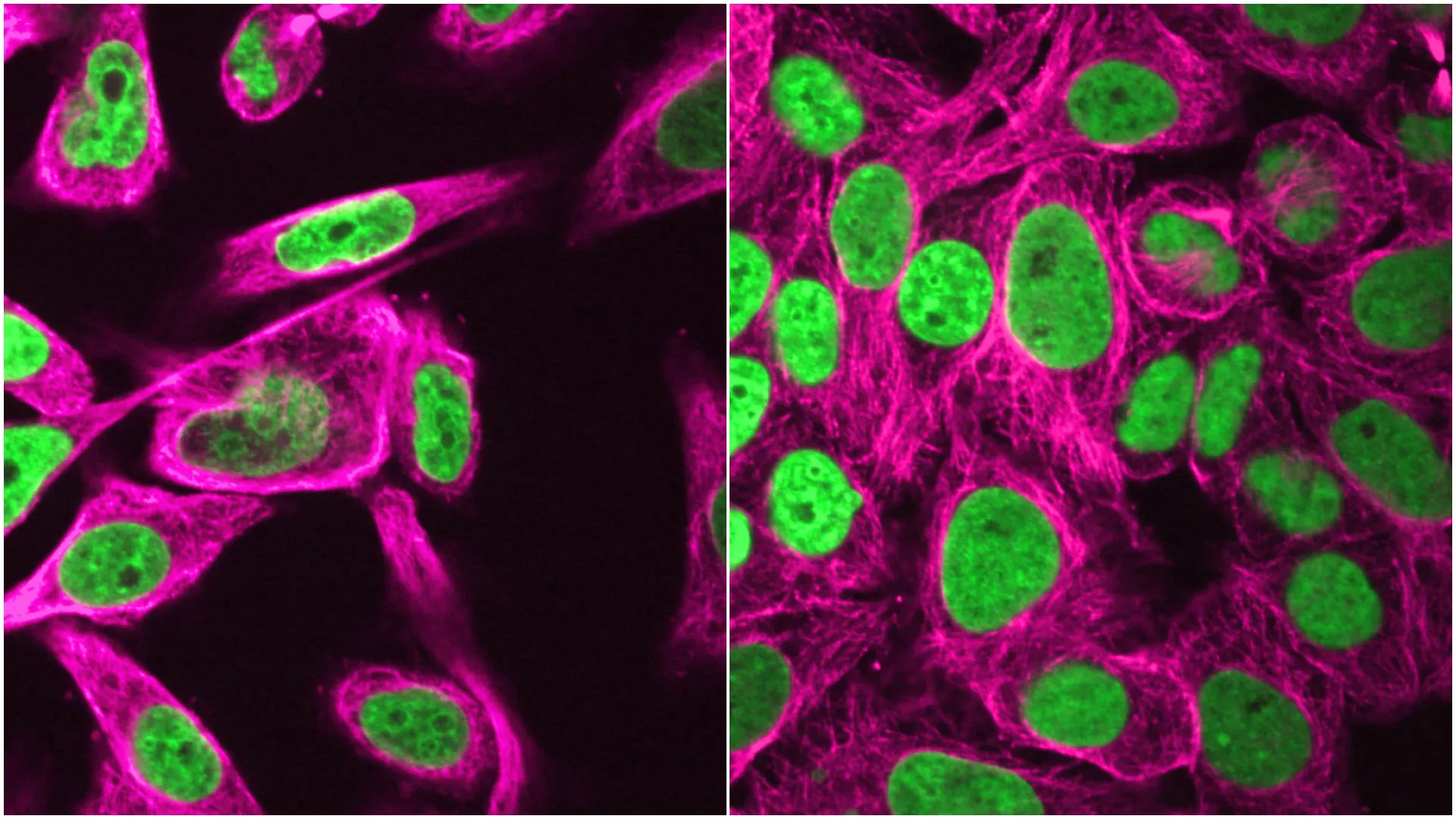
Scientists have taken a closer look at what happens to the human genome in simulated microgravity — and found that it is surprisingly resilient, at least over a single day.
In a new study, researchers at New York University built a custom random-positioning machine that continually changed the orientation of human cells relative to Earth's gravity. Crucially, the team developed algorithms that minimized the fluid currents normally generated inside rotating cell cultures, allowing it to distinguish the effects of simulated microgravity from those of mechanical flow.
After 24 hours, simulated microgravity had not disrupted genome organization or motion, nor produced detectable DNA damage. The nuclear envelope (the membrane that separates genetic material from the rest of a cell) also remained unchanged. But the nucleus increased in volume, and the nucleolus — a structure involved in producing ribosomes — became smoother. By comparison, strong fluid flows elongated the cells and caused DNA damage, a crucial control detail that explains why past experiments might have yielded misleading results.
The short exposure to simulated microgravity, however, cannot reveal what might happen during a months-long journey through deep space. "Such changes could occur during longer exposures and due to DNA damage occurring in space," study senior author Alexandra Zidovska, an associate professor of physics at NYU, said in a statement. Actual spaceflight also exposes cells to radiation and other conditions the experiment did not reproduce.
That said, this study is one step forward in this growing field of research. Scientists are beginning to treat gravity almost like a drug, varying its strength, duration, and frequency on the human body to learn what dose might keep astronauts healthy and whether the same stimulus could help rehabilitate patients on Earth.
NASA-funded "Gravity Dose" studies at Texas A&M University's new human centrifuge will examine responses to lunar and Martian gravity. European bed-rest studies called BRACE and BRAVE have paired centrifuge-generated gravity with exercise. And the GRACER1 clinical trial is investigating artificial gravity and exercise as rehabilitation for people with conditions including stroke and multiple sclerosis.
The NYU experiment does not establish a therapeutic gravity dose, but its technique could help researchers identify which cellular changes truly result from altered gravity — and potentially determine when the genome's short-term resilience begins to give way during long journeys away from Earth.
The study was published on Sept. 23 in the journal Science Advances.