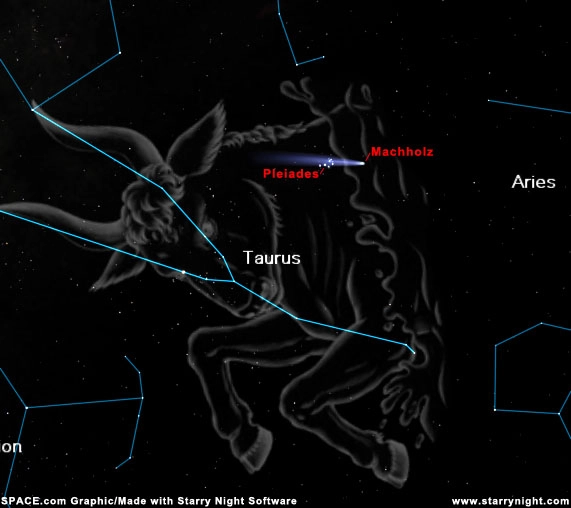
With the Moon reaching New phase on Jan. 10 and thus leaving the sky darker, now is an ideal time to get out your binoculars and explore the profusion of open or galactic star clusters now evident in our evening sky.
Such clusters represent aggregations of young, recently born stars. They are in our galaxy's local spiral arm, into whose interior we are looking at this time of year. These stars condensed out of the interstellar gas in this part of our Milky Way system.
Two of the very best are high in our evening sky and toward the south at around 9 p.m. local time. You can easily locate them by using the famous three-star belt of Orion, the Mighty Hunter.
Extending an imaginary line from the belt, upwards and to the right will take you to the clusters of the Hyades and Pleiades of Taurus, the Bull.
Interestingly, Australian aborigines believed that the three belt stars of Orion were three young men dancing to the music played by nearby maidens (the Pleiades). Indeed, the most beautiful and famous star cluster in the night sky is the Pleiades.
Comet to watch
Many will be training binoculars and small telescopes toward the Pleiades on the evenings of Jan. 7, 8 and 9 as the recently discovered comet Machholz slips by, only a couple of degrees to the west of this star cluster. (Your fist on an outstretched arm covers about 10 degrees of sky.)
The traditional Greek legend for the Seven Sisters - as this cluster has long been known - is that they are the daughters of Atlas and Pleione. Their father, Atlas, rebelled against Zeus, the king of the gods, who retaliated by sentencing him to forever holding up the heavens on his shoulders. This so grieved the sisters that Zeus placed them in the heavens so that they could be close to their father.
Few star figures are as familiar as the Pleiades, known also as the Seven Sisters. Anyone having difficulty in recognizing various stars and constellations should start with the Pleiades, because there is nothing else like them in the sky and nobody can look very long at the heavens on a winter night without noticing them and wondering what they are.
The Pleiades have always been held in high esteem through the ages. Ancient Grecian temples faced the Pleiades at their rising. One passage leading out from the Great Pyramid at Cheops in Egypt was directed toward the Pleiades when they passed overhead. The Japanese feast of the Lanterns are remnants of ancient Tauric rites in honor of the Pleiades. To the average eye, this group looks at first like a shimmering little cloud of light. But further examination, aided by good eyesight, will reveal a tight knot of tiny stars.
Seven Sisters
Interestingly, widely separated and totally different cultures have always described the Pleiades as the "Seven Sisters," "Seven Maidens," or "Seven Little Girls." Yet, only six stars are readily visible to most. Those with more acute eyes can glimpse up to 12. [Map] But why this cluster has been cited by more than one early people as having seven members remains a mystery.
About 250 stars have been identified as members of this cluster. Gaze at them through binoculars: the brightest stars glitter like an array of icy blue diamonds on black velvet. Or as Tennyson wrote, they "Glitter like a swarm of fireflies tangled in a silver braid."
This cluster may be one of the first astronomical subjects recorded. Hesiod knew it nearly 3,000 years ago and a reference to it has been found in Chinese annals dated around 2357 B.C. It is also mentioned three times in the Bible. So apparent is the group that almost all sky cultures concerned with the sky have told tales of its significance. Cultures of Central and South America began an important time period with the appearance of the Pleiades at their highest point at midnight. Hipparchus began the seasons with certain risings and settings of this group.
Several stars in the cluster seem to be enveloped in clouds of dust, perhaps left over from the stuff of which they were formed. About 410 light-years away and some 20 light-years across, the group may be no older than 20 million years and contain a total of perhaps 250 stars.
No Bull
The Pleiades cluster is in the Bull's shoulder. The Bull's face is plainly marked by the fine V-shaped cluster of the Hyades.
Notice the bright orange star at the end of the lower arm of the V, which represents the Bull's fiery eye. That's Aldebaran, "the follower." It rises soon after the Pleiades and pursues them across the sky.
The Hyades are among the nearest of the star clusters, which explains why so many of the separate stars can be readily seen. At a distance of 130 light years, the Hyades members travel through space like a flock of geese, their paths ultimately converging toward a between the stars Betelgeuse in Orion and Procyon in Canis Minor, while receding from us at the rate of 100,000 miles per hour.
Aldebaran on the other hand, is a foreground star that does not belong at all to the Hyades and is moving toward the south almost at right angles to the cluster's motion and twice as fast. Taurus's V-shaped head is, therefore, going to pieces. For 25,000 years or more it will pass for a V, but after 50,000 years it will be quite out of shape.
- Pleiades Potato Plot Proven!
- Pleiades and Space Clouds in 'Demolition Derby'
- What's Up Tonight: Sky Calendar
- Comet Machholz: Viewer's Guide


Starry Night software brings the universe to your desktop. Map the sky from your location, or just sit back and let the cosmos come to you.

Joe Rao serves as an instructor and guest lecturer at New York's Hayden Planetarium. He writes about astronomy for The New York Times and other publications, and he is also an on-camera meteorologist for News 12 Westchester, New York.