The Kuiper Belt is a cold donut-shaped region of icy objects that circles the outer solar system beyond the orbit of the eighth planet from the sun, Neptune.
It is similar to the main asteroid belt, found between Mars and Jupiter, in that its objects are comprised of material leftover from the formation of the solar system around 4.6 billion years ago, according to NASA.
The Kuiper Belt is far larger than the main asteroid belt, up to 20 times as wide and 20 to 100 times it's mass according to Nine Planets.
Related: Why is Pluto not a planet?
Like the main asteroid belt, the Kuiper Belt was shaped by the orbit of a giant planet. While the gas giant Jupiter fabricated the structure of the main asteroid belt, it was the orbit of Neptune that prevented material from coalescing into a large planet and thus that carved out the thin disk of the Kuiper Belt.
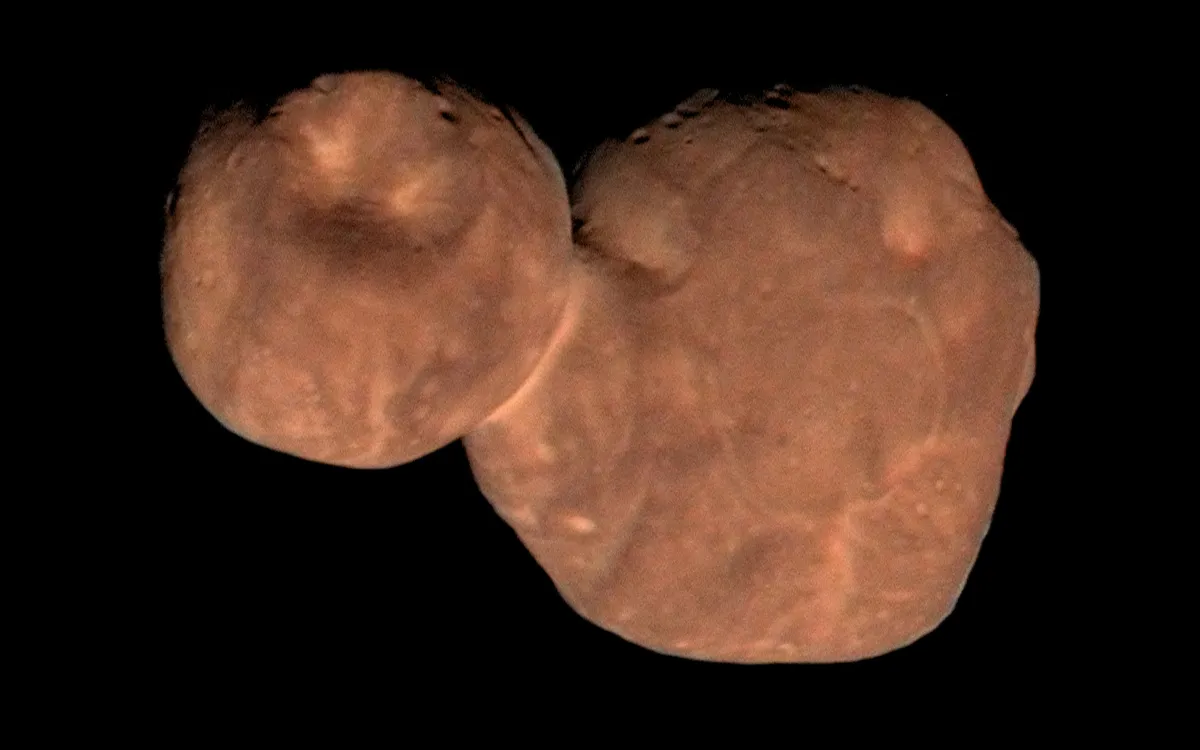
Humanity is only just beginning to explore the Kuiper Belt with just two spacecraft traveling out there thus far. In 1983, the Kuiper Belt region was visited by NASA's Pioneer 10 spacecraft, which crossed into the belt but didn't visit any of its worlds. It was followed by the New Horizons spacecraft which conducted an investigation of Pluto and its companion Charon in 2015 after a decade-long journey from Earth. The spacecraft went on to visit other Kuiper Belt objects including Arrokoth, the icy 'space snowman'.
NASA writes: "The Kuiper Belt is truly a frontier in space — it's a place we're still just beginning to explore and our understanding is still evolving."
Kuiper Belt FAQs answered by an expert

Dr. Samatha Lawler is an astronomer at the University of Regina in the United States who studies objects at the edge of the solar system.
We asked Dr. Samatha Lawler, an astronomer in the United States a few questions about the Kuiper Belt and objects at the edge of the solar system.
What is the Kuiper Belt?
The Kuiper Belt is a collection of small, icy bodies that orbit the sun farther away than Neptune. It's very similar to the asteroid belt, but colder and farther away from the sun.
What kind of objects are found in the Kuiper Belt?
The icy bodies in the Kuiper Belt are called "Kuiper Belt Objects" (I know, creative), or KBOs for short. Pluto is the best-known KBO, and one of the reasons it was demoted from being a planet was that thousands of other KBOs have been discovered orbiting in the same region. Only Pluto and one other KBO, Arrokoth, have ever had close-up pictures taken by a space probe. Pluto was visited by the New Horizons probe in 2015, and Arrokoth in 2019. Pluto is very round, made of water ice mountains and nitrogen ice glaciers, and has 5 moons. Arrokoth is only 18 miles (30 km) across, very red, and shaped like a snowman. All other KBOs have only been studied using telescopes, and even the best telescopes on Earth and in orbit still see them as dots, so we don't know as much about their shapes and colors as Pluto and Arrokoth.
What makes these Kuiper Belt objects interesting?
There are thousands of them that we know of, and probably hundreds of thousands bigger than 62 miles (100 km) across, waiting to be discovered and measured by astronomers. Each one of them is a little leftover bit of planetary material that formed somewhere in the solar system and was placed on its current orbit by gentle nudges from the planets or even the galaxy.
What can the Kuiper Belt tell us about the solar system?
By carefully measuring the orbits and information about the composition, we can learn where everything in the solar system formed, and how it may have been reorganized. Studying the Kuiper Belt has taught us that Neptune formed much closer to the sun than where it is today, and it migrated outward. Computer simulations have shown us that the KBOs we see today were shoved onto those orbits as Neptune moved.
What is the most surprising discovery made regarding the Kuiper Belt since you began studying it?
Seeing the shape of Arrokoth was completely shocking to me. I think it's safe to say that no one expected it to be snowman-shaped. But just knowing that one snowman-shaped object exists means that we need a way to form it, and many astronomers have worked on computer simulations to reproduce that shape, which tells us much more about the detailed steps of planet formation.
Where is the Kuiper Belt?

NASA says that the inner edge of the doughnut-shaped Kuiper Belt begins at the orbit of Neptune and a distance of around 2.8 billion miles (4.8 billion kilometers) from the sun, with its main concentration of bodies ending at around 4.6 billion miles (7.4 billion km) from the star.
Astronomers usually measure vast distances like this within the solar system in "Astronomical Units" (AU) with 1 AU equivalent to around 93 million miles, the average distance between the Earth and the sun.
This puts the inner of the Kuiper Belt at 30 AU from the sun and the end of its main region at about 50 AU. There is another more disordered region of the Kuiper belt called the "scattered disc" that continues out to around 1,000 AU away from the solar system's central star. Those distances mean that the Kuiper Belt is one of the largest structures in the solar system.
The Kuiper Belt may not be the most distant band of icy bodies in the solar system, however. Scientists hypothesize that even further out than the Kuiper Belt is a collection of objects called the Oort Cloud that is often confused with the Kuiper Belt.
While short-period objects are believed to originate from the Kuiper Belt, according to NASA the Oort Cloud is believed to be the source of long-period comets that take longer than 200 years to circle the sun.
The inner edge of the Oort is believed to exist between 2,000 and 5,000 AU from the sun, while the outer edge could be 10,000 or even 100,000 AU from our star, which NASA says is one-quarter to halfway between the sun and the nearest neighboring star.

Who discovered the Kuiper Belt?
The Kuiper Belt is named for Dutch astronomer Gerard Kuiper (1905–1973) who in 1951, proposed the existence of a disc-shaped region of icy objects beyond Neptune from which comets originate.
Prior to the work of Kuiper, the first Kuiper Belt inhabitant to be discovered was Pluto found by Clyde Tombaugh at the Lowell observatory in February 1930. This means astronomers had discovered the Kuiper Belt long before they knew about it, though finding Pluto did lead to speculation about other objects existing out past Neptune.
In 1943 Irish astronomer Kenneth Edgeworth published a paper arguing that solar system bodies and their distribution were not bounded by the orbit of Pluto, which can be seen as the genesis of the Kuiper Belt concept. Though Kuiper presented a much stronger case in favor of this idea 8 years later, many astronomers called this band of icy bodies the "Edgeworth-Kuiper" in reference to that contribution.
Confirmation of the existence of the Kuiper Belt would have to wait for another four decades. According to John Hopkins University Applied Physics Laboratory in 1992 University of Hawaii researchers Dave Jewitt and Jane Luu discovered a small body orbiting the sun beyond Neptune.
This object, the first "classical TNO (Trans-Neptunian Object)," was eventually designated 1992QB1 and triggered the discovery of thousands more Kuiper Belt Objects (KBOs). NASA points out that since the discovery of 1992QB1 astronomers have discovered over 2,000 KBOs.
The reason it took so long to discover Kuiper Belt belt objects is that they are so small and so far away.
Classifying Kuiper Belt objects
John Hopkins University Applied Physics Laboratory says Kuiper Belt bodies are classified as follows:
Cold Classical KBOs (Kuiper Belt Objects)
Cold refers not to temperature but to circular uninclined orbits. These objects are located in a band 6 AU wide between 42 and 48 AU from the sun and 3 AU.
These KBOs tend to be small, with none 500 miles across or wider. They are also redder in color than other KBOs.
The term "classical" refers to the fact these objects are on the type of obit Kuiper spoke about.
These are likely to be comprised of the original material that comprised the Kuiper Belt, unperturbed by the orbit of planets.
Hot Classical KBOs
"Hot" refers to the fact these KBOs have non-circular and inclined orbits.
This means these objects while usually located, at similar distances from the sun as cold classical KBOs can travel much further from the sun during their orbit.
Their sizes and colors vary, greyer than cold classicals, they also tend to be larger. They are found in a band around 12 AU thick.
Resonant KBOs
These KBOs are locked into a resonant dance with Neptune. 3:2 resonants make two orbits of the sun for every 3 orbits of the ice giant.
The 2;1 resonants, sometimes called "little Plutos" because the dwarf planet is a member of this group, make one orbit for every two orbits of Neptune.
Scattered KBOs
These KBOs possess unstable orbits, possibly because they have passed too close to Neptune and the ice giant's gravity has knocked them off-course.
These chaotic orbits can carry these bodies as far as 100s of AU away from the sun at their most distance, and closer than Neptune to the star at their closest.
Extreme TNOs (Trans-Neptunian Objects)
A very new grouping, there are only a few members of this category. These objects may eventually be revealed to not be part of the Kuiper belt at all as they can travel as far as 1,000 AU from the sun.
Famous inhabitants of the Kuiper Belt
The Kuiper Belt is home to millions of rocky and icy objects referred to as either Kuiper Belt objects (KBOs) or trans-Neptunian objects (TNOs). The frigid condition of these objects is due to their vast distance from the sun. NASA says there may be trillions of icy objects in the Kuiper Belt, with hundreds of thousands of these objects having diameters larger than 62 miles (100 km). It is home to at least five known dwarf planets, Eris, Haumea, Makemake, Quaoar, and of course Pluto.
Many of these dwarf planets have their own moons and even their own faint ring systems, with scientists recently spotting a ring around Quaoar which also has its own moon Weywot. Around 80 KBOs have been discovered to have binary companions of similar sizes meaning it can't be accurately determined which is the main body and which is the moon, these are referred to as "binary KBOs."
| Name | Radius (miles) | Orbital period (Earth years) | Average distance from the sun (AU) | Known moons | Rings? | Discovered |
|---|---|---|---|---|---|---|
| Pluto | 715 | 248 | 5.9 | Charon, Nix, Styx, Kerberos & Hydra | No | Feb 1930 |
| Eris | 722 | 557 | 68 | Dysnomia | No | Jan 2005 from data collected in 2003 |
| Haumea | 385 | 285 | 43 | Namaka & Hi'iaka | Yes, Discovered in 2017 | 2003 |
| Makemake | 444 | 305 | 45.8 | S/2015 (136472) or MK 2 (Provisional) | No | 2005 |
| Quaoar | 345 | 65.3 | 44 | Weywot | Yes discovered in 2023 | 2002 |
Kuiper Belt objects come in all shapes and sizes

The largest Kuiper Belt objects are Pluto and Eris, Pluto has a diameter of around 1,430 miles (2,380 km) while Eris's diameter is slightly larger at around 1,444 miles (2,330 km). There are as many as seven other Kuiper Belt objects known with diameters between around 600–900 miles (950–1,500 km). Only these larger KBOs are expected to have their own atmospheres.
The smallest KBO ever seen in visible light has a diameter of just 3,200 feet and was spotted at a distance of 4.2 billion miles away, but the constant collision of these objects means the Kuiper Belt is a population by a multitude of much smaller fragments.
KBOs can vary in color and surface reflectivity. Pluto, for example, reflects around 60% of incident sunlight that falls upon it, as a comparison Earth reflects just 10%.
Other KBOs have darker surfaces with reflectivity ranging from 20% to as low as 4%. John Hopkins University Applied Physics Laboratory suggests that the darkest of these objects could be rich in complex carbon-rich polymers. The color of Kuiper Belt objects is believed to range from dark grey to red, with this the result of a wide range of chemical compositions and their evolution though this is difficult to determine at such great distances.
KBOs also come in a range of shapes, with arguably the most unusual being that of (486958) 2014 MU69 or Arrokoth — meaning "sky" in Powhatan/Algonquian language — which is also referred to as the "space snowman" due to its shape.
Discovered by the New Horizons science team in 2014 using the Hubble Space Telescope, Arrokoth is double-lobed and partially flattened. The "head" and "body" of this 22 miles (35 kilometers) long, 12 miles (20 km) wide, and 6 miles (10 km) thick snowman are composed of two separate bodies that have merged into one, a so-called "contact binary." Unlike its snowman namesake, however, the object which went by the name "Ultima Thule" prior to its official naming in 2019, is extremely red in color.
Perhaps the most infamous hypothesized tenant of the solar system is "Planet X" or "Planet 9" following the demotion of Pluto to a dwarf planet. Proposed to exist way beyond Pluto, this Neptune-sized world would have a highly elongated orbit.
The primary line of evidence for this planet as it was proposed in 2015 is the strange elongated orbit of some smaller KBOs at the outskirts of the Kuiper Belt. This could be caused by the gravitational influence of an undiscovered massive object, though evidence beyond this has been scarce and controversial.
The Kuiper Belt is losing weight
The Kuiper Belt as we see it today might actually be a lot more empty than it used to be. The University of California Los Angeles (UCLA) says observations of the Kuiper Belt have led to the development of the "Nice Model" which suggests that the mass now in the Kuiper Belt, around 0.1 times the mass of Earth, is too great to have grown by accretion over the age of the solar system.
This means that the Kuiper Belt may have once contained material equivalent to 10 or even 100 times the mass of Earth, 100 to 1,000 times more than the mass it has today. The loss of this mass likely occurred due to shifting in the orbits of the giant planets, Jupiter, Saturn, Uranus, and Neptune.
According to NASA as the latter two planets were forced to drift outwards by Saturn and Jupiter they bent the path of many icy objects inwards. The massive gravity of Jupiter slingshotted out to the edge of the solar system, probably forming the Oort Cloud, or out of the solar system entirely.
NASA adds that the Kuiper Belt is still eroding today, objects there collide creating smaller collisional fragments which collide again grinding these objects to dust. This dust is then blown out of the solar system by streams of charged particles from the sun known as the solar wind.
Additional resources
The most infamous object in the Kuiper Belt is Pluto which is at the heart of a debate surrounding what should be considered a planet or what should not. The justification for downgrading Pluto to a dwarf planet, a decision made by the International Astronomical Union (IAU) in 2016, is explained here in this piece published here on the Library of Congress website.
Even further out in the solar system than the Kuiper Belt is an icy shell of billions or even trillions of objects called the Oort Cloud. You can chill and read about in more detail with these resources from NASA.
Thus far only one spacecraft has visited the Kuiper Belt when in 2015 the New Horizons mission flew past Pluto and its moons. You can read about the mission in more detail here on the official NASA website.
Bibliography
Kuiper Belt, Nine Planets, [accessed 02/22/23], [https://nineplanets.org/kuiper-belt/]
10 things to know about the Kuiper Belt, NASA, [Acessed 02/22/23] [https://solarsystem.nasa.gov/news/792/10-things-to-know-about-the-kuiper-belt/]
The Kuiper Belt, NASA, [Accessed 02/21/23] [https://solarsystem.nasa.gov/solar-system/kuiper-belt/overview/]
Arrokoth, NASA, [Accessed 02/21/23] [https://solarsystem.nasa.gov/solar-system/kuiper-belt/arrokoth-2014-mu69/overview/]
Dwarf Planets, NASA, [Accessed 02/21/23], [https://solarsystem.nasa.gov/planets/overview/]
Pluto, NASA, [Accessed 02/21/23], [https://solarsystem.nasa.gov/planets/dwarf-planets/pluto/overview/]
In Depth: Kuiper Belt, NASA, [Accessed 02/21/23], [https://solarsystem.nasa.gov/solar-system/kuiper-belt/in-depth.amp]
Pluto, NASA, [Accessed 02/27/23], [https://solarsystem.nasa.gov/planets/dwarf-planets/pluto/in-depth/]
Eris, NASA, [Accessed 02/27/23], [https://solarsystem.nasa.gov/planets/dwarf-planets/eris/in-depth/#:~:text=Eris%20is%20one%20of%20the,to%20be%20larger%20than%20Pluto.]
Makemate, NASA, [Accessed 02/27/23], [https://solarsystem.nasa.gov/planets/dwarf-planets/makemake/in-depth/]
Haumea, NASA, [Accessed 02/27/23], [https://solarsystem.nasa.gov/planets/dwarf-planets/haumea/in-depth/]
Frequently Asked Questions About Quaoar, Northern Arizona, [Accessed 02/27/23], [https://www.physics.nau.edu/~trujillo/quaoar/]
ESA's Cheops finds an unexpected ring around dwarf planet Quaoar, ESA, [2023], [https://www.esa.int/Science_Exploration/Space_Science/Cheops/ESA_s_Cheops_finds_an_unexpected_ring_around_dwarf_planet_Quaoar]