A solar eclipse occurs when the moon is positioned between Earth and the sun and casts a shadow over Earth.
Solar eclipses only occur during a new moon phase, usually about twice a year, when the moon aligns itself in such a way that it eclipses the sun, according to NASA.
If you want to know when the next solar eclipse will occur and where you can see it, check out our when is the next solar eclipse guide.
Related: How to observe the sun safely (and what to look for)
Types of solar eclipse
There are four different types of solar eclipses depending on how the sun, moon and Earth are aligned at the time of the event:
- Total solar eclipse: The sun is fully obscured by the moon.
- Partial solar eclipse: The moon doesn't fully block the sun so only a portion of the sun is obscured. Here the moon appears to take a "bite" out of the sun.
- Annular solar eclipse: The moon is centered in front of the sun but doesn't cover the entirety of the surface (as seen in a total solar eclipse). A "ring of fire" shines around the moon.
- Hybrid solar eclipse: The rarest solar eclipse is a combination of a total and annular eclipse (sometimes known as an A-T eclipse) and is produced when the moon's shadow moves across Earth. These begin as one type of eclipse and transition to another.
How and why do solar eclipses occur?
A solar eclipse is caused by the moon passing between the sun and Earth, casting a shadow over Earth.
When the moon crosses the ecliptic — Earth's orbital plane — it is known as a lunar node. The distance at which the new moon approaches a node will determine the type of solar eclipse. The type of solar eclipse is also affected by the moon's distance from Earth and the distance between Earth and the sun.
A total solar eclipse occurs when the moon passes between the sun and Earth, completely obscuring the face of the sun. These solar eclipses are possible because the diameter of the sun is about 400 times that of the moon, but also approximately 400 times farther away, says the Natural History Museum.
An annular solar eclipse occurs when the moon passes between the sun and Earth when it is near its farthest point from Earth. At this distance, the moon appears smaller than the sun and doesn't cover the entire face of the sun. Instead, a ring of light is created around the moon.
A partial solar eclipse occurs when the moon passes between the sun and Earth when the trio is not perfectly aligned. As a result, only the penumbra (the partial shadow) passes over you, and the sun will be partially obscured.
A rare hybrid solar eclipse occurs when the moon's distance from Earth is near its limits for the inner shadow — the umbra — to reach Earth and because the planet is curved. Hybrid solar eclipses are also called annular-total (A-T) eclipses. In most cases, a hybrid eclipse starts as an annular eclipse because the tip of the umbra falls just short of making contact with Earth; then it becomes total because the roundness of the planet reaches up and intercepts the shadow's tip near the middle of the path, then finally it returns to annular toward the end of the path.

How often do solar eclipses occur?
Approximately twice a year we experience an eclipse season. This is when the new moon aligns itself in such a way that it eclipses the sun. Solar eclipses do not occur every time there is a new moon phase because the moon's orbit is tilted about 5 degrees relative to Earth's orbit around the sun. For this reason, the moon's shadow usually passes either above or below Earth.
What happens during a solar eclipse?
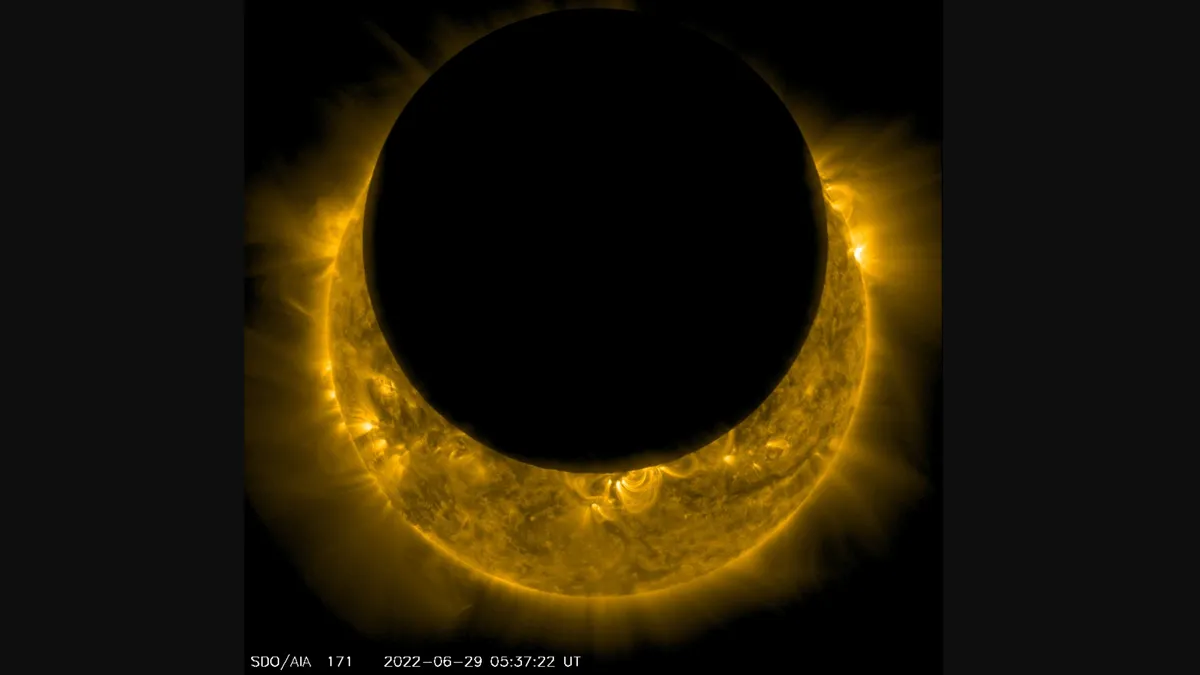
The type of solar eclipse will affect what happens and what observers will be able to see. According to the educational website SpaceEdge Academy, 28% of solar eclipses are total, 35% are partial, 32% are annular and only 5% are hybrid.
During a total solar eclipse the sky will darken and observers, with the correct safety equipment, may be able to see the sun's outer atmosphere, known as the corona. This makes for an exciting skywatching target for solar observers as the corona is usually obscured by the bright face of the sun.
During an annular solar eclipse, the moon doesn't fully obscure the face of the sun, as is the case in a total eclipse. Instead, it dramatically appears as a dark disk obscuring a larger bright disk, giving the appearance of a ring of light around the moon. These eclipses are aptly known as "ring of fire" eclipses.
Partial solar eclipses appear as if the moon is taking a "bite" out of the sun. As the trio of the sun, Earth and moon is not perfectly lined up, only part of the sun will appear to be obscured by the moon. When a total or annular solar eclipse occurs, observers outside the area covered by the moon's umbra (the inner shadow) will see a partial eclipse instead.
During a hybrid solar eclipse observers will be able to see either an annular or total solar eclipse depending on where they are located.
Solar eclipse FAQs answered by an expert
We asked Jamie Carter, Editor of WhenIsTheNextEclipse.com and author of The Complete Guide To The Great North American Eclipse of April 8, 2024some frequently asked questions about solar eclipses.

Jamie Carter is the editor of WhenIsTheNextEclipse.com and author of The Complete Guide To The Great North American Eclipse of April 8, 2024.
What happens during a solar eclipse?
During a solar eclipse, a New Moon obscures some or all of the sun. A partial solar eclipse is a mildly interesting event that must be observed using eye protection and solar filters. A total solar eclipse is a far grander and more nuanced spectacle. As the last slither of sunlight is still visible the temperature crashes, twilight takes hold and once it's 100% eclipsed the sun's white corona is revealed to the naked eye. It's a powerful, even life-changing experience.
What's the difference between a solar eclipse and a lunar eclipse?
During a solar eclipse, a New Moon gets in between Earth and the sun and the sun's light is partially or totally blocked. During a lunar eclipse, the Earth is between the sun and a full moon, so the moon is in Earth's shadow. The only light that reaches the lunar surface is first filtered through Earth's atmosphere — it's as if a thousand sunsets are projected onto its surface simultaneously, turning it an orangey-copper color.
What's the difference between a central and partial solar eclipse?
When the moon crosses the sun a cone-shaped shadow trails behind the moon. When the tip of that cone just misses Earth a partial solar eclipse is visible. When the tip touches Earth's surface it creates a narrow dark shadow from which it's possible to see a total solar eclipse. On either side of that 'path of totality' a partial solar eclipse is visible.
When is the next solar eclipse?
The next solar eclipse will be an annular solar eclipse on Feb. 6, 2027.
The next total solar eclipse will occur on Aug. 2, 2027.
Are solar eclipses dangerous?
Solar eclipses are dangerous if you do not observe the sun safely.
Never look at the sun without proper eye protection. It is never safe to look directly at the sun's rays even if the sun is partly obscured because they contain harmful ultraviolet (UV) and infrared (IR) rays that can damage your eye's retina and even cause blindness.
Never use regular sunglasses to observe the sun. The only safe way to look directly at the sun is through specifically designed solar filters, using solar eclipse glasses for direct viewing and solar filters for telescopes and binoculars.
A safe way to view a solar eclipse is to construct a "pinhole camera." A pinhole or small opening is used to form an image of the sun on a screen placed about 3 feet (or about 1 meter) behind the opening. Binoculars or a good telescope mounted on a tripod can also be used to project a magnified image of the sun onto a white card. The farther away from the card, the larger you can focus the image. Look for sunspots. Notice that the sun appears somewhat darker around its limb or edge. This method of solar viewing is safe so long as you remember not to look through the binoculars or telescope when they are pointed toward the sun; put another way, never look directly at the sun when any part of its blindingly bright surface is visible.
Related: How to build your own solar eclipse viewer (video)
A variation on the pinhole theme is the "pinhole mirror." Cover a pocket mirror with a piece of paper that has a ¼-inch (7 mm) hole punched in it. Open a sun-facing window and place the covered mirror on the sunlit sill so it reflects a disk of light onto the far wall inside. The disk of light is an image of the sun's face. The farther away from the wall the better; the image will be only 1 inch across for every 9 feet (or 3 centimeters for every 3 meters) from the mirror. Modeling clay works well to hold the mirror in place. Experiment with different-sized holes in the paper. Again, a large hole makes the image bright, but fuzzy, and a small one makes it dim but sharp. Darken the room as much as possible. Be sure to try this out beforehand to make sure the mirror's optical quality is good enough to project a clean, round image. Of course, don't let anyone look at the sun in the mirror.
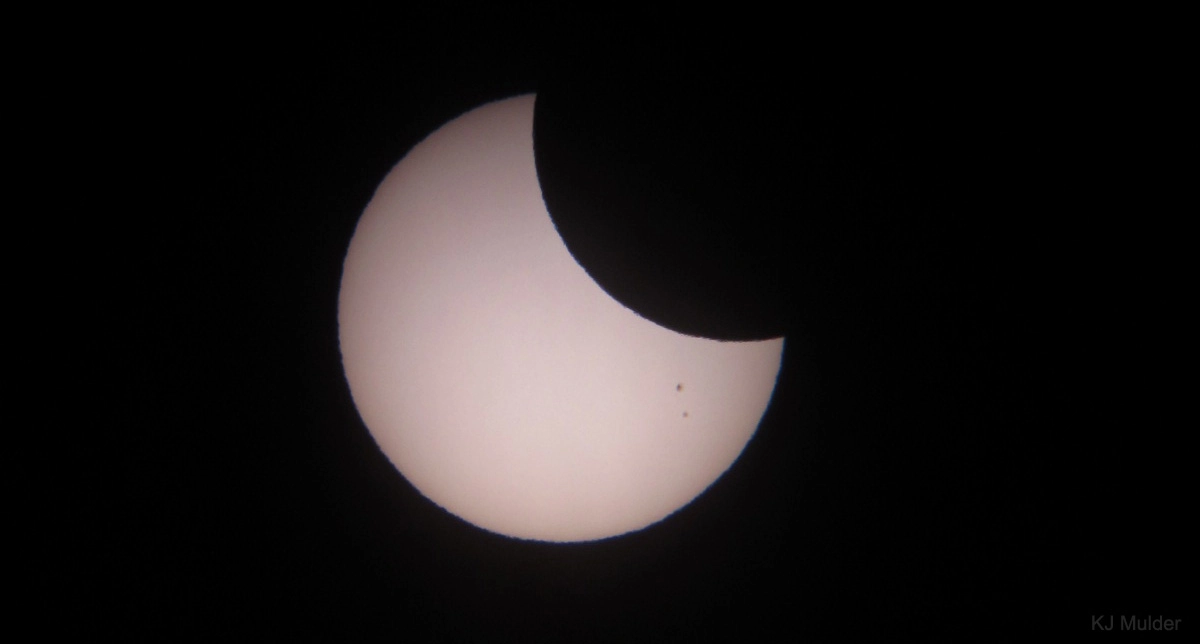
If you're around leafy trees, look at the shadow cast by them during the partial phases. What do you see? Is it worth a photograph? You will see scores of partially eclipsed suns projected through pinhole gaps between the leaves. This is caused by diffraction, a property of light. According to Vince Huegele, an optical physicist at the NASA Marshall Space Flight Center, the light rays do not shoot straight by the rim of the gaps, or a pinhole, but bend around the edge. This wave effect creates a pattern of rings that resembles a bull's eye. If you want to get all set up for it, we have guides to the best cameras for astrophotography, and the best lenses for astro, so you can be well prepared when the time comes. Our how to photograph an eclipse guide will also help you plan for your next solar-observing adventure.v
Additional resources
Want to look further ahead? You can find a concise summary of solar eclipses through to 2030 on NASA's eclipse website. Read more about solar and lunar eclipses on Eclipse Wise — a website dedicated to predictions of eclipses. Learn about eclipses on other planets with this short article from Cornell University's astronomy department.
Bibliography
NASA. (December 21, 2022). Types of solar eclipse. NASA. Retrieved February 7, 2023, from https://solarsystem.nasa.gov/eclipses/about-eclipses/types/
NASA. Moon in motion. NASA. Retrieved February 7, 2023, from https://moon.nasa.gov/moon-in-motion/overview
Solar eclipse guide: What they are and how to watch safely. Natural History Museum. Retrieved February 7, 2023, from https://www.nhm.ac.uk/discover/solar-eclipse-guide.html
Solar Eclipses (high school). Project: Solar Eclipses (High School). Retrieved February 7, 2023, from https://spacedge.academy/course/view.php?id=68
NASA. (2021, February 3, 2021). Eye safety during a total solar eclipse. NASA. Retrieved February 7, 2023, from https://www.nasa.gov/content/eye-safety-during-a-total-solar-eclipse
American Astronomical Society (December 18, 2022). Reputable vendors of solar filters & viewers. Solar Eclipse Across America. Retrieved February 7, 2023, from https://eclipse.aas.org/resources/solar-filters
Editor's Note: If you snap an amazing solar eclipse photo and would like to share it with Space.com's readers, send your photo(s), comments, and your name and location to spacephotos@space.com.
Follow us on Twitter @Spacedotcom and on Facebook.