


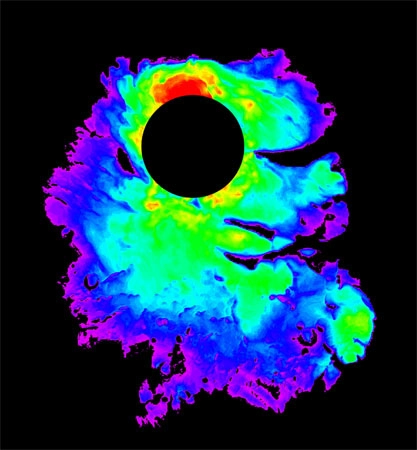
Mars is unlikely to sport beachfront property anytime soon, but the planet has enough water ice at its south pole to blanket the entire planet in more than 30 feet of water if everything thawed out.
With a radar technique, astronomers have penetrated for the first time about 2.5 miles (nearly four kilometers) beneath the south pole's frozen surface. The data showed that nearly pure water ice lies beneath.
Discovered in the early 1970s, layered deposits of ice and dust cap the North and South Poles of Mars. Until now, the deposits have been difficult to study closely with existing telescopes and satellites. The current advance comes from a probe of the deposits using an instrument aboard the Mars Express orbiter.
"This is the first time that a ground-penetrating system has ever been used on Mars," said the new radar study's lead author, Jeffrey Plaut of NASA's Jet Propulsion Laboratory. "All the other instruments used to study the surface of Mars in the past really have only been sensitive to what occurs at the very surface."
(NASA's Mars Odyssey spacecraft also carries instruments designed, among other things, to probe beneath icy polar surfaces.)
Deep probe
Plaut and his colleagues probed the deposits with radar echo sounding, typically used on Earth to study the interiors of glaciers. The instrument, called the Mars Advanced Radar for Subsurface and Ionospheric Sounding, or MARSIS, beams radio waves which penetrate the planet's surface and bounce off features having different electrical properties.
The reflected beams revealed that 90 percent or more of the frozen polar material is pure water ice, sprinkled with dust particles. The scientists calculated that the water would form a 36-foot-deep ocean of sorts if spread over the Martian globe.
"It's the best evidence that's been obtained to date for that thickness," said Ken Herkenhoff, a planetary geologist at the U.S. Geological Survey in Flagstaff, Ariz., who studies the Martian polar regions. He was not involved in the current study.
Scientists have long known that Mars' north polar cap is a massive storehouse of water ice, and the current research team says they will use their radar technique to refine past estimates of its thickness and make-up.
Missing water
"These polar ice deposits are by far the largest reservoir of water or water ice that we know of on Mars," Plaut said.
That's a lot of water, but not enough to account for the flowing streams thought to meander along Mars' surface in the past.
"There's evidence that about 10 times or maybe even 100 times that much water has flowed across the surface of Mars to carve the various channels, the outflow valleys and other features we see in the images and topography data," Plaut told SPACE.com.
So where's the rest of the water? One idea is that a subterranean plumbing system once ferried loads of water beneath the Martian surface. Plaut said his team also will search for underground pools with the radar technique.
Martian beach
A Martian water-world is unlikely in the near future, but astronomers have solid evidence that billions of years ago water flowed over the Martian surface. And recently, evidence has pointed to a warming trend as Mars emerges from an "ice age."
Scientists think variations in Mars' orbit and tilt drive the planet's climate over time, though a few astronomers have speculated about how the Sun's activity could be partly to blame for warming on several planets.
In addition to warming from the atmosphere, ice-thawing heat could come from the core of Mars, analogous to the plumes of heat that cause volcanic eruptions on Earth. But evidence from the new radar study suggests the Martian crust is icy cold and rigid.
- Mars Madness: A Multimedia Adventure
- Top 10 Best Mars Images Ever
- Video: A Wet Modern Mars?
- Images: Ice on Mars
- All About Mars
