Could we actually terraform Mars? Scientists are trying to find out
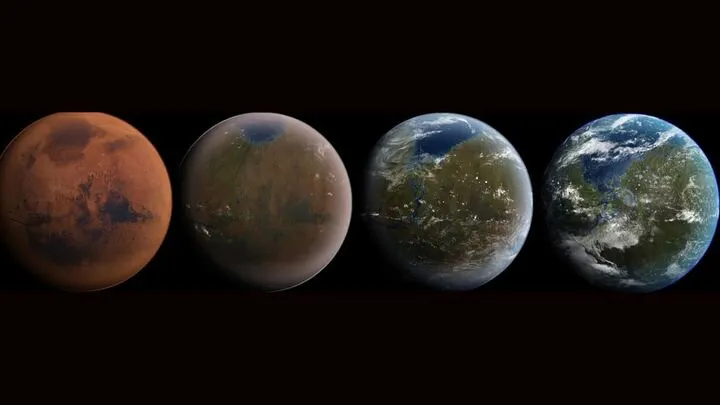
GOLDEN, Colorado — Scientists are engaged in research with an eye toward transforming the cold climes of Mars into a far more habitable place for Earthlings in the future.
One notion proposed is the dispersion of an aerosol meant to help warm up Mars' atmosphere. The idea is projected to be a first step toward terraforming the Red Planet. Also emerging recently as a new field of study is "applied astrobiology," which seeks to appraise what would be needed to create sustainable habitats and biospheres beyond Earth.
Scientists have drawn up a research blueprint for assessing the viability of warming the Red Planet, outlining what it might take to make Mars a place in space where life can thrive. Importantly, that roadmap does not presuppose that warming Mars is desirable. Rather, its purpose is to identify what is required for Mars to be warmed, what it would cost and what could go wrong.
Keep the option open
Edwin Kite, an associate professor of geophysical sciences at the University of Chicago, detailed the plan here at a Space Resources Roundtable, which was held from June 2 to June 5 on the campus of the Colorado School of Mines.
Kite's talk showcased a mission concept prototype to validate aerosol dispersal to warm Mars' atmosphere as a first step toward terraforming the Red Planet.
"Creating sustainable habitats and biospheres beyond Earth is an enormous scientific and technical challenge, but it's one we'll have to surmount if we're going to extend life beyond Earth," Kite told Space.com.
"We do not yet know enough to create a biosphere from scratch," he added. "Applied astrobiology, like planetary science, requires contributions from many disciplines."
Kite said that relatively modest research investments can keep open the option of extending life beyond Earth as the scientific exploration of Mars continues.
The roadmap, Kite explained to Space.com, identifies several approaches to warming Mars. Solid-state greenhouse membranes, he said, offer the nearest-term benefits, with direct applications to moisture farming and life support at human bases on Mars.
Strengthening Mars' natural greenhouse effect might warm large regions of the globe, Kite noted, although many aspects remain to be worked out. Each approach carries scientific and technical risks that research must address, he added.

A centuries-long process
Whether Mars can support a biosphere, however, is unknown. But, if activated, a biosphere on Mars would help sustain large numbers of people in bases beyond Earth, sparking the conditions for a centuries-long process of atmospheric oxygen buildup.
The questions raised by the possibility of warming Mars are numerous. But the immediate unanswered questions are identifiable, Kite suggested, and can be addressed with a focused research campaign.
He acknowledged that a consensus on moving forward requires more data on two fronts: whether Mars could support life in the future, and whether there's life on Mars today.
An approach to warming Mars would be inherently modular, in that it could be done by many sites in parallel, Kite suggested. An aspect of the endeavor may well involve orbiting reflectors for warming intermediate-sized areas, such as human bases.
Prototyping progress
Kite is also a resident researcher at the Berkeley, California-based Astera Institute, which was founded to steer science and technology towards an abundant future. And he's a participating scientist on the mission of NASA's Curiosity Mars rover, which has been exploring the Red Planet since August 2012.
Being scoped out by Kite and fellow researchers is a potential technology demonstration on Mars, an automated payload that would test an aerosol release concept. It would discharge less than 2 pounds (about 1 kilogram) of sub-micron artificial particles and laser track that dispersal to an altitude of roughly 1,500 feet (500 meters), to confirm ascent of the plume into the skies of Mars.
Kite said that dispenser requirements are particularly challenging. For example, researchers will need to show that it works on Earth before launching a demonstration mission to Mars.
There has been "prototyping progress," Kite said, with an experimental setup designed and built for rapid deployment.
To trial-run the particle dispersal concept and plume tracking technology, the plan calls for use of NASA's Planetary Aeolian Laboratory (PAL) at Ames Research Center in California this year. PAL is a unique facility used to support experiments under different planetary atmospheric environments, including Earth, Mars and Saturn's largest moon, Titan.

Filling big gaps
To help evaluate the feasibility of terraforming Mars, Kite points to the need for better maps of subsurface water ice on that world; climate-monitoring orbiters to observe the planet's natural variability; the return of Red Planet samples to Earth for study; and international cooperation.
"Mars sample return will be done by China's space agency. The original plan for their Tianwen-3 mission was to grab some rocks from wherever and then head back to Earth," Kite said. "The new plan is to go around with a helicopter and collect rocks from a wide area. I'm hopeful that they share their Martian samples, allowing all the world's labs to have a crack at them."
Then there's the prospect of an International Mars Ice Mapper, Kite said, a proposed Mars orbiter that's been studied by NASA, the Japan Aerospace Exploration Agency (JAXA), the Canadian Space Agency (CSA) and the Italian Space Agency (ASI). However, that mission appears at this moment to have been shelved.
"It's a good idea and could always come back," said Kite. "We should search for deep aquifers using electromagnetic soundings — that's the best strategy. We don't know whether there's still liquid water deep underground. There are big gaps in our knowledge about Mars."
Demonstrations on Mars
Kite reported that warming Mars with artificial aerosol appears feasible, backed by workshops about creating a "Green Mars" and applied astrobiology.
If early findings from aerosol release demonstrations on Mars prove positive, Kite said, those results would provide the quantitative basis for "government-scale programs" to evaluate whether extending habitable conditions beyond Earth is achievable, at what cost and on what timescale.
"Even under optimistic assumptions, warming at kilometer scale is at least a decade away, and wider environmental modification would require sustained investment over many decades beyond that," states the recent research paper, which Kite led.
"Relatively modest research investments would keep open the option of extending life beyond Earth as Mars’ scientific exploration continues," Kite and his colleagues concluded.