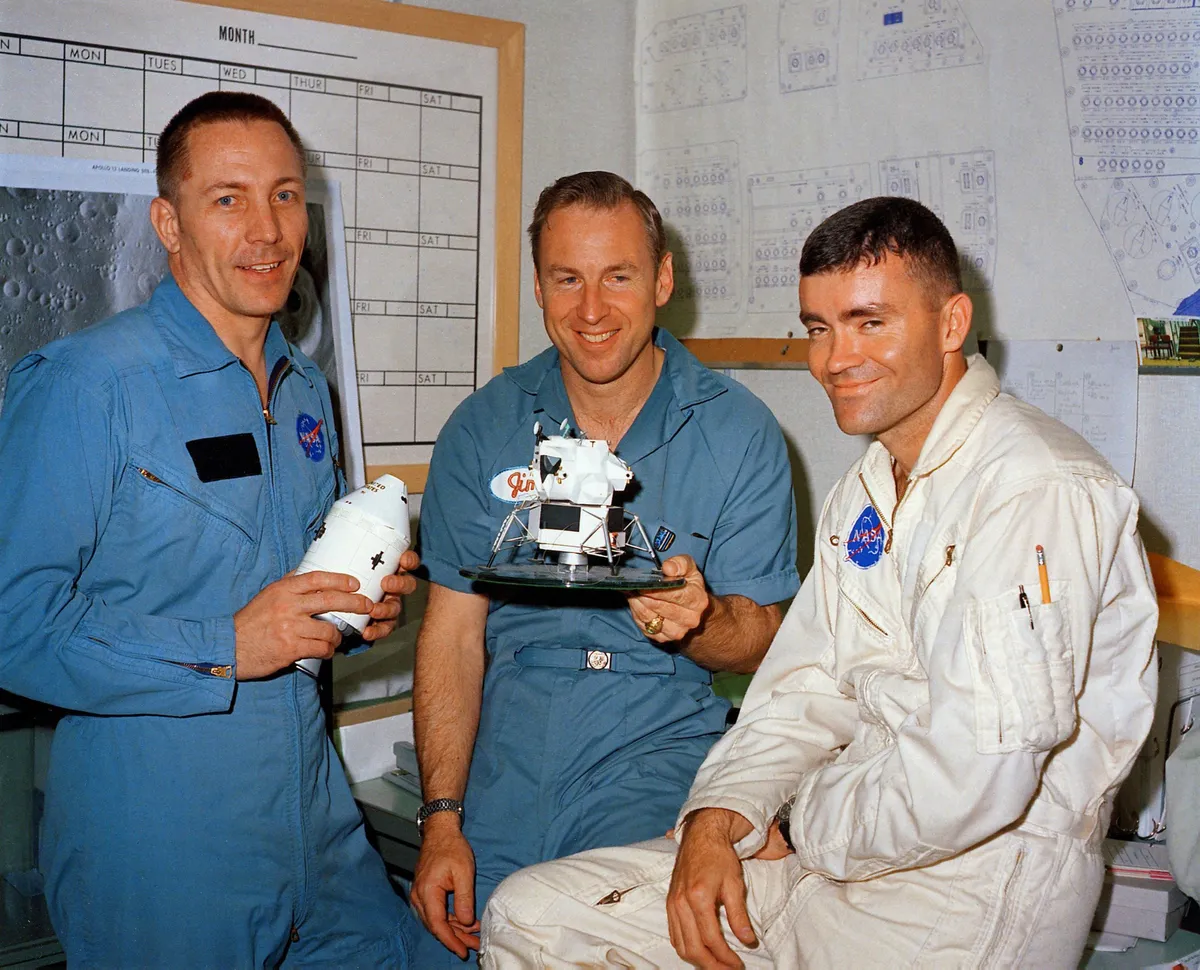
lloyd_rob asks: Pardon my ignorance, Mr. Haise, but did you fly again after Apollo 13?
Fred Haise: I did not fly back into space, but I flew five of the eight test flights on the space shuttle Enterprise during the approach and landing in 1977.
manolis_varnassinger asks: Mr. Haise, I saw the movie they did about Apollo 13 and I was very touched. It was one of the most touching tragedies that happened in the '70s. What do you most remember from that experience of yours, and what did you think of the movie they did about that mission?
Fred Haise: What I would remember from the flight would be the views from the window and the weightlessness. Otherwise, it was the trauma from the explosions and the trauma before returning home. I remember the extreme cold and lack of sleep -- we were very tired and fatigued. As to the movie, I thought they did a very good technical job in showing what it's like on a mission. However, most of the off-color or vulgar lines were not ours, and the crew conflict was something Hollywood added to make us seem more human.
MedicineHeart asks: Fred, do you ever regret taking that voyage on Apollo 13?
Fred Haise: No, I did not regret it. Today I truly feel very fortunate and privileged to have been born at the right time, have had the right experience to join the program, and now be only one of 24 human beings who have ever had the chance to go to the moon.
manolis_varnassinger asks: Jim Lovell didn't want to continue having other missions after that accident. Did you take other missions to space or do you wish to go back in space someday?
Fred Haise: I had hoped to go back to the moon on Apollo 19. I turned around as the backup commander on Apollo 16, which would have put me in the line to go on Apollo 19, if NASA had not cancelled those missions.

"When I got to the point of understanding we had lost one oxygen tank, my primary emotion was one of great disappointment because I knew we had lost thelanding mission. Losing one oxygen tank of the two was not life threatening."

mgas_1 asks: What was your inspiration to keep going and not give up during Apollo 13?
Fred Haise: Rather than inspiration, it was growing up in the system of flying airplanes, being a test pilot and being involved in the space program. All of this helped me get confidence to handle things that not only normally happen, but abnormal things as well.
MedicineHeart asks: Fred, were you one of the technical advisors for the film Apollo 13?
Fred Haise: No, I was not a technical advisor on the movie. I was still employed, running subsidiary companies for Northrop Grumman. So I was too busy!
MedicineHeart asks: Fred, when you found out it was the oxygen tank that exploded, what was your first thought?
Fred Haise: When I got to the point of understanding we had lost one oxygen tank, my primary emotion was one of great disappointment because I knew we had lost the landing mission. Losing one oxygen tank of the two was not life threatening.
lloyd_rob asks: I know you didn't sleep much during the Apollo 13 mission? Were you able to eat or drink? If so, what did you eat or drink?
Fred Haise: We had water both in the command and service module, as well as the landing module. We did not use the powdered freeze-dry, most of which required warm water. So we ate mostly dried cubes of bread or cookies and wet packs, which were like beef stew, or frankfurters.
mgas_1 asks: Why did you never fly the shuttle after training in the Enterprise craft?
Fred Haise: I was assigned to fly the third orbital flight of the shuttle, but I knew of the tile problems that would significantly delay flight. I was reaching an age where it seemed prudent to start my next career as an aerospace executive with the Grumman Corp., rather than wait around for three years.
jcsherwood asks: Do you believe the problems encountered and/or revealed during the Apollo 13 mission contributed to the funding cuts that curtailed the Apollo program?
Fred Haise: No, I do not believe that is the case. NASA was concerned with moving on to the next program with sufficient funding, which was Skylab.
lloyd_rob asks: What do you think about the Russians' decision to keep Mir aloft, even though they are committed to the ISS as well?
Fred Haise: I don't care if they would keep Mir alive, as long as they hold up financially their end of the bargain with the International Space Station.
manolis_varnassinger asks: Mr. Haise, what were your feelings after Jack Swigert died?
Fred Haise: I was very sad, particularly in the sense that Jack had put in a great effort through two elections to serve our country in Congress. And at the time of his death he was left a week away from realizing his dream.
manolis_varnassinger asks: Mr. Haise, did you always have that dream of becoming an astronaut?
Fred Haise: No, when I was growing up there were no real astronauts, only Flash Gordon and Buck Rogers at the Saturday serials and movie shows.
jcsherwood asks: When I interviewed Jim Lovell for a newspaper in 1995, I asked if he had any insight into why private enterprise has not "gone orbital" -- for example, with "space factories." He replied that insurers are unwilling to cover the potential liability. Do you agree, and do you have any additional insights or comments about the issues of "space insurance" or "space industry"?
Fred Haise: Jim is right as far as ongoing operations, but a very basic problem is to gather enough investor money to get through the development cycle, which is very costly.
jcsherwood asks: Do you believe that Jim Lovell's book, Lost Moon, presented an accurate, balanced account of your Apollo mission? Can the same be said for Ron Howard's film version?
Fred Haise: Yes, Jim's book was very good, well documented, particularly for the flight side. For the ground side there was a book by Cooper called Thirteen: The Flight That Failed. That was a very accurate portrayal of what happened on the ground. The movie was accurate, where it showed technical things like a launch or the actors free-floating and entry, the artifacts. The spacecraft, for example, were very accurate, as well as the Mission Control they built. Computer graphics were well done as well. There were a few exaggerations, of maneuvers that were done manually, of the vehicle motion. And most of the funny or spicy lines in the script were not ours.
jojo_47_ct asks: Has being in orbit, seeing the Earth as only a few people have changed your perspective of life?
Fred Haise: No, it has not, because a long time ago in high school, [I] studied a lot of astronomy. And with the picture of the scale of our universe, going to the moon is not going very far.
emoe0412 asks: Fred, what were you thinking as you approached the moon?
Fred Haise: I was mainly thinking about enjoying the brief and, as it turned out, only view I would have. Jack and I got out cameras and film to shoot a lot of pictures as we went by. It struck me as a very lifeless feature with the lack of color and the array of craters where it had been beat up by meteorites over the eons.
katherinedramirez asks: When was your most fearful moment during the mission?
Fred Haise: I'm not sure I can say I had a fearful moment. My concern was approaching entry with the condition of the heat shield. We had no way of knowing if the explosion had damaged it. But there was no choice but to perform the entry if we were going to get home.
noname_77065 asks: Did you ever think you would not get home?
Fred Haise: No, I did not. I think primarily because of being a part of the process through training that gave us confidence in ourselves and the Mission Control team with the many people across the country behind them. Apollo had collected some of the best minds in this country, which came for the challenge.
hmeiselman asks: Mr. Haise, do you regret that you never walked on the moon or returned on Apollo 17?
Fred Haise: That was Apollo 19. Certainly at that time, and for a period after that, I regretted that greatly, but after that it mellowed. And now I'm happy to just look back and know I had a chance.
kennedy_spaceman asks: What would be a comment you would give to children dreaming of becoming astronauts???
Fred Haise: The most important thing is to assure that you are working through your education toward a career that one enjoys and matches their God-given talent. The competition is up, and following a path that would lead to an enjoyable employment would make one happier, even if you do not succeed in becoming an astronaut. A measure of success is when you find yourself in a job where most of the time you feel like you're cheating to be getting paid.
porta_63376 asks: Do you think NASA is doing its job well?
Fred Haise: NASA's doing probably as well as it can with current funding levels. With the recent Mars missions, they may be going too far with the policy of "faster and cheaper" to stretch the budget.
elijahgreg asks: do you think we should go to Mars or the moon?
Fred Haise: I think the next endeavor ought to be to go to Mars.
brwaybby asks: Do you see an actual manned landing on Mars in the foreseeable future?
Fred Haise: I am not a futurist, but I would say we will not go to Mars in my lifetime.
hmeiselman asks: Mr. Haise, are you still involved in the space program now, and do you have plans to go back into space?
Fred Haise: No I'm not involved in the program today. I've retired and emotionally enjoying grandchildren.
porta_63376 asks: Do you have any material objects from the [Apollo 13] experience?
Fred Haise: We had very few things remaining because we utilized both vehicles until the last minute and did not have the opportunity that other crews had to remove equipment.
achaikin_2001 asks: Fred, if you could visit any place in the solar system, or beyond, where would you go?
Fred Haise: Someday I hope we find a suitable planet, probably beyond our solar system, to plant the human race for its survival. The Earth is a single spaceship with no guarantees it will be here forever.
jojo_47_ct asks: Were you a fan of science fiction as a child...did you ever imagine going into space?
Fred Haise: No I was not a fan of science fiction as a child. I had never thought of going into space or even flying an aircraft. My initial college career was aimed at becoming a journalist. In my first two years of college that was my major -- journalism.
trekkie1701f asks: Who most inspired you when you were young?
Fred Haise: When I was young the primary people were my parents. I can recall a few teachers in grammar, elementary and high school, and my Boy Scout leader, who was also the editor of the Biloxi-Gulfport Mississippi Daily Herald. And the managing editor of that newspaper.
clovesmokin asks: Forgive me if this is common knowledge, but what were you involved in before joining NASA?
Fred Haise: I had gone through the Naval aviation cadet program to be commissioned as a U.S. Marine fighter pilot. I subsequently had 20 years as a pilot. First as a test pilot at NASA's Lewis Research Center and the Flight Research Center at Edwards Air Force Base before joining the astronaut program.
rob444b asks: Mr. Haise how confident were you of the Apollo program; were you surprised that everyone got back alive? The safety margins appear so slim, especially for lunar landing.
Fred Haise: It's hard for me to make a judgment on the odds; the practices and the process for the design development and checkout of the equipment; and our training was the best possible to provide what I felt were good odds.
lloyd_rob asks: How long did it take after your rescue to start feeling "normal" again? For instance, when did you start sleeping regularly, eating regularly and calming down?
Fred Haise: After I returned we immediately had to continue work relative to supporting the accident investigation, writing a mission report, testifying to Congress and taking part in many public events -- all this while I was needing two shots a day to overcome a lower urinary tract infection. In other words we didn't get to slow down.
porta_63376 asks: How many years did you spend to prepare for that trip?
Fred Haise: For the specific mission we went into training three days after Apollo 11 landed. In a broader sense, I had trained as the backup lunar module pilot on Apollo 8 and Apollo 11 earlier.
angelwings4u2luv asks: Do you still talk to the guys who were with you?
Fred Haise: Yes, I talk frequently to Jim, but more on the basis of our roles with new not-for-profit organizations. Jim is currently head of the Astronaut Scholarship Foundation, filling in for Al Shepard after his death. I am on the Board of Directors of the Astronauts’ Memorial Foundation. We frequently partner on fundraisers to support these organizations. We don't talk much on "war stories" relative to Apollo 13.
mgas_1 asks: Why did you never fly the shuttle after training in the Enterprise craft?
Fred Haise: The primary reason was the tile problem on the first vehicle, Columbia. I knew I could not continue flying forever, and it seemed appropriate to take advantage of an opportunity and join the aerospace business as an executive manager.
padaguisage asks: What do you foresee in NASA's future?
Fred Haise: All I see at the current budgeting level is the continuation of the shuttle program, and hopefully the completion of the International Space Station as the major projects. Remaining funding will be utilized for a continuation of science probes within the solar system.
trekkie1701f asks: Mr. Haise, are you a Trekkie?
Fred Haise: Yes, I am a Star Trek fan, I enjoyed the original program very much, the follow-ons, and particularly the movies. I just wish they would divulge how we could get to warp 6!
rob444b asks: Do you believe the ISS is worthwhile, or should we be spending our money going further into deep space?
Fred Haise: That is a difficult question to answer because the primary mission of the International Space Station is to provide a number of scientific laboratories or experiments. The nature of experiments is one that does not know their return or value until they are conducted. Therefore the worthwhile return of the International Space Station is defined as a "Catch 22."
davidbritnn asks: Was Al Shepard really the character he has been portrayed as? "The Icy Commander" and all...
Fred Haise: I did not find Al as the icy commander at all. He was my supervisor through most of my 13 years in the astronaut program. I found him very human and a very good boss.
fenway_faithful14 asks: Hello, Mr. Haise. When you were sitting in the lunar module on your trip home, what did you do to pass the time? In Jim Lovell's book, it said that it was often too cold to sleep.
Fred Haise: Most of the time I spent, and for most of the first two days following the explosion, I was on duty alone. Other than copying messages from Mission Control, and manually switching communication antennas, I would just enjoy the view out the window.
trekkie1701f asks: How do you think NASA's new policy of "Faster, Better, Cheaper" compares to the all-out, unlimited spending of the "Space Race?"
Fred Haise: The current policy was inaugurated to enable more missions within the limited budget today. The disadvantage is obviously due to shortcuts in the thorough process utilized before of review and oversight.
achaikin_2001 asks: Do you think NASA, or the country, has lost the ability to take risks?
Fred Haise: Most of the influence is based on dealing within budget constraints. I would certainly say that some of the missions, including the recent Mars missions, involved taking more risks that might have been done prior.
anthony_schmitt asks: The Apollo 13 accident notwithstanding, did you feel Jim Lovell made the right call in taking Swigert over Mattingly (due to German Measles exposure) as opposed to the whole crew being bumped to a later mission? Would you have made the same decision if you were the commander?
Fred Haise: That was not a decision made by Jim Lovell. We trained as primary and backup crews, with the policy being that the lunar module crew would be moved as one, and the command module pilot individually could be replaced. So the training was done in duplicate to allow that to be done without risk of mission safety.
pitch92 asks: During Apollo 13, did you find it hard to disengage from your personal life being in that situation and having to think about your loved ones or did you even have time to do so?
Fred Haise: I thought about my loved ones and other people back home, but it was no different than I might think of them at any time when I have free time, so to speak. And nothing more than that -- it did not influence my performance in fulfilling what had to be done during the Apollo 13 mission.
jcwb1 asks: Mr. Haise, did you fully recover from your accident in 1973?
Fred Haise: In 1973 I was involved in an aircraft crash of a BT 13 aircraft that had been modified for the Tora! Tora! Tora! movie by 20th Century Fox to look like a Japanese VAL dive-bomber. In the ensuing fire I was burned over 65 percent of my body and spent three months in the hospital to recover. It took 14 months for me to regain flight status in 1974, and go on to fly the space shuttle Enterprise in 1977. Other than scars remaining, I have no physical inability as a result of that accident.
fenway_faithful14 asks: Were you planning on saying any special "first few words" if you had walked on the moon? After all, you would have only been the seventh man to walk on it.
Fred Haise: I would have been the sixth, but no, we had no special plans for any pronouncements.
rpellicciotti asks: Mr. Haise, are you disappointed in the lack of progress in manned space exploration over the past 30 years? Should we return to the moon?
Fred Haise: Based on a limited flight time, I would say yes, I am disappointed that we have not gone farther -- to the moon again, and beyond. But if I look at the 20th century, where we only learned to fly at the very end, to where we have gone, it is quite remarkable.
davidbritnn asks: Do you think NASA should educate the public about the financial gains made in the private sector by space technology? Wouldn't it improve public approval?
Fred Haise: NASA is limited or even restricted from open marketing. It has attempted to do promotion of the gains through publications, but the technical content is difficult to transform to the general public.
rosa_portell asks: Do you think Americans fully understand the stake we all have in space exploration?
Fred Haise: I think that the people at large that I've spoken to are interested, they find it intriguing. But many do not have the sense of the "why" -- in particular, the returns.
marslander1976 asks: Good evening Mr. Haise. In spite of the circumstances with the mission, what part in your mind was the most enjoyable?
Fred Haise: The most enjoyable part was to survive the entry and find ourselves floating in the warm south Pacific, in our originally-planned recovery area. Feeling good that we as a team hit the ground was almost a minor miracle.
SPACE.com_moderator: Thank you for joining astronaut Fred Haise for SPACE.com's 30th Anniversary coverage of the Apollo 13 mission. This has been brought you by SPACE.com and Yahoo! Chat.