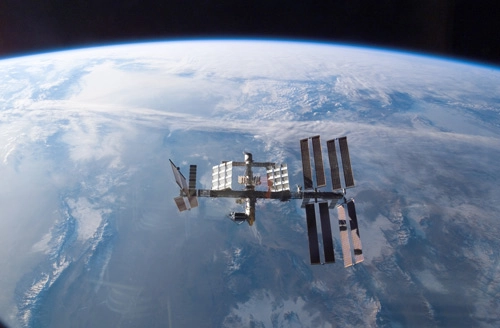
WASHINGTON-- NASA's attempt to finish the International Space Station by the time itretires its space shuttle fleet in two years would require much to happen andvery little to go wrong, a congressional auditor told lawmakers Thursday.
"It will be a challengefor NASA to complete the space station by 2010 given the compressednature of the schedule, maintenance and safety concerns, as well as eventsbeyond its control, such as weather," said Cristina Chaplain of theGovernment Accountability Office, the investigative arm of Congress.
Chaplain testified beforethe House Science and Technology Subcommittee on Space and Aeronautics.

Its chairman, Rep. MarkUdall, a Colorado Democrat, said he was impressed with the space station'sprogress but expressed concern over how NASA plans to sustain the project afterthe shuttle's retirement.
"If we are to receivea meaningful return on the nation's investment in the ISS, we need to ensurethat the station's post-shuttle logistics resupply needs are adequately funded,"he said.
Chaplain said that for NASAto finish the space station within the next two years, the agency must stick toits current aggressive schedule -- just slightly less demanding than the one itpursued prior to the Columbiadisaster. At the time of the 2003 accident, NASA launched a shuttle aboutevery other month and used four vehicles -- one more than its current fleet --to maintain its schedule.
Ten more flights arescheduled before NASA retires the shuttle in 2010. That schedule includes twocontingency" missions that would deliver critical spare parts to thestation.
Chaplain pointed out thatonce the space station is finished, NASA will have a hard time supplying itbecause there won't be spacecraftlarge enough to carry necessary cargo.
The agency will be relying heavilyon the Russians, and eventually on the Europeans and Japanese, to supplyvehicles that can servicethe space station once the shuttles retire. But, she noted, none of thosevehicles are capable of bringing cargo back.
Chaplain also noted thatNASA must complete the space station to expand its scientific research.Currently, most of the crew's time is spent maintaining the station, as opposedto conducting experiments.
According to NASA, the crewspends no more than three hours per week on science, she said.
Rep. Dana Rohrabacher, aCalifornia Republican, noted the testimony of several scientists who spokeabout the medical research taking place because of the space station.Rohrabacher said he viewed himself as a great supporter of the space station,but he doubts whether any of the scientific accomplishments mentioned have beenvalidated.
"I've heard a lot ofrhetoric today. I've been listening to that rhetoric for 20 years," hesaid. "I'm satisfied with the fact that we now have capabilities ofbuilding structures in space. I would hope they're not just pyramids. . . . Ihope there is something that comes out of it in terms of a cure for a disease.Believe me, I've been listening to that for 10 years, I haven't seen ityet."
- VIDEO: Orbital Arrival: Europe's Jules Verne ATV Arrives at ISS
- VIDEO: Europe's Special Delivery to Space Station, ATV Mission Control
- VIDEO: Part 1: Europe's First ISS Cargo Ship, Part 2
Published under licensefrom FLORIDA TODAY. Copyright: 2008 FLORIDA TODAY. No portion of this materialmay be reproduced in any way without the written consent of FLORIDA TODAY.