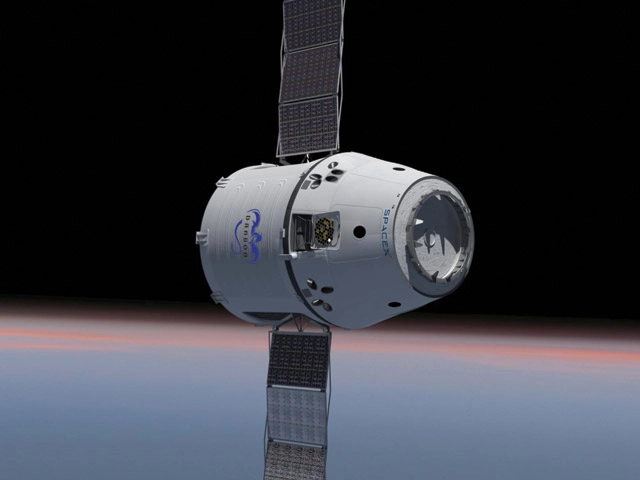
WASHINGTON -Space Exploration Technologies(SpaceX) held an invitation-only meeting at its Hawthorne, Calif.-basedheadquarters on Friday for potential customers of its new DragonLab,a free-flying version of the reusable Dragon capsule the company is buildingfor International Space Station resupply missions.
?We?re committed to flying it,? MaxVozoff, SpaceX?s Dragon product manager, said in an Oct. 29 interview here.Vozoff said SpaceX?s message to attendees of the DragonLab userconference would be pretty straightforward: ?It?s a commercial mission flyingwith or without you,? he said. ?There are slots available if you want to comealong.?
Between 40 and 50 scientists, engineers and other technical expertsfrom government, industry and academia were expected to attend and learn about DragonLab during today's event.

So far,SpaceX has lined up at least one customer for the first DragonLab flightplanned for 2010. Although Vozoff would not tell Space News anythingabout its anchor customer, SpaceX told other space officials here that it hadsigned up a classified U.S. government customer for DragonLab?s debut.
Designed tolaunch atop the Falcon 9 rocket SpaceX has in development for a planned 2009debut, the DragonLab can accommodate up to 13,227 pounds (6,000 kg) of pressurizedand unpressurized upmass and up to 6,613 pounds (3,000 kg) of downmass,according to a SpaceX specifications sheet. DragonLab is designed for a waterrecovery off the California coast.
Vozoff saidDragonLab missions could last from one week to two years, depending on customerinterest. After its initial flight, SpaceX hopes to fly DragonLab once or twicea year.
SpaceX has just begun to briefprospective customers on DragonLab, with Vozoff making recent visits to NASA?sAmes Research Center, Goddard Space Flight Center, Jet Propulsion Laboratory?and Johnson Space Center to discussthe concept and assess interest. He said SpaceX also is seeing substantialinterest in DragonLab from the U.S. Defense Department.
Differences between DragonLab andthe reusablecapsule SpaceX is vying to sell to NASA for cargo missions and eventuallycrewed flights are minor, according to Vozoff, and have mainly to do withinternal outfitting and onboard power.
In additionto the seven to?10 cubic meters of pressurized spaceavailable inside the Dragon?s recoverable main capsule, the proposedconfiguration includes an unpressurized trunk offering 14 cubic meters ofpayload capacity to experiments that need not be returned. Vozoff saidDragonLab is well suited ?for people who have flown or want to fly mid-decklocker experiments? on the space shuttle or space station.
SpaceX is confidentthat there is a market for DragonLab. Vozoff cited an Oct. 16 presentation tothe NASA Advisory Council by NASA?s assistant associate administrator for theinternational space station, Mark Uhran, to back up his claim that a biotechbreakthrough aboard the station could touch off a ?gold rush? in microgravityresearch that SpaceX, with DragonLab, would be well positioned to capitalizeon.
SpaceX hasyet to demonstrate a successful Falcon 9 flight. The company had its firstlaunch success in late September with an apparently flawless flight of themuch smaller Falcon 1. The company is on track to deliver its first Falcon 9 toCape Canaveral, Fla., early next year for its maiden launch on behalf of anunnamed U.S. government customer.
- Video - SpaceX?s Falcon 1 Rocket Success!
- Video - NASA Destroys Suborbital Rocket
- Future of Flight: Space Tourism, Investment and Technology