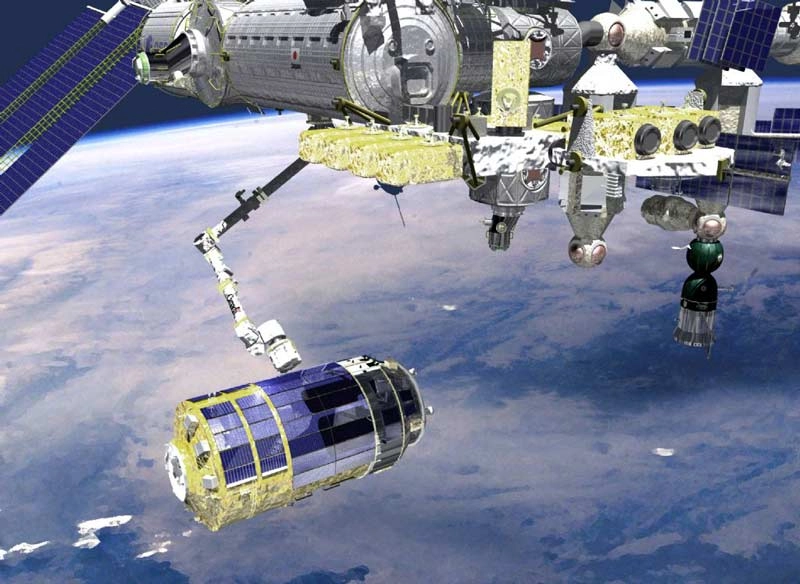
Japan's first unmanned cargo ship is on track to arrive Thursdayat the International Space Station (ISS) to deliver precious supplies andscience experiments.
The H-2Transfer Vehicle (HTV-1), which launchedSept. 10, is doing well and has been performing nominally so far, said MatsuoNaoko, spokesperson for the Japanese Aerospace Exploration Agency (JAXA).
"We conducted demonstration tests on last Saturday, Sept.12," Matsuo told SPACE.com. "It did very well, so the mission managementteam will review the data of demonstration tests and they will decide whether wewill 'go' or 'not go' to the space station."
Once HTV-1 arrives at the ISS, it must be grabbed byastronauts controlling the station's robotic arm. The cylindrical freighter isdue to stay at the orbital outpost for about 40 to 45 days, and then be let goto burn up in the Earth's atmosphere during re-entry.
Among the 3.5 tons carried by the cargo ship are scienceexperiments to go in the station's Japanese Kibo laboratory, which contains anoutdoor exposed facility as well as indoor pressurized compartments. The HTVcraft isunique in its ability to transport items meant for both inside and outsideenvironments.
"We have two big exposed facility payloads," Matsuosaid. "One is a NASA payload and one is a JAXA payload. And in the pressurizedsection many crew items, food and clothes are packed."
The successof this ship is especially important given the expected retirement of thespace shuttle fleet in the next year or two. After that, the HTV will join Europe'sAutomated Transfer Vehicles and the Russian Progress spacecraft as the mainsources of cargo transport to the ISS.
- Video - Japan's Spaceship Dreams: Part 1, Part 2
- Video - Inside Japan's New H-2B Rocket
- Video - Maiden Flight of Japan's Space Freighter

