





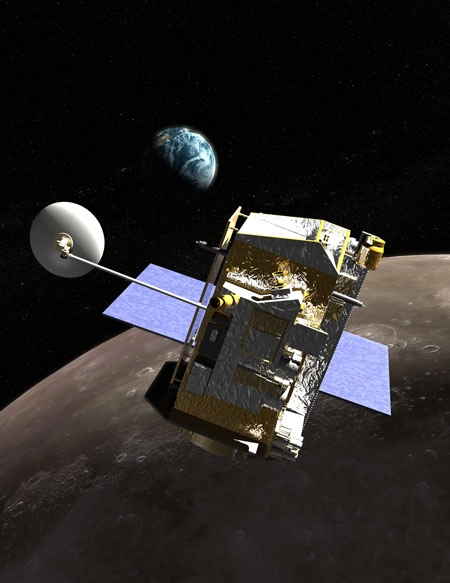
A powerfulrobotic lunar scout, NASA?s first in more than a decade, arrived at the moon early Tuesdayon a mission to seek out potential landing sites and hidden water ice forfuture astronauts.
NASA?sLunar Reconnaissance Orbiter (LRO) fired its thrusters at 5:47 a.m. EDT (0947GMT) in a 40-minute maneuver to begin orbitingthe moon. It is NASA?s first unmanned moon shot since 1998.
?We are inlunar orbit,? said LRO project scientist Richard Vondrak at NASA?s GoddardSpace Flight Center in Greenbelt, Md. ?We?re not going past the moon. We?rethere to stay.?
About thesize of a Mini Cooper car, the $504 million LRO probe launched toward the moonon June 18 and spent four days in transit - about a day longer than astronautson the Apollo missions in the late 1960s and early 1970s. The robotic probe isexpected to spent at least one year mappingthe moon for future manned missions, as well as several more yearsconducting science surveys.
?LRO hasreturned NASA to the moon,? a flight controller said as NASA?s LRO mission controlcenter erupted in applause. The probe's lunar arrival comes just under one month ahead of the 40th anniversary of NASA's first moon landing by Apollo 11 astronauts on July 20, 1969.
Thespacecraft carriesseven instruments to map the moon in unprecedented detail, seek out waterice hidden in the permanent shadows of craters at the lunar south pole, andmeasure the temperature and radiation hazards future astronauts may face. Thenames of 1.6 million people are also riding aboard LRO as part of a publicoutreach program.
LRO iscurrently circling the moon in an extremely elliptical orbit that brings thenearly 2-ton probe within about 124 miles (200 km) of the lunar surface at itsclosest and reaches out to 1,863 miles (3,000 km).
?It wentlike clockwork,? said Craig Tooley, NASA?s LRO project manager. ?In the end, itwent exactly as planned.?
Over thenext few days, more thruster firings should fine-tine the spacecraft?s flightpath until it reaches its planned observation orbit of between 31 and 135 miles(50 to 218 km). Two of LRO?s seven instruments, a pair of radiation sensors,scanned the space environment between the Earth and the moon, with theremaining five instruments to be activated in the next few weeks.
The firstimages from the powerful camera aboard LRO should be beamed back to Earth inthe next few weeks, mission managers said.
?This wholenew moon we?re ready to see is out there waiting, and this mission is going togo get it,? said Jim Garvin, NASA?s chief scientist at Goddard.
A secondunmanned spacecraft, the $79 million Lunar Crater Observation and SensingSatellite (LCROSS), also launched with LRO and is expected to slingshot pastthe moon later today at about 8:20 a.m. EDT (1220 GMT). The spacecraft and anattached empty Centaur rocket stage will fly by the moon and shift into a polarorbit that will ultimately end in an Oct. 9 crash into a shadowed crater at themoon?s south pole to probe for hidden water ice.
NASA plansto release live video from LCROSS as it flies past the moon at a distance ofabout 5,592 miles (9,000 km), mission managers have said.
Click here for NASA's streaming video of the LCROSS lunar flyby.
- Video - LRO?s Road to the Moon
- New Video - Target Moon: NASA?s New Lunar Scouts, Part 2
- Image Gallery - Full Moon Fever
