





This story was updated at 11:59 p.m.EST.
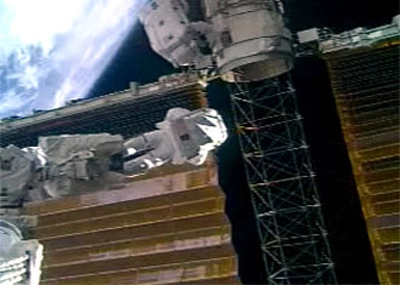
HOUSTON -- A reluctant solar wing isfinally furled atop the International SpaceStation (ISS) after two spacewalkingastronauts poked and prodded it with tape-covered tools.
Veteranspacewalker RobertCurbeam and crewmate ChristerFuglesang spent just over six and one half hours freeing snags on the half-furledarray as, bit by bit, its two solar blankets folded into their storageboxes.
"You guysare doing very great work today," Discovery pilotWilliam Oefelein, who choreographed the unplannedextravehicular activity (EVA) from the shuttle's flight deck, told thespacewalking astronauts. "We're not even going to eat you're lunches."
Applauserang out across the communications link between Mission Control, Discovery and the spacewalkingduo as the stubborn array's boxes closed for the first time in six-years atabout 6:54 p.m. EST (2354 GMT).
"Yes!"Curbeam said just before the applause.
But thesolar wing played one last card: some guide wires failed to reel in completelyduring the retraction, forcing Curbeam to move in and gently tug them with apair of spaceworthy needle nose pliers. The pliers and other tools used wereinsulated from electric shocks by the liberal application of translucent orangeKapton tape [image1, image2].
"RobertCurbeam, you do good work," NASA astronaut Steve Robinson in Mission Controlsaid when the guide wires were cleared.
About 30minutes later, the solar array boxes were latched and locked.
"Congratulations,"Fuglesang radioed down to flight controllers here at NASA's Johnson Space Center.
Today's six-hour,38-minute spacewalk began at 2:00 p.m. EST (1900 GMT) [image].
Curbeam seta new shuttle record during the EVA as the first astronaut to make fourspacewalks in a single orbiter flight. Today's EVA marked Curbeam'sfourth of the STS-116mission and his seventh overall, hurling him from 13th to fifthplace in the annals of total spacewalking time with 45 hours and 34 minutes ofspacesuit-ed work.
Fuglesang,who participated in three of the four STS-116 spacewalks, racked up 18 hoursand 14 minutes while his fellow astronaut SunitaWilliams performed in one for a total of seven hours and 31 minutes.
Thespacewalkers also installed a newpiece of the ISS and rewiredthe orbital laboratory's power grid during the STS-116 mission.
Solarwing showdown
Monday'ssolar array showdown began Dec. 13, when astronauts aboard Discovery and theISS firstattempted to retract the portside member of two wings extending from the mast-likePort 6 (P6) truss some 90 feet (27 meters) above the station [image].
The115-foot (35-meter) solar wing, designated as P6-4B, repeatedly foldedimproperly as it was pulled in remotely for the first time since its December2000 installation [image].Snags between guide wires and the metal eyelets, or grommets, they threadthrough were cited as the source.
Attempts towigglethe snags free by moving the solar array, as well as sending vibrations upthrough the ISS by a vigorously exercising astronaut, failed though physicallyshaking the wing using two spacewalkers' hands and a bit of elbow grease metwith some success on Saturday [image].
It was thenthat mission managers officially added today's unplanned spacewalk to theSTS-116 mission.
"The entire EVA was put together over a course of a coupleof days," said Tricia Mack, NASA's lead STS-116 spacewalk officer, adding thatnot only had Curbeam never trained to work from theISS robotic arm on this flight, but that mission controllers scrambled to comeup with a safe and doable plan. "Normally we train for a year and a half, is a typical flow."
The P6solar arrays must be retracted before the massive station segment is hauledfrom its current location to the portside edge of the orbital laboratory's maintruss next year [image].Mission managers were also concerned thatleaving the P6-4B array half-furled could leave the wing's mast open to damageduring future ISS reboost maneuvers.
S
While Fuglesang floated freely at the base of the P6-4B array,shaking it at times to free snags. Curbeam flicked stuck grommets with his adhoc tools from the tip of the space station's robotic arm [image],which was controlled by Williams and STS-116mission specialist Joan Higginbotham.
"There is just no replacing eyeballs and hands in space," Currysaid.
Shuttledeparture delayed
Monday'sspacewalk delayed Discovery's undocking from the ISS by a full 24 hours and ledmission managers to giveup one of two spare days typically reserved in case weather or glitches preventan on-time landing.
Initiallyslated to undock today, Discovery and its seven-astronaut crew will now departthe ISS Tuesday at 5:09 p.m. EST (2209 GMT) with landing set for Friday, Dec.22.
PhilEngelauf, NASA's mission operations representative, said Discovery will undockfrom the ISS slightly later than typical orbiter departures to give the STS-116crew additional time to ferry all the spacewalking equipment used today intothe orbiter.
The shuttleastronauts, meanwhile, said they hoped to find some time during theiradditional day to soak up their orbital surroundings.
"The extra dayis just wonderful," Higginbotham told television reporters Sunday. "Maybe I'llhave a little more free time to look out the window."
- Images: The Spacewalks of NASA's STS-116
- Images: Discovery's STS-116 Launch Day Gallery
- STS-116 Video: Power is Everything
- STS-116 Video: Building Blocks
- Mission Discovery: The ISS Rewiring Job of NASA's STS-116
- Complete Space Shuttle Mission Coverage
- The Great Space Quiz: Space Shuttle Countdown
- All About the Space Shuttle
