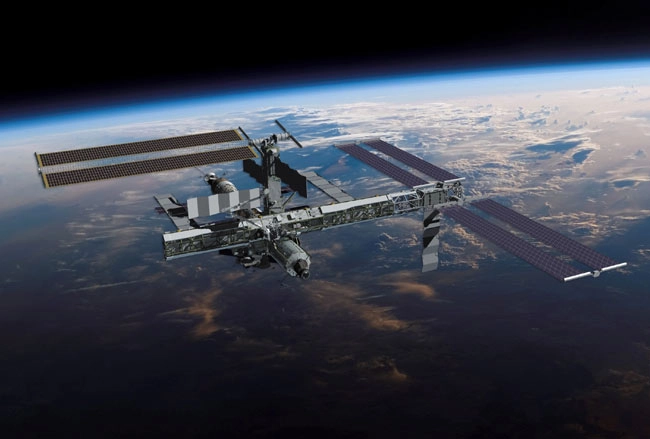
HOUSTON--Astronauts aboard the International SpaceStation (ISS) are due to reel in one of the orbital laboratory's expansivesolar wings as part of power grid overhaul by avisiting shuttle crew.
The joint crews of the station's Expedition14 mission and NASA's spaceshuttle Discovery will retract one of two 115-foot (35-meter) arraysextending from the Port6 (P6) truss that currently sprouts up mast-like above the ISS.
"We're looking forward to a greatday with the P6 solar array retract tomorrow," Discovery's STS-116commander Mark Polansky told flight controllersearlier today, just before his crew went to sleep at 2:17 a.m. EST (0717 GMT).

Much is at stake for today's P6solar array retraction.
The power-generating wing must bereeled in at least 40 percent so that it does not block another set of solararrays--which sprout perpendicular to P6's panels from the station's Port3/Port 4 (P3/P4) truss--from rotating like a paddlewheel to track the Sun later today.
Those P3/P4 arrays arrivedat the ISS in September and are expected to serve as the station's primary powersource until new solar wings arrive next year and the P6 truss is relocated toits final position at the tip of the Port 5(P5) spacer segment, which itself wasinstalledTuesday by STS-116spacewalkers.
John Curry, NASA's lead ISS flightdirector during Discovery's STS-116mission, said mission controllers will power down the obstructing P6 solararray at about 9:00 a.m. EST (1400 GMT), with the initial retraction beginningat about 1:25 p.m. EST (1835 GMT).
The P6 solar arrays have beenextended and generating power sinceDecember 2000, when they were installed during NASA's STS-97mission aboard the shuttle Endeavour. Neither of the solar wings have everbeen reeled back in, a process ISS flight controllers have compared torefolding a crusty old map back into its original compact form.
"I feel anxious, I think is theright word," Curry said late Monday, adding that he and his team have spentfour years preparing for the next four days of work at the ISS. "I don't knowthat it won't go perfect, but I can tell you for sure that this team hastrained as well as we possibly can to manage it."
Curry said that the P6 retractionwill be directly overseen by astronauts aboard the ISS and Discovery, withflight controllers giving them signals proceed as theysee fit at various stages.
Built by Lockheed Martin, the P6solar arrays, their P3/P4 counterparts, as well as two still unflown solar wings destined for the space station'sstarboard side, are affixed to an erector set-like mast that is split into 31 ?bays.
Curry's plan is to initially havethe ISS and Discovery's astronauts retract P6 about three bays worth, pause toevaluate its stability, then reel the solar wing downto one bay before finally securing them closed.
If the P6 solar array fails toretract automatically, STS-116 astronauts could be called upon to stage aspacewalk in an attempt to reel it in manually, or latch and lash tight itssolar blanket boxes. If the panel jams fast, the astronaut would then have todiscard it completely.
"I would consider a jettisonunlikely," Curry said. "We don't want to lose that solar array if we don't haveto."
The P6 solar array retraction marksthe start of an intense four-day series of ISS construction to overhaul theorbital laboratory's power system.
On Thursday, STS-116 spacewalkers RobertCurbeam and Christer Fuglesang are due todon their spacesuits for the second time this week to reroute two of four powerchannels to plug into the P3/P4 solar arrays. The remaining two channels aredue to be routed in a planned Saturday spacewalk by Curbeamand ISS astronaut Sunita Williams, who arrived at the station aboardDiscovery this week,
- Images: Discovery's STS-116 Launch Day Gallery
- STS-116 Video: Power is Everything
- STS-116 Video: Building Blocks
- Mission Discovery: The ISS Rewiring Job of NASA's STS-116
- Complete Space Shuttle Mission Coverage
- The Great Space Quiz: Space Shuttle Countdown
- All About the Space Shuttle
