





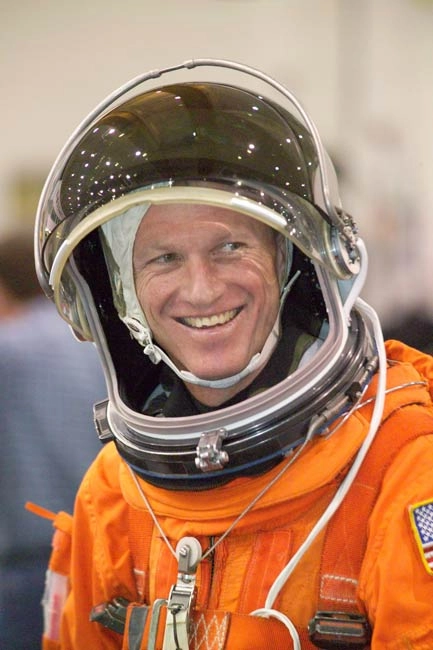
The space shuttle Atlantis will havea mix of hands-on experience and first-time enthusiasm at its helm when the spacecraft launches toward the International SpaceStation (ISS) on Sunday.
In thecommander's seat will be NASAastronaut Brent Jett, a three-time shuttle flyer who has already led onemission to deliver power to the ISS. His pilot is ChrisFerguson, an accomplished U.S. Navy aviator, who will reach space for the firsttime during Atlantis' STS-115mission to jump start ISS construction.
NASA's STS-115 Crew Stats |
| Find out more about Atlantis' STS-115 crew:Commander: Brent Jett Pilot: ChrisFerguson |
"You know,we have to finish the station," Jett said in an interview. "I think that thisis the first return to assembly, and there's a little more scrutiny or a littlemore focus on it."
Jett,Ferguson and their four STS-115crewmates are poisedto launch toward the ISS at 4:30 p.m. EDT (2030 GMT) on Aug. 27. NASA'sthird shuttle flight since the 2003Columbia accident, the mission will deliver the first major addition - thePort 3/Port 4 (P3/P4) truss and solar panels - to the space station sinceNASA's STS-113flight launched in November2002.
Solararray veteran
A captainin the U.S. Navy, Jett, 47, hails from Ft. Lauderdale, Florida and joinedNASA's astronaut ranks in 1992. He admits that human spaceflight was not alwayson his to-do list even though the early Mercury, Gemini and Apollo astronautswere among his childhood heroes.
"But I didnot have that revelation at that early age that some day I'm going to be anastronaut," Jett said in a NASA interview. "It just didn't seem like it waseven a possibility for me."
It was theNavy that led Jett to NASA. He graduated from the U.S. Naval Academy in 1981 asthe first in a class of 976 and was designated a Naval Aviator two years later.
After nineyears as a test pilot, Jett visited NASA's Johnson Space Center astronauttraining center and decided to pursue a spaceflight career. He served as apilot aboard Endeavour during NASA's STS-72 mission in 1996, then again oneyear later during Atlantis' STS-81 flight to Russia's Mirspace station.
Jett'scommanded his third shuttle flight - STS-97aboard Endeavour in November 2000 - to deliver the first U.S.-built solararrays to the ISS. The mission hit a snag when parts of the first solar panel stucktogether while being deployed, forcing a spacewalkrepair.
"Of course,we were pretty disappointed," Jett recalls of that last flight. "We felt likemaybe we could have done things a little better had we waited [for sunlight towarm the array], which is kind of what we're going to do now."
Keeping theSTS-115 crew together and fit for flight across more than four years oftraining and delays has been the greatest challenge for Jett.
"We were 12weeks from flight when the Columbia accident occurred...we were pretty much asready as we needed to be," Jett said this month. "If you're with a group offolks for an extended period of time you become really like family."
Jett, whois married to wife Janet, told reporters that while human spaceflight is arisky pursuit, there are positive returns on many levels.
"It's alsoa very personally rewarding experience," Jett said. "Hopefully, once wecomplete the station, the benefit to folks here on Earth will be worth it.
"When youcompare the risks that we take to some of the risks that our colleagues in theArmed Forces are faced with on a daily basis, I'm not sure you can compare thetwo," he added.
Fly-arounddreams
Like Jett,Ferguson - who answers to the nickname "Fergie" - is also a veteran Navy testpilot and sidelines as the drummer for the all-astronaut rockband Max Q. But alas, he said, he'll leave his drum sticks on Earth duringSTS-115.
"I one more[personal item] left and they said that a pair of drum sticks was two items,"Ferguson, 44, said in an interview this month. "So I had to leave the drumsticks back."
A native ofPhiladelphia, Pennsylvania, Ferguson joined NASA's astronaut corps in 1998 andhas spent more than four years training for his first flight, which was delayedas NASA recovered from theColumbia accident.
"Well, thisis as close we've ever been," Ferguson said of his upcoming launch. "Of courseI'm anxious, it's my first flight. If anybody told you they weren't anxious ontheir first flight, they'd be lying to you."
Ferguson israising three children with his wife Sandra, all of whom are currentlypreoccupied with the upcoming school year and not their father's impendingspace shot. But the 23-year veteran Navy pilot knows that they have a hardlaunch day ahead when they watch him rocket spaceward aboard Atlantis.
"Isympathize with my wife, she's going to have to put up with that," Fergusonsaid, adding that he's discussed the risks of spaceflight with his family."We've talked about the things you'd expect."
Butresuming ISS construction, he said, is vital not only to fulfill NASA'sinternational partner obligations, but also to push human space explorationforward.
"I'd liketo think we're going to end up on the Moonon at least a semi-permanent basis, and that's a good thing," Ferguson said ina NASA interview. "There's [a] lot to be gleaned from the Moon."
Morethan an orbital housekeeper
Fergusonhas likened his much of his Atlantis pilot duties that of shuttle housekeeper,but he also serves as backup robotic arm operator during the STS-115 mission'svital orbiter heat shield inspections, as well as the P3/P4 truss delivery.
"Shuttlepilots are often the overlooked crewmember on flights," Jett said of hiscrewmate. "But I'll tell ya, if I was allowed to pick a pilot to fly with, Icouldn't have picked a better person than Chris Ferguson. Not only is he veryprofessionally confident, he's just a great guy to have around."
But the personalhighlight, Ferguson said, comes when Atlantis undocks from the ISS. If theshuttle's fuel supply is ample enough, Ferguson will get a chance to fly theorbiter around the ISS while his crewmates photograph what is expected to be a dramaticallydifferent space station with the newsolar arrays unfurled.
"I'mexcited," Ferguson said. "I like to think that we're going to get some greatshots."
- VIDEO: Shuttle Commander Brent Jett
- Complete Space Shuttle Mission Coverage
- NASA's STS-115: Shuttle Atlantis to Jump Start ISS Construction
- The Great Space Quiz: Space Shuttle Countdown
