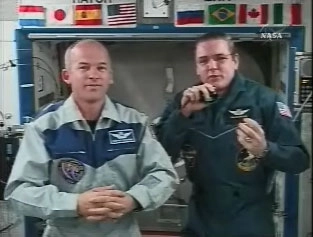
Spacestation commander Bill McArthur said Wednesday that he is looking forward to asteaming cup of coffee on Earth now that he and four other astronauts havepassed the midpoint of a week-long orbital crew swap.
"The verynext thing I'd like to do is smell a cup of coffee," McArthur told the AssociatedPress Wednesday during video link broadcast on NASA TV, adding that hehopes to see his family first. "It's just an absolute thrill and joy to liveand work in space, but we miss the richness, the texture, the three-dimensionalnature of living on our home planet."
McArthurhas lived aboard the International Space Station (ISS) with Russian cosmonautValery Tokarev for six months during their Expedition 12 mission.The two astronauts will handcontrol of the ISS over the Expedition13 commander Pavel Vinogradov and flight engineer Jeffrey Williams - who arrivedearly April 1 with Brazilian astronaut MarcosPontes - before returning to Earth with Pontes on April 8.

"It's a lotlike if you were to buy a new house and you're moving in...except in this casethe former owners are still there and they're still living in it, their closetsare all full and they're not going to clean it up," Williams told the HoustonChronicle of the handover process Wednesday. "It never occurred to me howdifficult that would be to move in to somebody's house with all their stuff init and then pick up without a pause in the normal day-to-day operations."
Airlockcampout details
McArthurand Williams, both NASA astronauts, spent a portion of Monday night sealedinside the space station's U.S.-built Questairlock during a test of spacewalk preparation procedures to flush nitrogenfrom the human body. The measure, in which astronauts sleep at a loweratmospheric pressure than that inside the rest of the ISS, could shave up toone hour off the typical time it takes astronauts to prepare for U.S.spacewalks, but the Monday night test was cut short due to a pair of apparentlyerroneous alarms, NASA said.
"We werenever in any danger," McArthur said of the airlock campout. "There was neverany problem with the [airlock's] atmosphere."
A softwareglitch led to two inadvertent alarms, the second of which awoke the two NASA astronautsand prompted NASA ISS flight controllers to call off the overnight airlocktest, NASA said.
"They wereworried about us getting a good night's sleep," McArthur said.
NASAofficials said Wednesday that the three primary goals of the airlock campoutwere met, despite the abbreviated test. Those goals included checking theperformance of an atmosphere-watching device called a mass constituencyanalyzer during a rapid sampling phase as the airlock depressurized, anauto-sequence mode to check the environments of multiple ISS modules -including the Quest airlock - and the collection of data on the actual campoutprocess itself.
Flightcontrollers are now looking through that data to determine whether anothercampout test will be required before the process is used in earnest duringNASA's upcoming STS-115 shuttle mission - slated to fly no earlier than lateAugust - to install new solar arrays outside the station, the space agencysaid.
Roboticarm training
TheExpedition 12 and Expedition 13 astronauts spent part of Wednesday trainingwith the space station's robotic arm, while Tokarev used the day to pack theSoyuz TMA-7 spacecraft that will return him, McArthur and Pontes to Earth.
Earlier, McArthurand Tokarev tested the satellite phone they will use after landing Saturday onthe steppes of Kazakhstan in Central Asia. The two astronauts are alsofamiliarizing their Expedition 13 counterparts with the location of items inthe space station's numerous compartments.
"Jeff andPavel are definitely ready to take over," McArthur said of the Expedition 13crew, which is beginning its own six-month mission.
As thejoint space station crews continue their handover activities, Pontes - Brazil'sfirst astronaut - is engaged in a full schedule of science experiments andvideo conferences.
Pontes, whocarried Brazil'snational flag, stamps,coins and other objects from his native country into orbit, is expected tospeak with Brazilian President Luiz In?cio Lula da Silva today via aspace-to-ground video link, according to the Brazilian Space Agency (Ag?nciaEspacial Brasileira, or AEB). He is also expected to speak to a group of 250children and Brazilian journalists during a pair of planned video conferenceslater this week, AEB officials said.
Pontes isspending 10 days in space - eight of them aboard the ISS - and will return toEarth with the Expedition 12 crew at 7:46 p.m. EST (2346 GMT) on April 8.
- Brazilian Stamps, Coins Fly Aboard ISS with Nation's First Astronaut
- ISS Airlock Camp Out Cut Short by Alarm Glitch, NASA Says
- Complete Coverage: ISS Expedition 12
- Complete Coverage: ISS Expedition 13
