


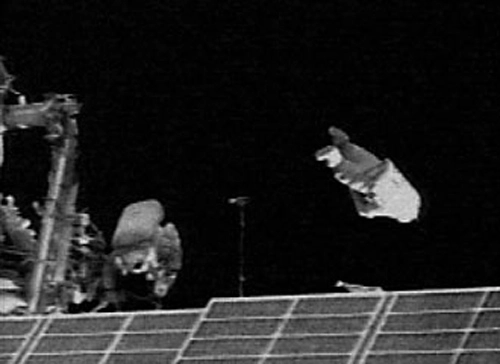
A doomed spacesuit is alone and tumblingthrough space after a Friday spacewalk by two astronautsoutside the International Space Station (ISS).
ISS Expedition12 commander Bill McArthur and flight engineer ValeryTokarev launched the ham radio-equipped spacesuit -an expiredOrlan dubbed "SuitSat" that researchers had hoped would broadcast fordays - at the start of their spacewalk220 miles (354 kilometers) above Earth.
"Goodbye, Mr. Smith," saidTokarev, a cosmonaut with Russia's Federal SpaceAgency, as he shovedthe spacesuit away from the ISS.
Video cameras mounted to theexterior of the ISS watched as the tumbling SuitSatdrifted away.
Less than one hour later, flightcontrollers reported that SuitSat was performing asexpected - though admittedly with a weaker than expected signal - transmittinggreetings to the Earth in five different languages and other data down toEarth. [Click here formore information on the SuitSat experiment.]
"Japan has been listening," veteranNASA astronaut Michael Foale, serving as spacecraft commander, told theExpedition 12 crew. Coincidentally, Foale was thelast astronaut to wear the Orlan spacesuit - during a spacewalkin February 2004 - now orbiting the Earth, NASA officials said.
"Really, that's outstanding," saidMcArthur, who is serving as NASA's science officer during Expedition 12.
But after only two orbits, or aboutthree hours, SuitSat went silent. [Note: Later updates found that the spacesuitwas indeed still broadcasting a signal, albeit very weak.]
"Apparently, the batteries on thespacesuit have either frozen or died," NASA commentator Rob Naviassaid. "SuitSat is no longer being heard by ham radiooperators around the world."
SuitSat will eventually burn up in theEarth's atmosphere in a few weeks' time, NASA officials said.
The Expedition 12 crew tossed SuitSat behind the ISS, in the opposite direction of thestation's relative motion, about 18 minutes after exiting the Pirs docking compartment clad in their own, red-stripedRussian-built Orlan spacesuits at 5:44 p.m. EST (2244GMT). McArthur and Tokarev spent a total of fivehours and 43 minutes walking in space, NASA officials said.
Cable woes
Amid other ISS science andmaintenance tasks, McArthur and Tokarev were alsotapped to safeguard a vital cable against an automated guillotine-like systemattached to the station's Mobile Transporter.
The Mobile Transporter moves muchlike a railcar to transport the outpost's robotic arm, astronauts or massiveISS components - such as solar arrays - across the space station. Two cables,one primary and a backup, transfer power, data and video between thetransporter and the ISS.
But in December, a spring-loadedcutter system designed to fire in the event of a snag inexplicably cut a trailingumbilical cable, leaving the Mobile Transporter with only one workingcable.
McArthur and Tokarevattempted to drive a safing bolt, which would blockthe cutter system from firing into the operable cable system, but were unableto install the bolt completely using power screwdriver-like pistol grip tool.
Instead, the astronauts removed thecable from the cutter system entirely. But while that guarantees the vitalcable will not be accidentally cut, the solution also rendered the MobileTransporter immobile until the cutter system can be replaced or fixed, NASAofficials said, adding that it could a problem for astronauts set to repair thesevered cable during NASA's next shuttle flight - STS-121aboard the Discovery orbiter - to launch later this year.
"It's disappointing that it didn'tgo exactly like we wanted, but that's life in the big city," McArthur saidafter the activity.
Grapplers, biology and photographyin space
SuitSat and the bolt safingwork aside, the rest of the Expedition 12 crew's spacewalk went swimmingly.
McArthur and Tokarevmoved a grapplefixture used to attach Russian-built Strela cargobooms to the ISS from its perch along the station's Zaryacontrol module to a new berth at alongside the PressurizedMating Adapter-3 (PMA-3), where NASA space shuttles dock duringstation-bound flights. STS-121 spacewalkers plan to use the Strelacrane during their upcoming mission.
The Expedition 12 crew alsoretrieved a canister full of microorganisms, part of the Russian experiment Biorisk, and will return it to Earth for researchersstudying the space environment's effect on living creatures.
For their final task, McArthur and Tokarev hauledthemselves hand-over-hand to the aft end of the station's Zvezda service module, where they took detailedphotographs of peeling paint and soot-covered areas discolored by residue fromthe module's thruster firings over the years. Engineers on the ground will goover the images to study the state of the module.
"Thank you Bill, good job," said Tokarev, who served as lead spacewalker during theextravehicular activity, after the astronauts had climbed back inside the Pirs docking compartment.
Friday's spacewalk marked the secondcareer spacewalk for Tokarev and the fourth forMcArthur following a Nov. 7, 2005excursion. Together, the two astronauts have spent 11 hours and fiveminutes walking space during their mission. While that's a total for Tokarev, it brings McArthur up to 24 hours and 21 minutesof orbital work sans spacecraft.
To date, astronauts have performed 64spacewalks to assemble and maintain the ISS, 36 of which were launched from thestation itself with14 of those beginning at the Pirshatch. Humans have spent 384 hours and 23 minutes putting together andrepairing each piece of the ISS since its first component launch in 1998, NASAofficials said.
McArthur and Tokarevhave lived aboard the ISS since October2005, and are slated to return to Earth in early April.
"What a beautiful spacecraft thisis," McArthur said of the station during Friday's spacewalk. "It was anadventure."
- Orlan Overboard: The Suit Behind the Sat
- Astronauts to Toss Spacesuit From International Space Station
- Complete Coverage: ISS Expedition 12
