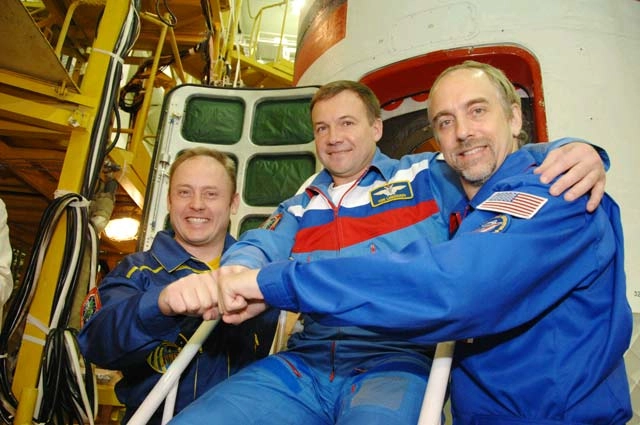
A new crew is poised to launch to the International SpaceStation early Sunday to help outfit the laboratory for double-sized occupancy.
Expedition 18 commander Michael Fincke and flight engineerYury Lonchakov are scheduled to launch aboard a Soyuz TMA-13 spacecraft fromthe Baikonur Cosmodrome spaceport in Kazakhstan Sunday at 3:01 a.m. EDT (0701GMT). Set to join them on the journey is space tourist RichardGarriott, the first American second-generation spaceflyer. His father,former NASA astronaut Owen Garriott, will be watching the launch from theground at Baikonur.
Fincke and Lonchakov are set to begin a six-month stayaboard the orbiting outpost, while Garriot is flying under a $30 million dealbetween Russia?s Federal Space Agency and the Vienna, Va.-based firm SpaceAdventures. He is slated to return Oct. 23 aboard a Soyuz vessel carrying twocurrent space station crewmembers, Expedition 17 commander Sergei Volkov andflight engineer Oleg Kononenko, home to Earth. Coincidentally, Volkov, son ofRussian cosmonaut Alexander Volkov, is also a second-generation space traveler.
Garriot, a a computer game developer from Austin, Texas,will be the 6th space tourist to fly in space. He plans a packed schedule ofscience experiments for his roughly 10-day trip. His father, who flew on the Skylab3 mission in 1973 and rode aboard the shuttle Columbia?s STS-9 trip in 1983,will serve as chief scientist for his son?s mission.
Finckeand Lonchakov are both veteran astronauts: Fincke served as flight engineeron 2004?s Expedition 9 mission to the International Space Station (ISS, whileLonchakov rode aboard the space shuttle Endeavour?s STS-100 mission in 2001,and a Soyuz flight to the station in 2002. Lonchakov, chief cosmonaut atRussia?s Yuri Gagarin Training Center, will serve as commander of Sunday?sSoyuz trip.
When the trio arrive at the space station, there will be noworking toilet aboard. The lone facility at the station brokeon Thursday, forcing the current crew to use the toilet aboard the Soyuzvehicle docked at the lab. When the new flight arrives, its crew use the pottyaboard their own Soyuz, if the toilet is still broken.
Space station expansion
The two are set to join NASA astronaut Greg Chamitoff, anExpedition 17 flight engineer currently aboard the ISS, to help convert thestation to hostsix-person crews, expanded from its current crew compliment of three.
?It?s exciting to be on the 18thexpedition to our beautiful space station, and we are right at the cusp ofgoing from a three-person crew to a six-person crew,? Fincke said in a NASApreflight interview. ?Our crew, Expedition 18, we are ready to make thattransition. It?s going to require several space shuttles to come up and give usthe missing pieces.?
Some necessary supplies and equipment for the transition aredue to be launched aboard the space shuttle Endeavour?s STS-126 flight inNovember, and Discovery?s STS-119 mission in early 2009. Endeavour is alsoscheduled to ferry new Expedition 18 flight engineer Sandra Magnus to thestation, and carry Chamitoff home. Magnus is slated to be replaced by JapaneseAerospace Exploration Agency astronaut Koichi Wakata, arriving on next year?sDiscovery flight.
To get the station ready to accommodate more people, theExpedition 18 crewmembers will help install new sleeping cabins, new kitchenequipment, a new toilet (to supplement the current balky one), and a machine torecycle urine into drinkable water.
?On one hand, the engineer in me says it's probably purerwater than most we've ever drunk before, but on the other hand it's still kindof funny to know where that water's been,? Fincke said. ?But we're a closecrew.?
Fincke and Lonchakov are also scheduled to perform aspacewalk in Russian-built Orlan spacesuits in late December to install newscience experiments.
?The name of the hardware is Explorer Impulse; it isintended for geophysics studies, for measuring velocity of charged particles,for defining parameters of the ambient environment around the station,?Lonchakov said. ?So our objectives are very interesting. They are substantialbut feasible.?
The crew will also be involved in many science experimentsduring their stay in space, with a heavy focus on life sciences research thatcan help pave the way for future manned space exploration missions.
?Those experiments address different biological processesthat take place in zero gravity, how zero gravity impacts the habitableenvironment, plants, animals, those life forms that are expected to be used forfuture interplanetary flights to moon and Mars,? Lonchakov said.
One such project will study a Russian device called abraslet (meaning ?bracelet?) that can be used to gently restrict the flow ofblood in astronauts? legs, and could make the transition to the microgravityenvironment of space more comfortable.
The Expedition 18 crew is set to launch into space onSunday, Oct. 12 at 3:01 a.m. EDT (0701 GMT). NASA will broadcast the launchlive via NASA TV. Click here forSPACE.com's NASA TV feed and space station mission updates.
Richard Garriott is chronicling his spaceflight trainingand mission at his personal Web site: www.richardinspace.com.