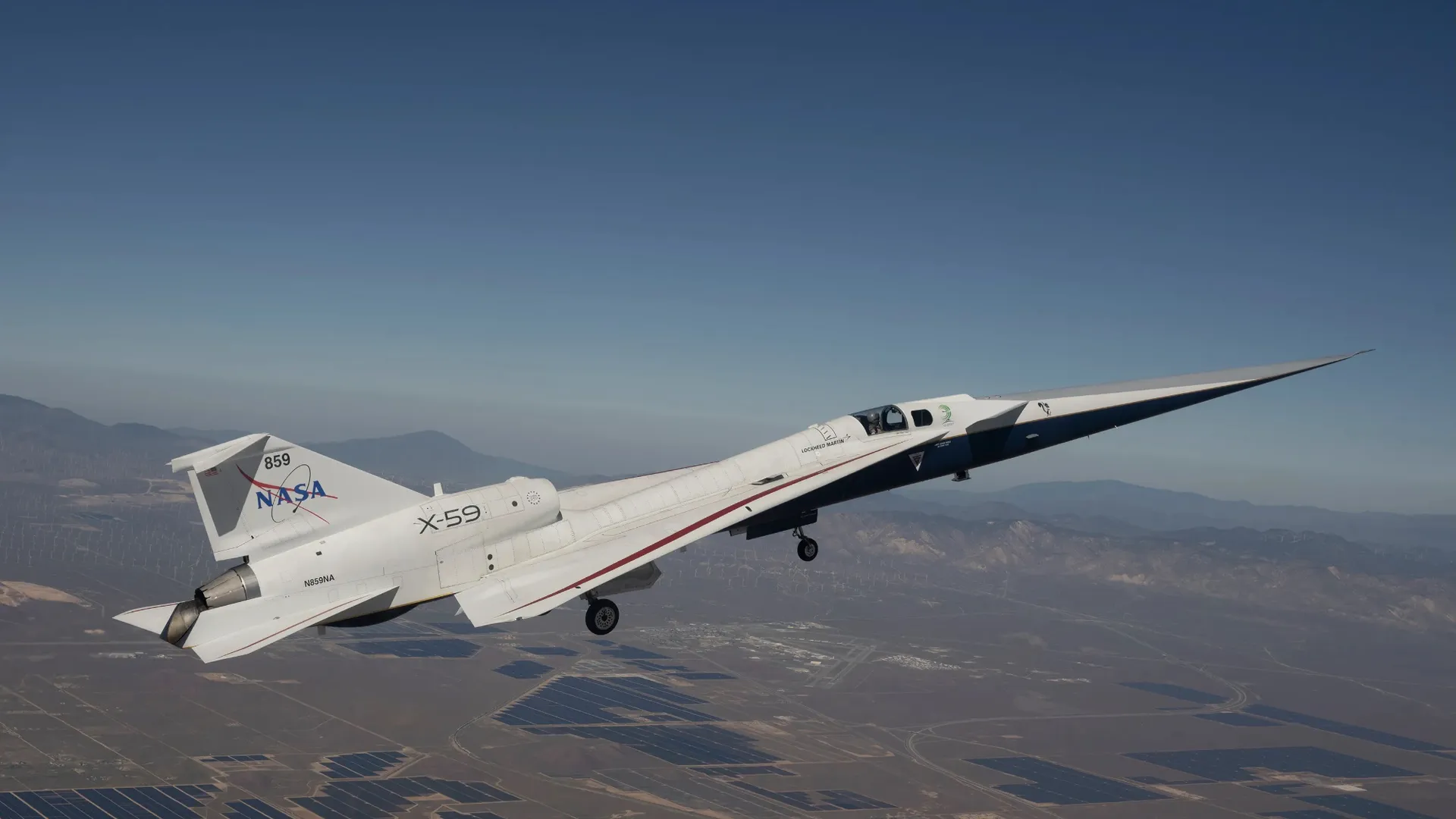
NASA's new supersonic X-59 jet took to the skies for the second time ever on Friday (March 20), but it didn't stay up for long.
The potentially revolutionary X-59 landed just nine minutes after takeoff on Friday, its sophomore effort cut short by a warning light in the cockpit.
"Despite the early landing, this is a good day for the team. We collected more data, and the pilot landed safely," Cathy Bahm, project manager for NASA's Low-Boom Flight Demonstrator at NASA's Armstrong Flight Research Center in Edwards, California, said in a statement on Friday. "We're looking forward to getting back to flight as soon as possible."
Civilian supersonic flights — those that go faster than the speed of sound — have been prohibited over the United States since 1973 due to the disruptive effects of sonic booms. (The speed of sound at sea level is about 761 mph, or 1,225 kph).
NASA hopes to help change that with the X-59, the centerpiece of its Quesst ("Quiet Supersonic Technology") mission. The long-nosed plane is designed to generate mere thumps rather than booms when it goes supersonic.
Using Quesst information, "new data-driven acceptable noise thresholds related to supersonic flight over land can be established, which would open the doors to new commercial cargo and passenger markets to provide faster-than-sound air travel," NASA officials wrote in a description of the program.
The 100-foot-long (30.5 meters) X-59 flew for the first time on Oct. 29, 2025, taking off from Lockheed Martin Skunk Works in Palmdale, California. (The X-59 is a joint effort of NASA and Lockheed Martin.) That 67-minute debut went well, according to NASA: Pilot Nils Larson took it to a maximum altitude of 12,000 feet (3,660 m) and a top speed of 230 mph (370 kph), "precisely as planned."
NASA wanted to "expand the envelope" on the X-59's second flight, which was also expected to last about an hour. Pilot Jim "Clue" Less was supposed to hit those previous altitude and speed marks, then get the jet to 260 mph (418 kph) at 20,000 feet (6,100 m). But that didn't happen.
The X-59 took off from Edwards Air Force Base in Southern California on Friday at 1:54 p.m. EDT (1754 GMT; 10:54 a.m. local time) and landed safely just nine minutes later.
"The takeoff roll and liftoff was uneventful, and we were climbing out, getting ready to set up the first test point, when we got the warning, which required an immediate return to base," Less said during a press briefing on Friday afternoon.
"Although I had not intended to have to land quite as urgently for my first landing, the plane performed beautifully," he added.
It's too soon to say what caused the warning, Quesst team members said during the briefing. A caution — a level lower than a warning — also cropped up about an hour before liftoff involving a separate vehicle system, they added, but that didn't derail the flight attempt.
Both issues are under review, and there's no reason to be too concerned about either one, according to Less.
"This was just the beginning of a long flight-test campaign," he said. "We got data we didn't have before, and there's a lot of flights to come to gather a lot more data."