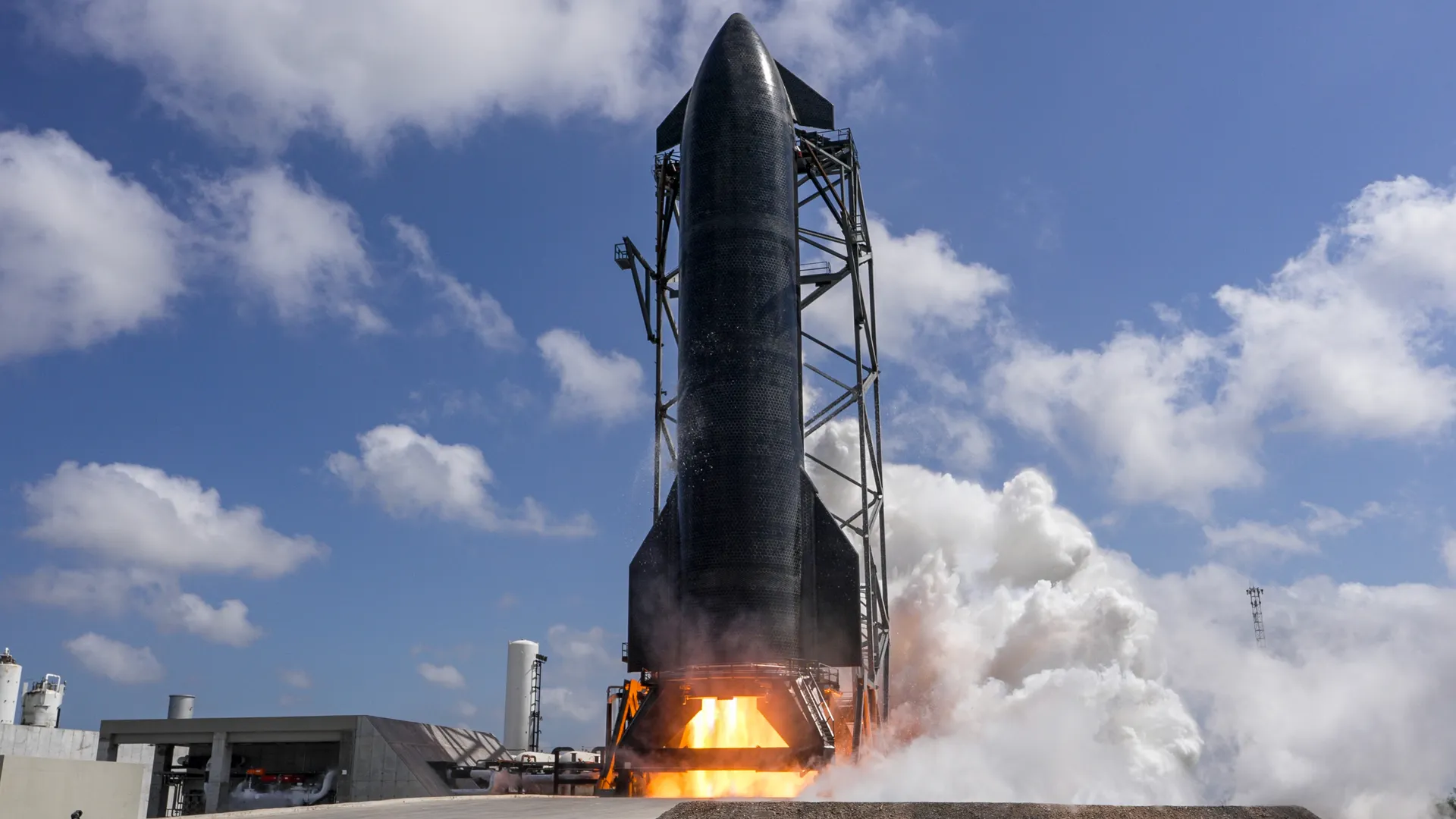
The new, juiced-up version of SpaceX's Starship megarocket just cleared a big hurdle on the path to its first-ever launch.
That liftoff, targeted for early or mid-May, will be the 12th overall for Starship but the first for the vehicle's "Version 3," which is bigger and more powerful than its predecessors.
On Tuesday evening (April 14), SpaceX announced that it had conducted a static-fire test with a Starship V3 upper stage, lighting its engines while the vehicle stayed anchored to the pad.

"Full-duration static fire for the first time on Starship V3," the company wrote via X.
The milestone came four weeks after the first static fire of a Starship V3 first stage, a trial that involved just 10 of the booster's 33 Raptor engines and ended early due to an issue with ground equipment.
When stacked, Starship V3 stands 408.1 feet (124.4 meters) tall — about 4 feet (1.2 m) taller than its immediate predecessor, the V2.
The V3 is also much more powerful, thanks to its new V3 Raptor engines. This latest Starship variant can carry more than 100 tons to low Earth orbit, compared to about 35 tons for the V2, SpaceX founder and CEO Elon Musk has said.
Starship has flown 11 suborbital test missions to date, most recently in October 2025. The five latest launches were performed by the V2.
SpaceX is working to get the megarocket ready for astronaut missions to the moon; NASA selected Starship to be the first crewed lunar lander for its Artemis program.
The agency's Artemis 2 mission just sent four astronauts around the moon and back to Earth. NASA is now gearing up for Artemis 3, which will test docking operations in Earth orbit between the agency's Orion capsule and one or both of Artemis' contracted moon landers — Starship and Blue Origin's Blue Moon.
Artemis 3 is targeted to launch in mid-2027. If all goes well with that mission, Artemis 4 will put astronauts down near the lunar south pole in late 2028, aboard either Starship or Blue Moon.