Residents in the midwestern U.S. reported hearing a powerful sonic boom that has since been attributed to a potential daytime meteor, whose dramatic demise may have been witnessed by a satellite from geostationary orbit over 22,000 miles (35,000 kilometers) above Earth.
"The latest GLM imagery (1301Z) does suggest that the boom was a result of a meteor," wrote the official account for the Cleveland National Weather Service in an X post responding to a curious user. The explosion heard over northern Ohio may have been a sonic boom, produced as the interplanetary visitor passed through Earth's atmosphere at supersonic speeds.
Dr. Jim Lloyd of northern Ohio posted what appears to be footage of the event to X, which clearly shows a bright fireball streaking through the daytime sky at 8:56 a.m. EDT (1256 GMT). The daytime fireball can be seen leaving a glowing trail as it flared Earthward through the cloud-dappled sky.
Video from our bus garage camera. A meteor in the sky. This is authentic. pic.twitter.com/8XhvovGh1zMarch 17, 2026
Another view was captured by Pittsburgh National Weather Service employee Jared Rackley, once again revealing a fireball tearing through the morning sky. Others reported that their homes physically shook as a result of the loud boom.
One of our employees, Jared Rackley, caught this morning's meteor on camera from the Pittsburgh area. pic.twitter.com/2LdqOpChtiMarch 17, 2026
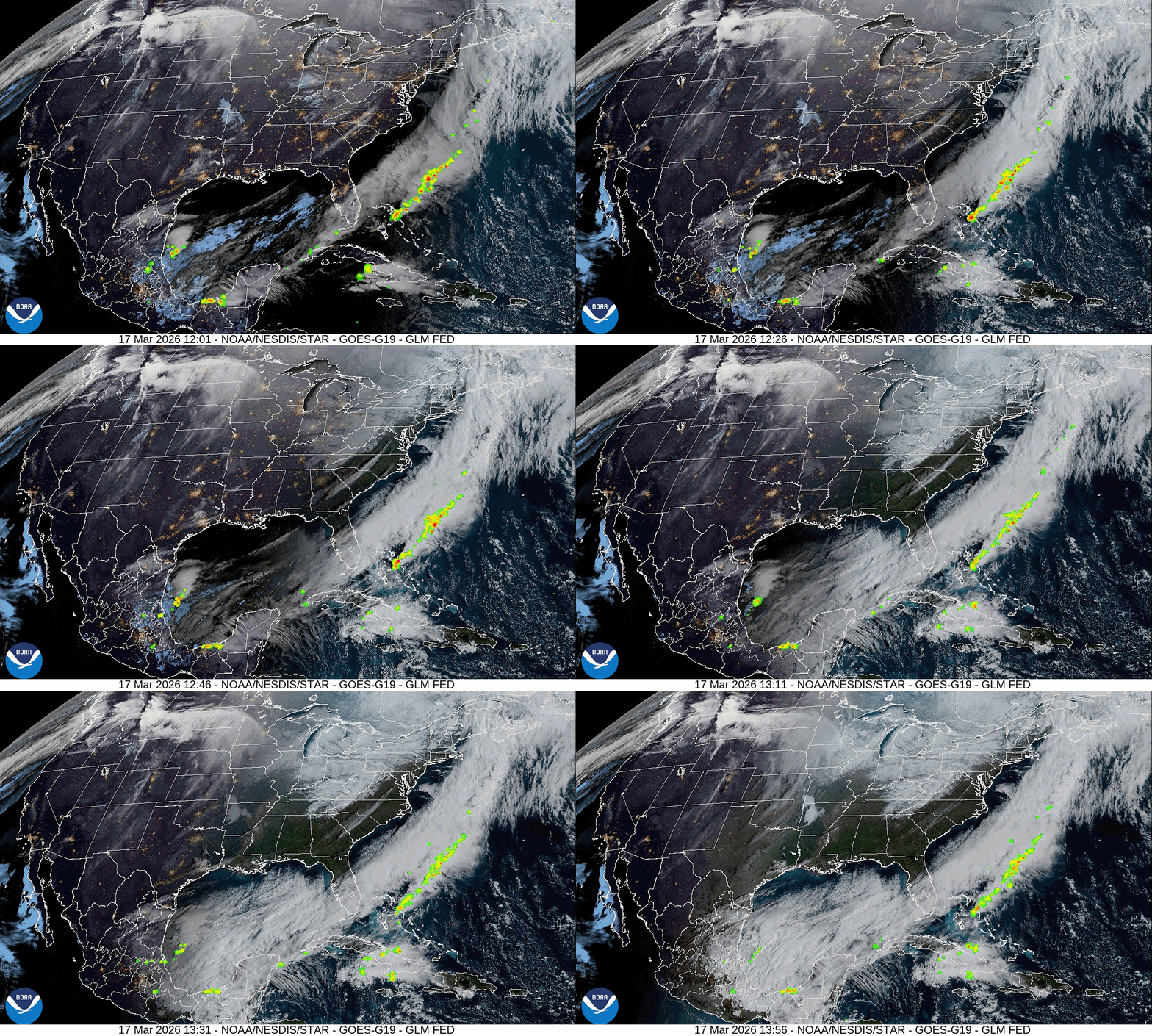
The meteor's passage was also seemingly captured from orbit by the National Oceanic & Atmospheric Administration's GOES-19 satellite, which recorded a bright flash of light above northern Ohio in its Geostationary Lightning Mapper instrument.
Did anything make it to the surface?
It takes a significantly large chunk of space debris — sometimes larger than a beachball — to create a fireball meteor that can be seen in the daytime sky. As such, they are exceedingly rare.
"When an extraordinarily large meteor (beach ball size or larger) enters the atmosphere it often survives down to the lower atmosphere where the air molecules are dense enough to carry sound," Robert Lunsford of the American Meteor Society told Space.com.
"Therefore, folks below the path will hear a sonic boom that is usually delayed by many seconds compared to seeing the fireball. This is also a good indication that the fireball produced fragments on the ground. Our computer generated trajectory indicates that these may have fallen in the vicinity of Akron, Ohio. The source of this object is not yet known, but it is most likely a random occurrence not associated with any known meteor shower."