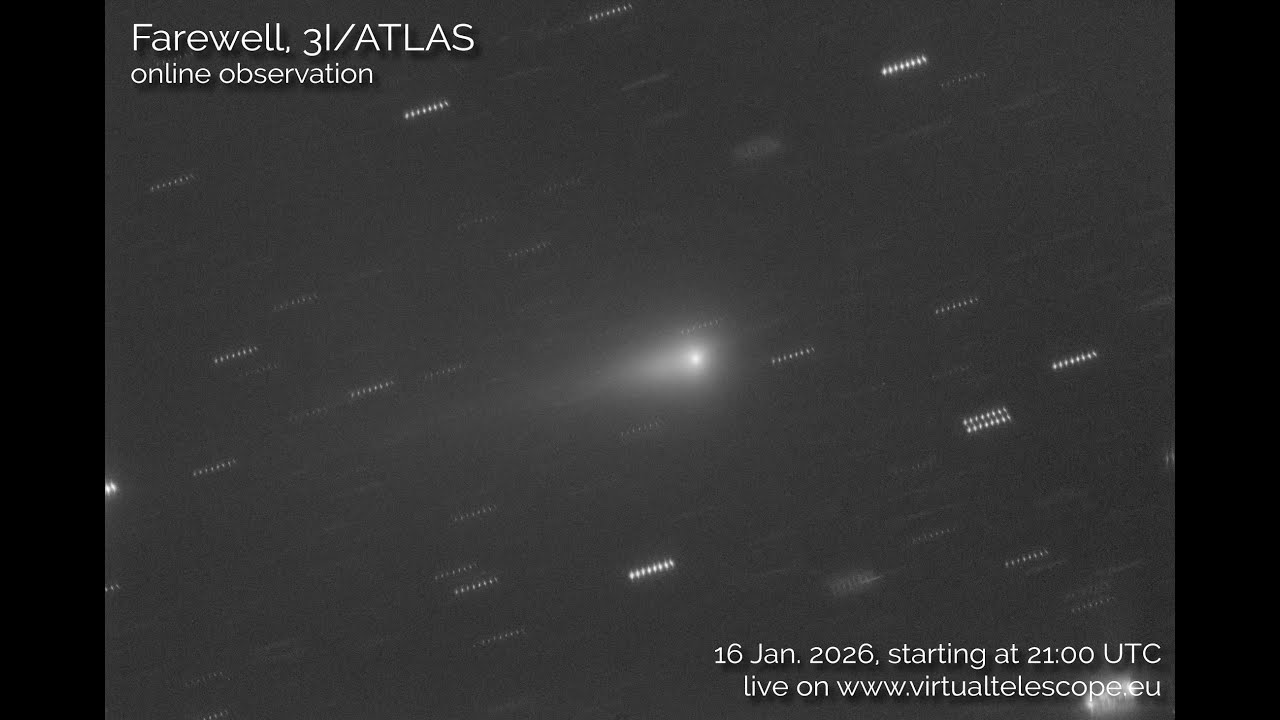
Tune in tonight(Jan. 22) to watch live views of interstellar comet 3I/ATLAS at opposition, as it appears opposite the sun in Earth's sky and races out of the solar system, courtesy of the Virtual Telescope Project.
Tonight's livestream is due to start at 6:30 p.m. EST (2330 GMT) and will feature live views of the interstellar comet captured by the Virtual Telescope Project's robotic scopes in Manciano, Italy. Of course, there's always the possibility that clouds could conspire to ruin the show — an eventuality that led to the cancellation of the earlier Jan. 16 livestream.
3I/ATLAS at opposition
"Magnitude" is used to measure the apparent brightness of objects in the night sky. The lower the number, the brighter the object! The brightest stars are around Mag +1, while a full moon is -13 and the sun is -27.
Comet 3I/ATLAS will be positioned at opposition on the night of Jan. 22 — a time when solar system objects and planets are typically at their best and brightest for observation, appearing fully illuminated by sunlight from Earth's perspective, much like a full moon.
Sadly, 3I/ATLAS is forecast to remain relatively faint, with a predicted magnitude of +13.2 as it reaches opposition, according to the Comet Observation Database (COBS) run by the Crni Vrh Observatory in Slovenia. As such, it'll be too faint to see with the naked eye, only becoming detectable through large telescopes.
3I/ATLAS' journey through the solar system
Comet 3I/ATLAS was first detected on July 1, 2025, by astronomers analyzing data collected by a telescope scanning the sky as part of the NASA-funded Asteroid Terrestrial-impact Last Alert System (ATLAS) project. A frenzied analysis of its orbit swiftly led scientists to conclude that it was just the third interstellar visitor to our solar system, behind 1I/ 'Oumuamua and 2I/Borisov.
3I/ATLAS made its closest approach to the sun on Oct. 31, 2025, around which time it disappeared for weeks behind the glare of a parent star. It later emerged to perform its closest proximity pass of Earth — an event known as perigee — on Dec. 19. It's due to make a planetary flyby in March later this year, when it will pass 33.4 million miles (53.7 million km) from Jupiter before continuing on its one-way journey out of the solar system, never to be seen again.