





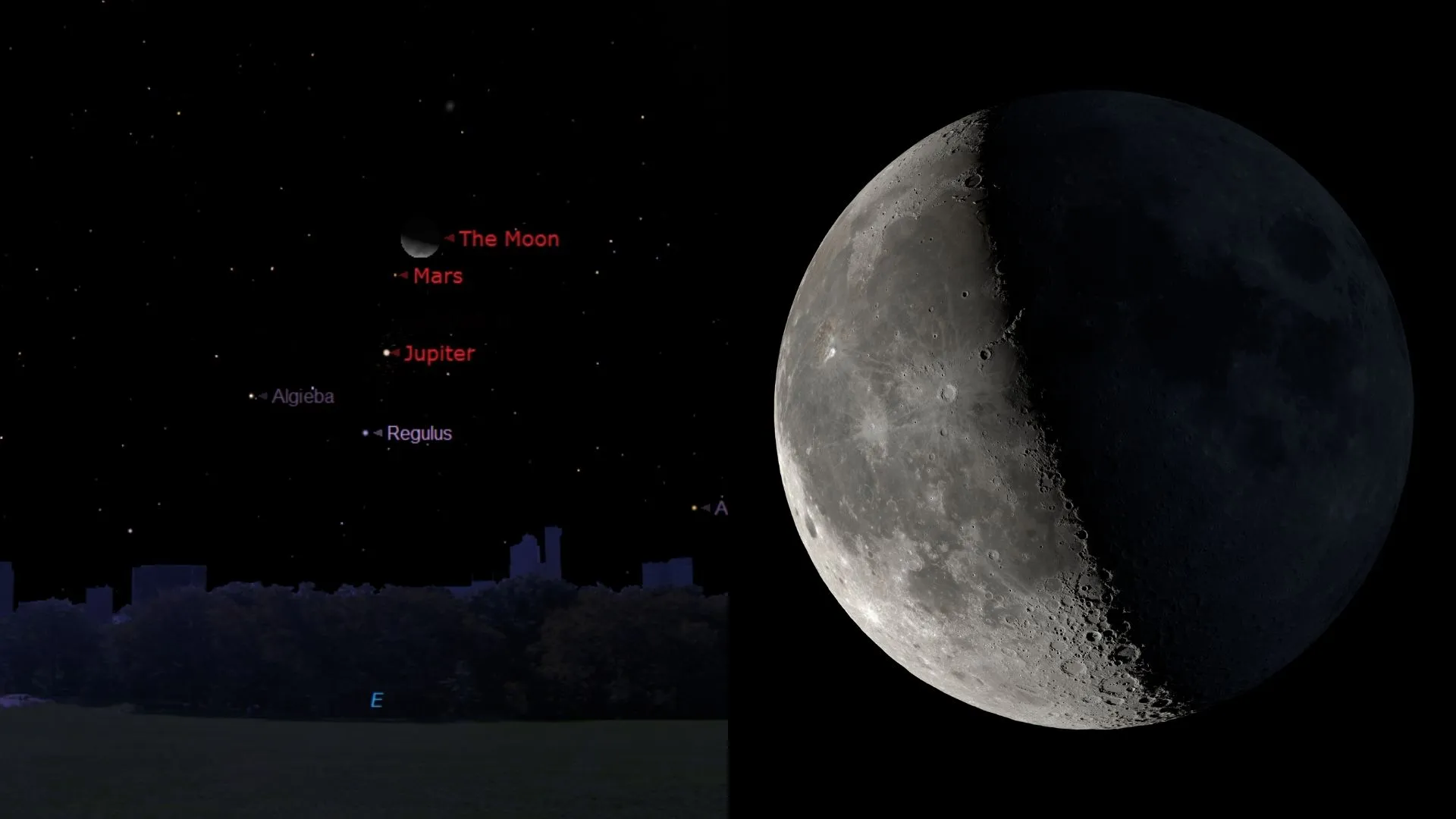
The moon dives towards the glowing heart of the constellation Leo for a spectacular rendezvous with Mars and Jupiter overnight on Nov. 1-2, as the glittering stars of the Beehive Cluster shine nearby. Here's what you need to know.
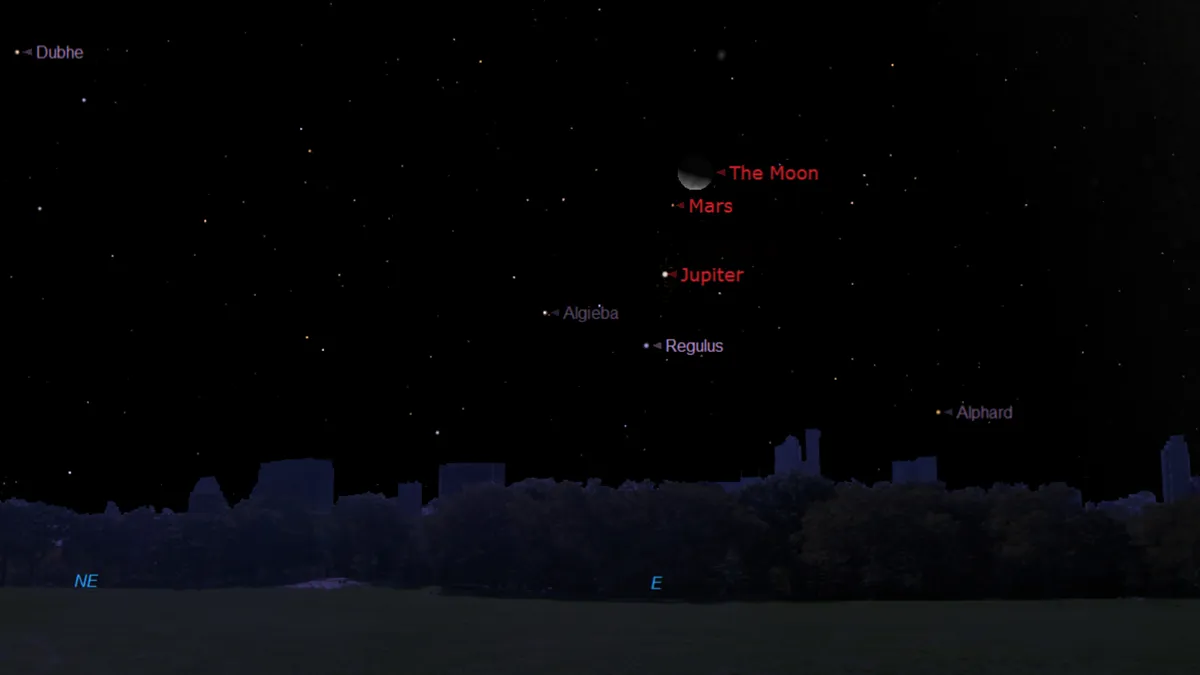
Look to the eastern horizon an hour after midnight to see the 45%-lit waning moon shining less than 5 degrees from the red light of Mars — roughly the width of your three middle fingers held at arm's length to the night sky.
Jupiter's bright light will gleam just below the red planet, with the bright star Regulus lining up beyond to form a dazzling procession leading back to the horizon. The stars of the Beehive Cluster (M44) can be found twinkling 10 degrees from the unlit side of the lunar disk around this time, in the middle of the constellation Cancer.
Stargazers in Australia, Indonesia and a host of other island nations and territories will see the moon pass directly in front of Jupiter, hiding its light in an event known as an occultation starting at 3:45 p.m. EST (2045 GMT) on Nov. 2 , according to In-The-Sky.org. However, the exact visibility and timings depend on location.
The cosmic pile-up serves as a spectacular reminder of the scale and diversity of targets on display in the night sky. After all, the moon appears largest from our Earthly perspective, but in reality it's less than half the diameter of Mars.
Jupiter, meanwhile, is over 20 times wider than the red planet, while mighty Regulus is up to four times larger than the sun, andcould easily fit all the planets of the solar system in its vast expanse.
By moonrise on the night of Nov. 3, the lunar crescent will have leapt past Jupiter and Mars, to appear just 1 degree from the blue-white light of Regulus for viewers in the U.S. Meanwhile, viewers in several South American countries including Brazil, Peru, Argentina and Bolivia will see the moon occult Regulus beginning at 6:59 EST (1024 GMT) on Nov. 3. The exact timings for a selection of South American countries can be found below, courtesy of In-The-Sky.org.
Country |
Time in GMT |
Brazil |
07:01–09:03 |
Argentina |
07:15–09:03 |
Chile |
07:07–08:55 |
Colombia |
07:09–07:38 |
Want to get a closer look at the moon and planets of the solar system? Then be sure to check out our picks of the best telescopes and binoculars for exploring the night sky, including the Celestron NexStar 8SE, which we rank as the best motorized telescope out there.
Editor's Note: If you would like to share your astrophotography with Space.com's readers, then please send your photo(s), comments, and your name and location to spacephotos@space.com.