
Latest articles by Stefanie Waldek

Research reveals that human cells exposed to simulated microgravity for 24 hours show surprisingly few changes and suggests gravity could become a form of therapy on Earth.

We're one step closer to interstellar weather forecasting.

Twenty years after Pluto became a dwarf planet, people are still fighting over its status. Experts explain why the debate feels so personal.

Astronomers have found the fastest known star in the Milky Way, a faint object racing around Sagittarius A*, the supermassive black hole at the heart of our galaxy.

Astronomers have captured the death of a massive star from its first faint flash of X-rays, revealing an unusual supernova.

The dinosaurs may not have starved through a years-long winter. New evidence suggests a blanket of ultrafine impact dust set the planet on fire within hours.

The moon that rose on July 4, 1776, was slightly closer to Earth than it is today.

Satellites captured footage of an underwater volcano eruption in a part of the sea that remains largely a mystery.
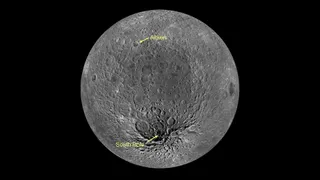
An ancient impact may have scattered material from deep inside the moon toward NASA's planned Artemis landing sites near the lunar south pole.

The rock is nicknamed "Atacama."

Scientists used SWOT to observe the 2025 Kamchatka tsunami, and their resulting work gives an unusually clear view into tsunamigenesis.

A new catalog of potentially habitable exoplanets provides the framework for future observations in the search for alien life.

Ganymede's auroras splinter into small, bright patches — structures that mirror features seen in Earth's own auroral displays.

A new analysis of Apollo moon samples reveals insight into the history of the lunar magnetic field.

Albert Einstein's theory of general relativity strikes again.

At the center of the Egg Nebula is its yolk: a deteriorating sun-like star.

Antarctica's subglacial bedrock was previously one of the least-mapped planetary surfaces in our solar system.

Scientists studying Jurassic rocks in China found that cyclical changes in Earth's orbit affected not only the climate, but also the development of shale oil reserves.

New measurements demonstrate that smoke particles in the upper atmosphere are twice the size of lower-altitude ones.

Using high-resolution observations from the GHGSat satellite constellation, researchers have produced the first global, facility-level estimate of methane emissions from the energy sector.

We don't often get a good look at X-class solar flares from ground-based observatories.

It all comes down to the difference in temperature between the North Pole and the equator.

Two perplexing structures deep inside Earth might be ancient remnants of our early planet, and they could hold clues about the origin of life.

