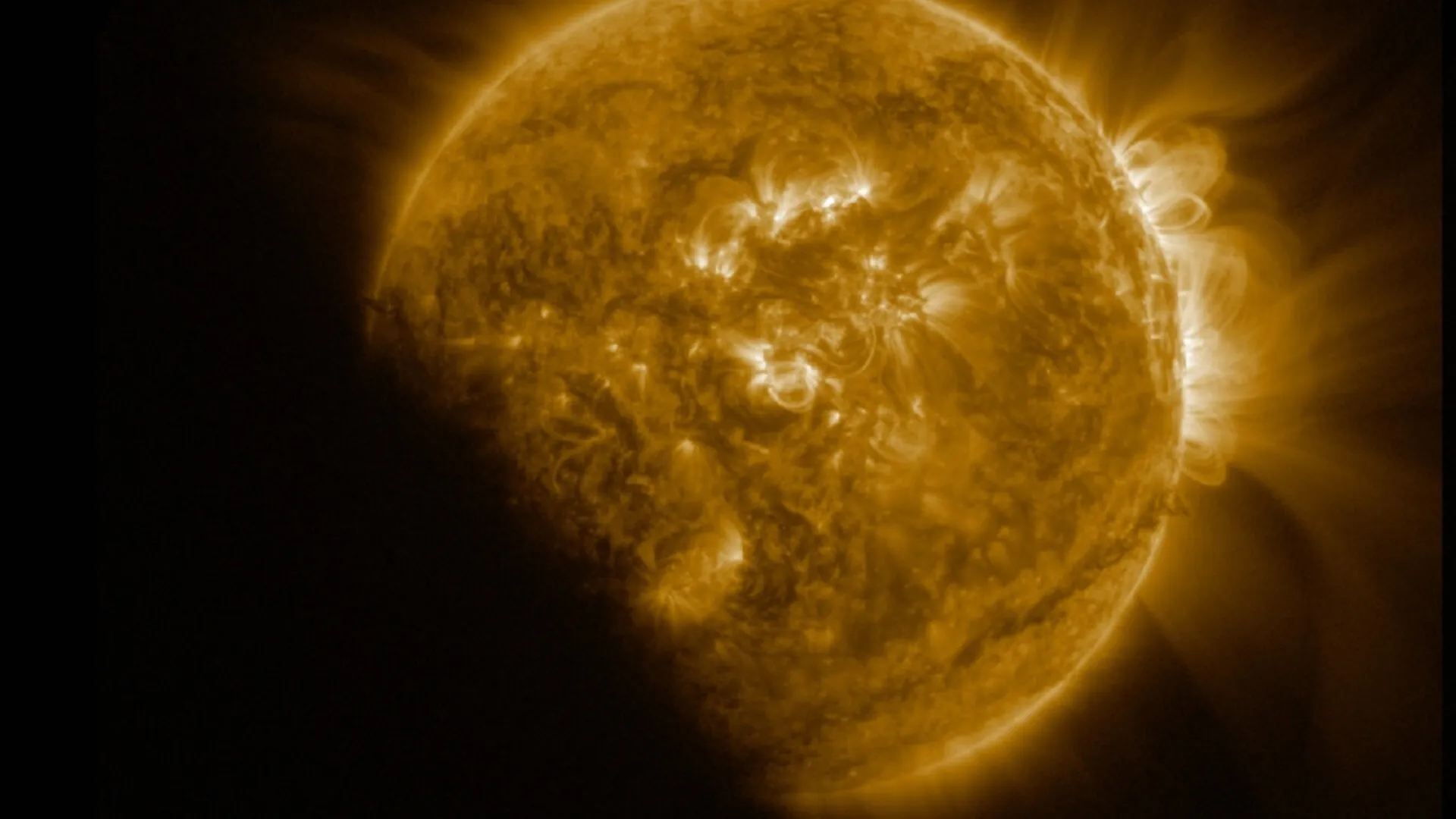
The sun's powerful magnetic dynamo that drives sunspot activity and contributes to unleashing powerful solar flares and coronal mass ejections has been confirmed as existing 124,000 miles (200,000 kilometers) beneath the sun's visible surface — equivalent to 16 Earth widths' deep.
Earth's magnetic dynamo is situated in our planet's outer core, where the convection of molten iron generates electrical currents.
The sun's core is a nuclear furnace of shredded atoms, and its inner two-thirds make up a radiative zone of gamma-ray photons, so the solar magnetic field cannot be generated there. Instead, all the convection takes place in the sun's outer-third, in the suitably named convective zone.
Some scientists had wondered whether the sun's magnetic dynamo was situated in a narrow near-surface layer, or perhaps extends throughout the entire convective layer. The most popular hypothesis, however, has been that the magnetic dynamo is generated at the boundary between the lower convective zone and the inner radiative zone.
We call this boundary the tachocline, and through about 30 years' worth of studying oscillations reverberating across the sun's visible surface — the photosphere — and its deep interior, Krishnendu Mandal and Alexander Kosovichev of the New Jersey Institute of Technology have found direct evidence that the dynamo is generated there.
"For years we suspected the tachocline was important for the solar dynamo, but now we have clear observational evidence," said Mandal in a statement. "[But] until now, we simply hadn't heard enough from inside the star to be certain where the Sun's intense magnetic fields are organized."
Mandal and Kosovichev utilized data collected by the Michelson Doppler Imager on the joint NASA–ESA Solar and Heliospheric Observatory (SOHO), which launched in 1995, and the National Solar Observatory's ground-based Global Oscillation Network Group of six telescopes around the world that came online that same year.
Both SOHO and GONG are still in operation, and between them they measure the changing pattern of oscillations rippling through the photosphere every 45 to 60 seconds.
The oscillations are influenced by the structure of the Sun's interior, which is defined by flows of plasma within the convective layer. The temperature and motion of these rotational flows of plasma therefore affect the period and amplitude of the oscillations as they pass through the flows before breaking through the photosphere.
Mandal and Kosovichev found that these rotating bands of plasma inside the Sun form a butterfly pattern that matches the way the location of sunspots changes across the sun's 11-year cycle of magnetic activity. Sunspots are cooler patches of the sun created by magnetic fields looping out through the photosphere. As such, they are a fingerprint of the Sun's magnetic field.
"Now, with nearly three 11-year solar cycles' of data, we're finally seeing clear patterns take shape that give us a window inside the star," said Mandal
The measurements show that this butterfly pattern originates from the tachocline, 200,000 kilometers below the sunspots on the photosphere. In the tachocline, the rotation of plasma is distinct from the convective layer above, with more shearing motions that drive electric current generating the magnetic field.
"Rotating bands originating from magnetic structural changes near the sun's tachocline can take several years to propagate to the surface," said Mandal. "Tracking these internal changes gives us a clear picture of how the solar cycle unfolds."
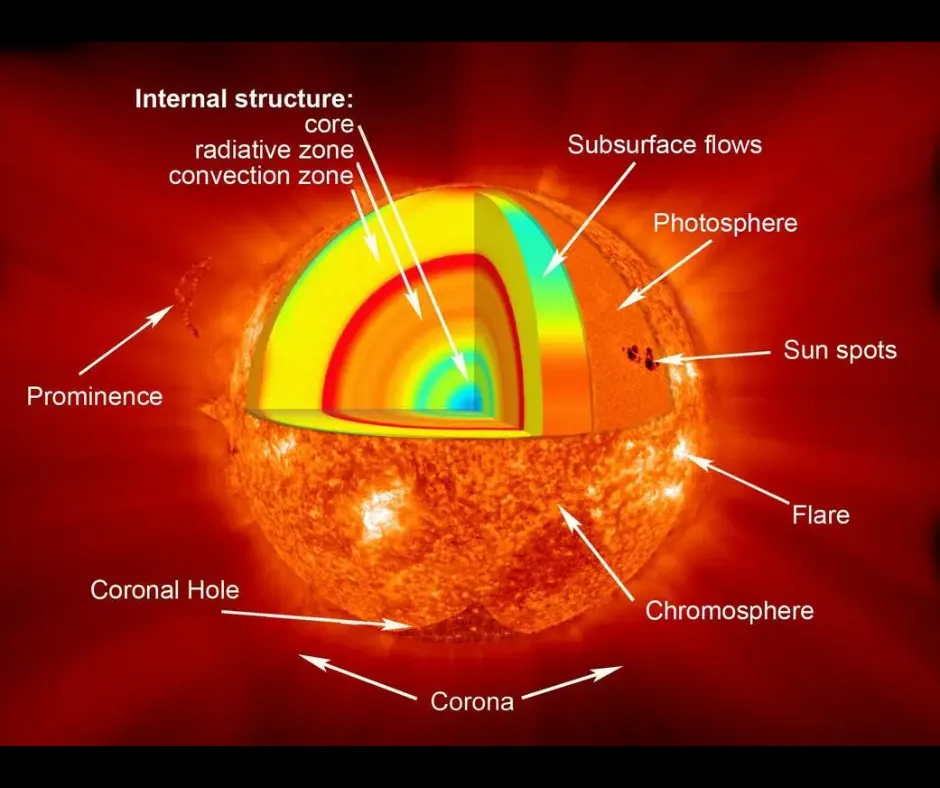
Moreover, a better understanding of how the sun's magnetic field is generated, and how it manifests on the surface in active regions that produce sunspots, flares and ultimately coronal mass ejections, could aid in better predictions of harmful space weather. Eruptions from the sun can send clouds of charged particles heading our way, which can disrupt satellites, communications and energy grids and endanger astronauts.
"While our findings do not yet enable precise predictions of future solar cycles, they highlight the importance of including the tachocline in space weather prediction models," said Mandal. "Many current simulations account for processes only on near-surface layers, but our results show the entire convection zone, especially the tachocline, must be considered."
Further afield, the findings will help us to better understand magnetic activity on other stars. As our Sun is the only star that we can observe close up, it is often used as a baseline for understanding other stars.
The findings are presented in a paper published on January 12 in Scientific Reports.