Solar wind in the sun's atmosphere, the corona, flows up to four times faster than scientists had thought, a study based on photographs taken by a solar eclipsing spacecraft revealed.
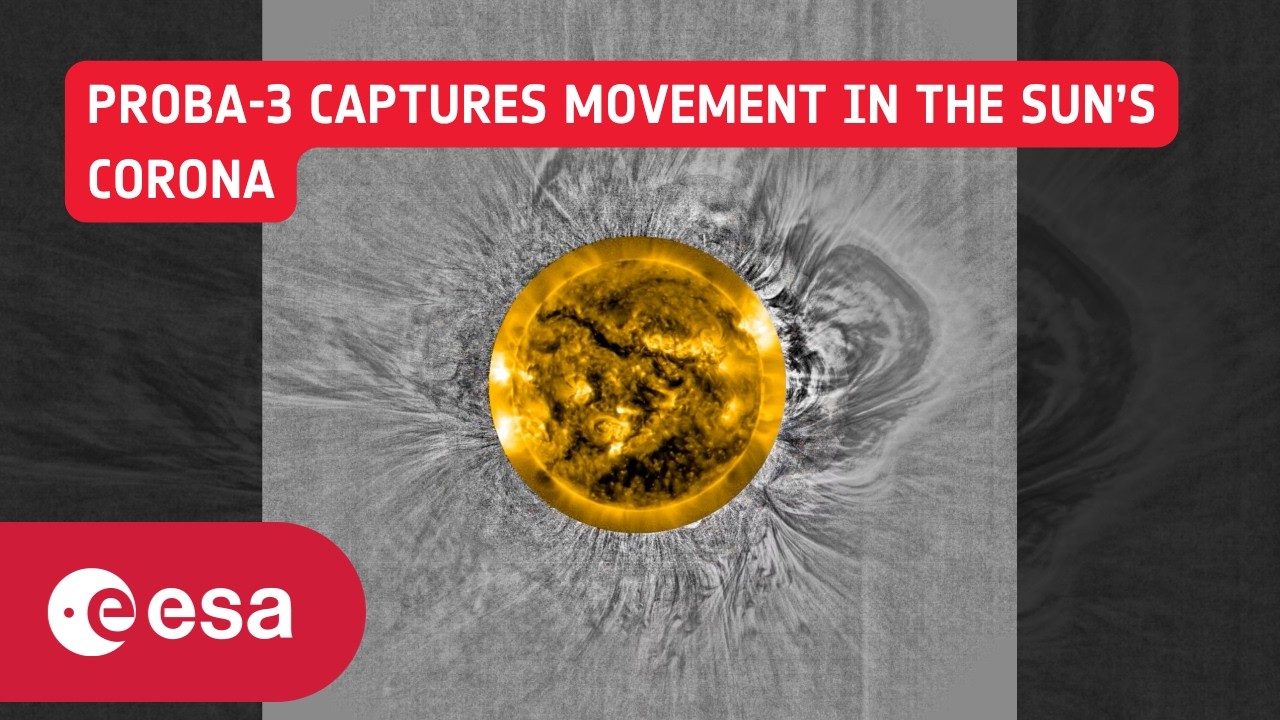
The type of wind that the researchers studied forms very close to the sun's surface and had previously been known to blow at speeds of 60 miles per second (100 kilometers per second). That's considerably slower than the 480 miles per second so-called fast solar wind that blows from coronal holes — dark, cool regions with open magnetic field lines in the sun's upper atmosphere, the corona. But images taken by the European Space Agency's (ESA) Proba-3 mission — a duo of satellites flying in a formation to simulate the solar eclipse — revealed that even the slow kind of solar wind can be much faster than expected.
"In the inner corona, a region very difficult to observe, we saw slow solar wind gusts moving three to four times faster than expected," Andrei Zhukov, a solar physicist at the Royal Observatory of Belgium and the lead author of the study, said in a statement.

Instead of the expected 60 miles (100km) per second, the wind gusts just above the solar surface were reaching speeds up to 300 miles (480km) per second.
Solar wind is a stream of charged particles that constantly emanates from the sun and spreads across the solar system, causing geomagnetic storms and bringing intense radiation. The slow kind of solar wind, which was the object of this study, is likely generated when the sun's magnetic field lines break and reconnect, scientists think. But the process is still shrouded in mystery. Unlike the smooth stream of fast coronal wind, the slow solar wind comes out of the sun in gusty blobs, which are visible in coronal images as bright rays.
Until recently, imaging the solar corona was rather difficult. The corona is extremely faint compared to the luminous disk of the sun, which outshines it a million times, unless hidden behind special instruments called occulters. The problem with occulters mounted on Earth-based telescopes is that they must also cover the region of the corona nearest to the sun's surface to prevent the solar light from spilling over. It's in this region where the solar wind originates. Until recently, the only option to view this region was during natural total solar eclipses.
The moon, by coincidence, is just the right size and at the right distance from Earth to cover the entire solar disk. The distance between the moon and observers on Earth means that the overspilling of light that plagues telescopes on Earth is negligible. But total solar eclipses are a rare phenomenon. They occur on average less than once a year somewhere on the planet and only last a few fleeting minutes — not enough to allow scientists to crack the sun's major mysteries.
The ESA Proba-3 mission solves this problem. It consists of two spacecraft flying in a formation 490 feet apart (150 meters), with the spacecraft closer to the sun acting as a giant occulter to the observer satellite farther away. Since its launch in December 2024, the spacecraft has recreated 57 artificial solar eclipses, capturing 250 hours of high-resolution video of the little-understood region where solar wind forms.

"We can track how solar wind speeds up close to the Sun, we see it all over Proba-3's field of view, and we have already seen speeds and accelerations that surprised us," Joe Zander, the Proba-3 project scientist at ESA, said in the statement.
The measurements reveal that the slow solar wind emerges from the sun's surface in a nonuniform manner, producing small-scale magnetic-field disturbances.
"This first dataset is just the beginning of the much longer journey to fully understand what's happening," Zander said.
The study was published in The Astrophysical Journal Letters in March.