




Astronomers may have, for the first time ever, directly witnessed a star engulfing its companion, a new study reports.
As stars die, they swell up to hundreds of times their original size, consuming anything orbiting nearby. In a binary star system, this can include a dying star merging with its companion star. However, scientists had never directly seen any examples of such a cosmic drama unfolding — until now.
"Catching a star engulfing its companion in the act is very difficult," study lead author Viraj Karambelkar, an astrophysicist at Columbia University in New York, told Space.com. "When a star engulfs its companion, its effect is very subtle — like throwing a bucket of water in a large ocean. We need sensitive telescopes monitoring the sky for a long time in order to catch this effect."
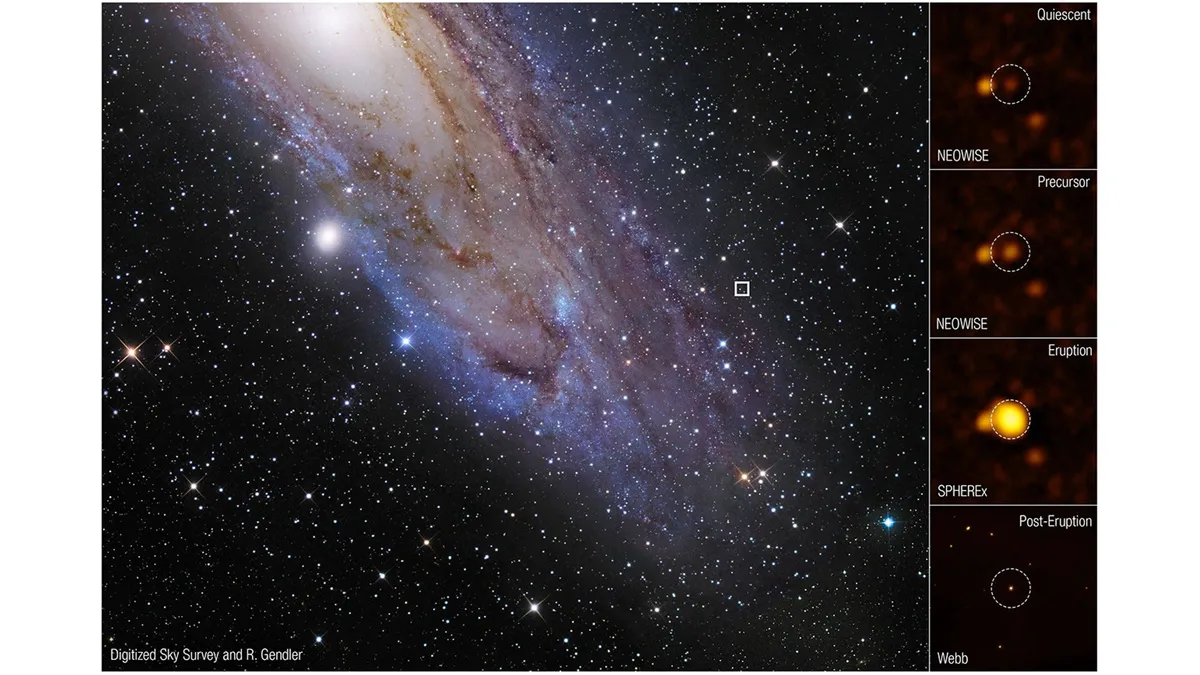
In the new study, the researchers investigated a red giant star designated WNTR23bzdiq, which is located about 2.5 million light-years away in the Andromeda galaxy. The star is about seven times heftier and 350 times wider than our own sun.
In 2023, using NASA's now-defunct NEOWISE space telescope and the WINTER telescope at Palomar Observatory in California, the scientists noticed that this star was brightening. By analyzing previous records, they found that the red giant had gradually started growing more luminous in 2018.
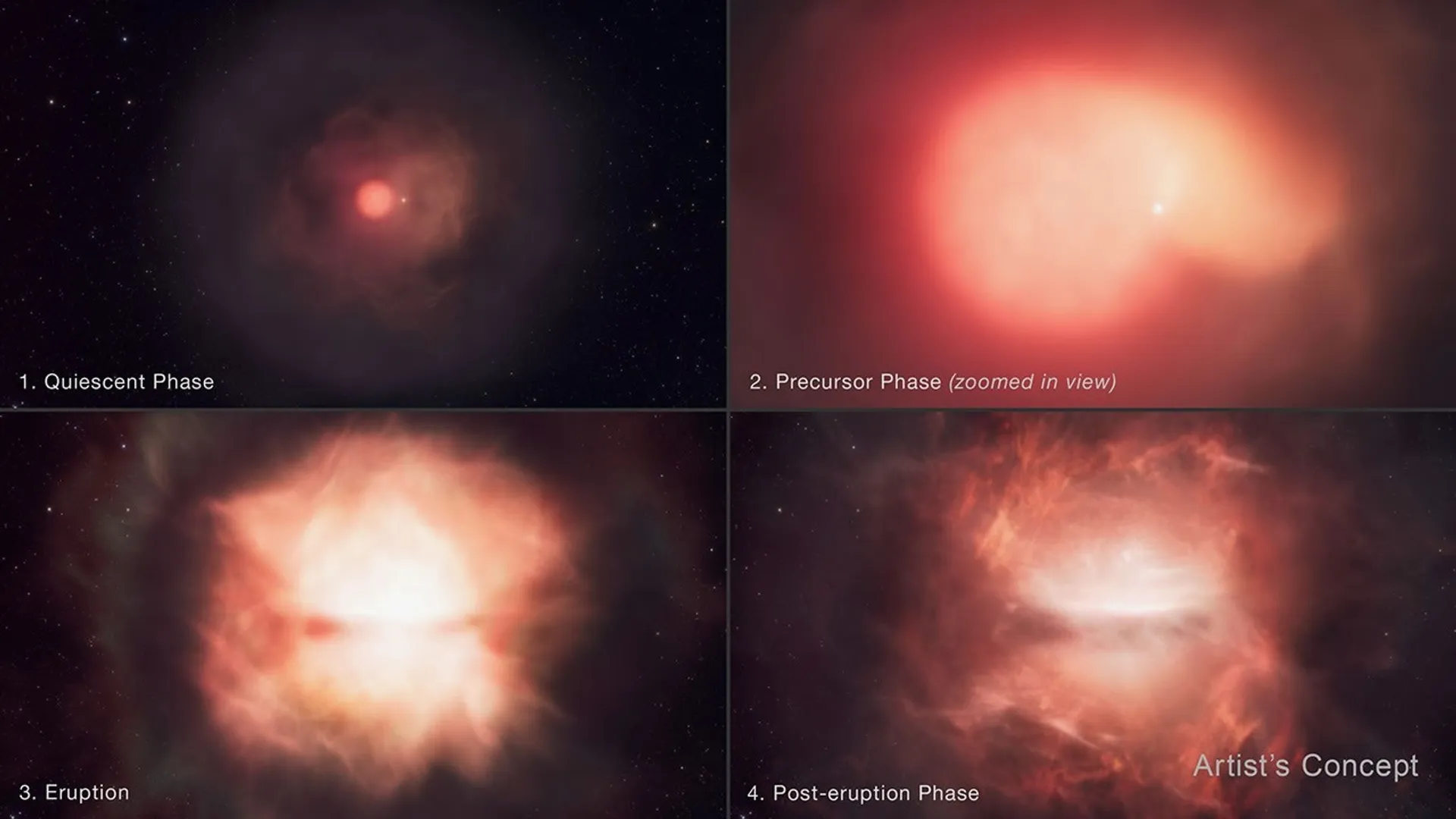
The researchers had previously suggested this brightening potentially occurred because the giant star engulfed a companion star. As this companion spiraled toward the giant's core, it would generate friction, heat and light, explaining the increasing luminosity.
Then, near the end of 2025, the astronomers saw a giant eruption of light from this giant star. NASA's James Webb Space Telescope observed the star just 47 days after that eruption, allowing the team to characterize the event in detail. The researchers now propose that this explosion happened when a companion star about 70% the sun's mass rammed into the giant's heart.
"I was absolutely flabbergasted when we saw this," Karambelkar said.
In the new study, the scientists estimated that the eruption expelled an amount of material equal to about 0.1 to 0.2 times the mass of the sun. "Stars engulfing their companions have been theorized for many decades, and this event provides the first observations of this theoretical prediction," Karambelkar said.
Although these findings suggest that two stars — a binary system nicknamed "Bao" — merged into one, "it is not the only possibility," Karambelkar said. "The other possibility is that both stars survived, in a much shorter orbit. In order to conclusively determine what happened, we need to continue monitoring what the system does, once the heft of the eruption settles down."
Now that astronomers may have found the first such merger, "I can't wait to find more," Karambelkar said. "Upcoming telescopes like the Nancy Grace Roman Space Telescope and the Vera Rubin Observatory will be very useful in discovering many more such events."
The scientists detailed their findings Nov. 18 in the journal Nature.
