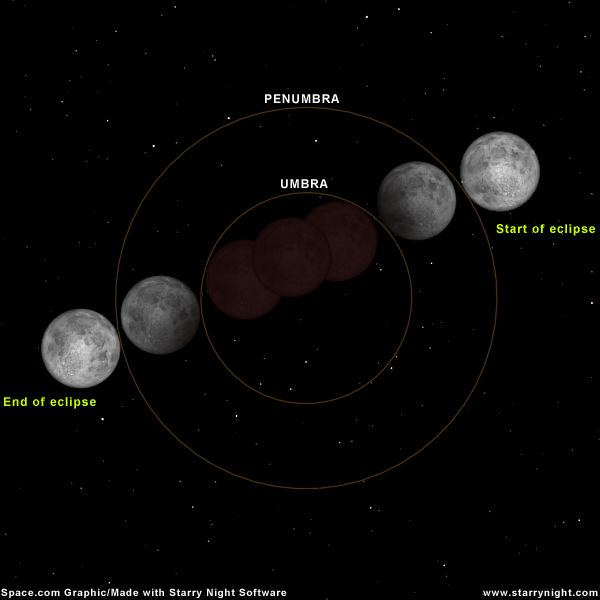
Less than a year after North America was treated to a total lunar eclipse, another one will take place on the Wednesday, Oct. 27.
Along the immediate West Coast the first partial stage of the eclipse will get under way just minutes after the Moon has risen. But by late twilight even Westerners will have a fine view of the totally eclipsed Moon, probably glowing dimly like a reddish ember low in the eastern sky.
Article continues belowAcross much of Alaska, the eclipse will already be underway when the Moon comes up; over southwest Alaska, the Moon will rise totally eclipsed, appearing like a weird, mottled, dim ball among the twilight stars. For Hawaiians, moonrise comes just after the end of totality, with the Moon ascending with its gradual emergence from the shadow readily visible.
Easy to watch
It is easy to view this celestial spectacle.
Unlike an eclipse of the Sun, which requires special viewing precautions in order to avoid eye damage, an eclipse of the Moon is perfectly safe to watch. All you'll need are your eyes, but binoculars or a telescope will give a much nicer view.
Totality will last somewhat longer than average, as eclipses go. The Moon will track through the northern portion of the Earth's total shadow, called the umbra, creating a total shadow on the Moon for 1 hour and 22 minutes.
Unless airborne volcanic aerosols or other atmospheric effects influence its appearance, the Moon's disk should appear relatively bright, even when in shadow and especially right around the beginning and end of totality. The upper part of the Moon will likely appear brightest and glowing a ruddy or coppery hue, while the lower half of the Moon should look grayer or chocolate in color.
The eclipse will actually begin when the Moon enters the faint outer portion, or penumbra, of the Earth's shadow more than an hour before it begins moving into the umbra. The penumbra, however, is all but invisible to the eye until the Moon becomes deeply immersed in it. Sharp-eyed viewers may get their first glimpse of the penumbra as a faint "smudge" on the left part of the Moon's disk at or around 8:48 p.m. EDT or 6:48 p.m. MDT.
Main event
Below is a timeline, for Eastern Daylight Time. In the Central Time Zone, subtract one hour from these times; in the Mountain Time Zone, two hours, and for the Pacific Time Zone, three hours.
- 9:14 p.m.: Moon enters Earth's dark umbral shadow
- 10:23 p.m.: Totality begins
- 11:04 p.m.: Mid-eclipse
- 11:45 p.m.: Totality ends
- 12:54 a.m. (Oct. 28): Moon leaves the umbra

"Presently we are living in a period where tetrads take place, while no tetrads at all occurred at the time Louis XIV was king of France," says the well-known Belgian eclipse calculator Jean Meeus.
After this month's eclipse, there will be no other total lunar eclipses until March 3, 2007.
More Eclipse Information
- Viewer's Guide to the Oct. 27 Lunar Eclipse
- It Will be the First World Series Eclipse!
- Full Moon Fever: Lunar News & Lore
- Pictures of May 15, 2003 Eclipse
- Pictures of Nov. 8, 2003 Eclipse
- Sky Calendar & Moon Phases

Starry Night software brings the universe to your desktop. Map the sky from your location, or just sit back and let the cosmos come to you.

Joe Rao serves as an instructor and guest lecturer at New York's Hayden Planetarium. He writes about astronomy for The New York Times and other publications, and he is also an on-camera meteorologist for News 12 Westchester, New York.