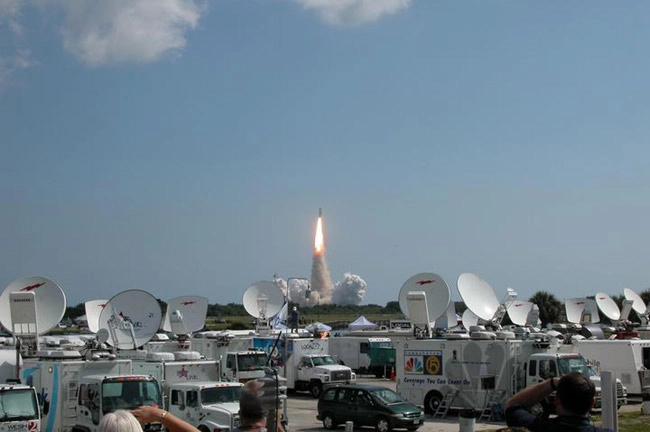
STS-114 Mission Elapsed Time
DaysHoursMinutesSeconds

STS-114 Mission Highlights
(Times Approximate)
Launch KSC
Tuesday, July 26, 2005
10:39 a.m. EDT
Orbital Boom Deployment
Wednesday, July 27
3:54 a.m. EDT
Wing Leading Edge/Nose Cap Survey Begins
Wednesday, July 27
5:24 a.m. EDT
Rendezvous Pitch Maneuver
Thursday, July 28
6:08 a.m. EDT
Docking at ISS
Thursday, July 28
7:18 a.m. EDT
Hatch Opening
Thursday, July 28
9:19 a.m. EDT
Orbital Boom Handoff
Thursday, July 28
11:44 a.m. EDT
MPLM Cargo Module Removal
Friday, July 29
2:14 a.m. EDT
MPLM Installation Begins
Friday, July 29
3:09 a.m. EDT
EVA 1 Begins
Saturday, July 30
4:44 a.m. EDT
U.S. PAO Event
Sunday, July 31
6:49 a.m. EDT
8:39 a.m. EDT
EVA 2 Begins
Monday, Aug. 1
4:14 a.m. EDT
Russian PAO Event
Tuesday, Aug. 2
6:54 a.m. EDT
English Translation at 12:00 p.m. EDT
Joint Crew News Conference
Tuesday, Aug. 2
5:59 a.m. EDT
EVA 3 Begins
Wednesday, Aug. 3
4:14 a.m. EDT
JAXA PAO Event
Thursday, Aug. 4
5:19 a.m. EDT
English Translation at 6:30 a.m. EDT
Cargo Module Retrieval
Friday, August 5
6:24 a.m. EDT
Crew Farewell/Hatch Closure
Saturday, Aug. 6
12:24 a.m. EDT
Undocking from ISS
Saturday, Aug. 6
3:22 a.m. EDT
Deorbit Burn
Tuesday, Aug. 9
7:06 a.m. EDT
Edwards Air Force Base Landing
Tuesday, Aug. 9, 2005
8:12 a.m. EDT
Read the Columbia Report
The final analysis of the Columbia Accident Investigation Board's seven-month inquiry.
> Download PDF (10 MB)

After Successful Flight, a Warm Texas Greeting for STS-114 Crew
HOUSTON – More than 1,000 space fans, dignitaries and NASA engineers, workers and officials greeted the seven astronauts of Discovery STS-114 mission – the first shuttle flight since the Columbia disaster – during a welcome back ceremony here at an Ellington Field hangar. > Read More
Discovery Lands Safely in California

Discovery Lands Safely in California


9 August 2005, 8:12 a.m. EDT


Space shuttle Discovery has safely landed at Edwards AFB, California, ending NASA's Return-to Flight mission to the International Space Station.


Discovery touched down at 8:12 a.m. EDT (1212 GMT) at the back-up landing site in California's Mojave Desert, where weather conditions were perfect for the vehicle's return.


Commander Eileen Collins and pilot Jim Kelly guided the Orbiter on its fiery plunge through the atmosphere and hour-long free-fall descent back to Earth, then precisely executed a series of turns and banking maneuvers that slowed the vehicle for its powerless landing on the 3-mile long concrete runway 22 on Rogers Dry Lake in the high desert of California's Antelope Valley.


Discovery was diverted to the West Coast alternate landing site when continued instability in the Florida weather – rain showers and thunderstorms within 30 nautical miles of the Shuttle Landing Facility - forced NASA to wave-off both of today's possible landing opportunities at the Kennedy Space Center.


STS-114 marks the 50th space shuttle mission to land at the California landing site.


The Orbiter will now be ferried back to the Kennedy Space Center on the back of a specially-modified 747 airliner, a procedure that takes about a week at a cost of $1 million.


-- Roger Guillemette


Discovery on Final Approach for Landing


9 August 2005, 8:04 a.m. EDT


Space shuttle Discovery is on final approach for a landing at Edwards AFB, California. Touchdown is scheduled for 8:12 a.m. EDT (1212 GMT) and weather conditions are ideal for the vehicle’s return to Earth.


Discovery crossed the California coast north of Los Angeles – between Oxnard and Ventura – on its approach to Edwards AFB. Commander Eileen Collins and Pilot Jim Kelly have completed a series of four banking maneuvers that slowed the space plane’s velocity and dissipated heat from the vehicle’s protective tiles. All spacecraft systems are functioning normally and the vehicle is being tracked by radar and infrared cameras at the landing site.


The Orbiter will make a right overhead turn in the pre-dawn skies above the Mojave Desert, followed by a long gliding approach to runway 22 on Rogers Dry Lake – a concrete runway 15,013 feet in length, 300 feet wide.


-- Roger Guillemette


Discovery Heading Home to California


9 August 2005, 7:09 a.m. EDT


Space shuttle Discovery has ignited its braking rockets to initiate a fiery plunge through Earth's atmosphere and a long, gliding descent to the backup landing site - Edwards AFB, California.


Discovery is scheduled to touch down at 8:12 a.m. EDT (1212 GMT) and weather conditions in the Mojave Desert are ideal for the space plane's approach and landing in the pre-dawn darkness, about 53 minutes before sunrise (local time).


Commander Eileen Collins and pilot Jim Kelly just completed a two minute, 42 second firing of Discovery's twin Orbital Maneuvering System engines that began at 7:06 a.m. EDT (1106 GMT) to reduce the shuttle's velocity sufficiently to drop it out of orbit and begin an hour-long free-fall descent back to Earth. The Orbiter will encounter the upper fringes of the atmosphere at about 400,000 feet in altitude, followed by a series of turns and banking maneuvers to slow the vehicle for its approach to Edwards AFB.


Discovery will cross the California coast north of Los Angeles – between Oxnard and Ventura – on its approach to Edwards AFB. The Orbiter will make a right overhead turn in the pre-dawn skies above the Mojave Desert, followed by a long gliding approach to runway 22 on Rogers Dry Lake – a concrete runway 15,013 feet in length, 300 feet wide.


Discovery was diverted to the West Coast after unstable weather conditions forced NASA to wave-off both of today's landing opportunities at Florida's Kennedy Space Center.


-- Roger Guillemette


Discovery Cleared for California Landing


9 August 2005, 6:43 a.m. EDT


Space shuttle Discovery has been cleared for a landing this morning in the high desert of California.


Flight controllers at Mission Control have given the ‘Go’ to commander Eileen Collins and pilot Jim Kelly to begin the de-orbit burn at 7:06 a.m. EDT (1106 GMT), culminating in a landing at Edwards AFB, California at 8:12 a.m. EDT (1212 GMT).


Discovery’s pair of Orbital Maneuvering System engines will fire for two minutes, 42 seconds to slow the spacecraft to initiate its descent through the atmosphere - the start of the burn will occur about 205 miles over the western Indian Ocean, just above the northern tip of Madagascar.


Weather conditions at Edwards AFB are ideal for a landing attempt this morning, with mostly clear skies and light winds blowing straight down the runway. Discovery’s approach and landing will occur in the pre-dawn darkness, about 53 minutes before sunrise (local time).


Discovery was diverted to the West Coast alternate landing site when continued instability in the Florida weather – rain showers and thunderstorms within 30 nautical miles of the Shuttle Landing Facility - forced NASA to wave-off both of today's possible landing opportunities at the Kennedy Space Center.


Discovery will cross the California coast north of Los Angeles – between Oxnard and Ventura – on its approach to Edwards AFB. The Orbiter will make a right overhead turn in the pre-dawn skies above the Mojave Desert, followed by a long gliding approach to runway 22 – a concrete runway 15,013 feet in length, 300 feet wide. STS-114 will mark the 50th space shuttle mission to land at the California facility.


-- Roger Guillemette


Discovery to Land in California


9 August 2005, 5:04 a.m. EDT


The space shuttle Discovery will land in California after continued instability in Florida weather forced NASA to wave-off both of today’s landing opportunities at the Kennedy Space Center.


Persistent rain showers and thunderstorms in the skies surrounding the Kennedy Space Center convinced flight controllers to bypass the potential for a Florida landing once again today and instead, re-directed Commander Eileen Collins and the STS-114 crew toward a landing at the alternate site at Edwards AFB, California.


Weather conditions at Edwards AFB are ideal with light winds and clear skies. Discovery is scheduled to fire its engines in a de-orbit burn at 7:06 a.m. EDT (1106 GMT), resulting in touchdown in the Mojave Desert at 8:12 a.m. EDT (1212 GMT).


-- Roger Guillemette


Discovery Presses on with KSC Landing Attempt


9 August 2005, 4:49 a.m. EDT


CAPE CANAVERAL, Fla. – Flight controllers have given the seven STS-114 astronauts aboard the space shuttle Discovery to press forward with plans to land at Kennedy Space Center (KSC).


There are some rain clouds on the edge of the 30-nautical mile perimeter around NASA’s Shuttle Landing Facility here at KSC, but weather officers report that they are moving away from the landing site, flight controllers said.


“We think there’s still hope for this opportunity,” astronaut Ken Ham, serving as spacecraft communicator, told the STS-114 crew.


Flight controllers gave Discovery’s crew, commanded by veteran astronaut Eileen Collins, the go ahead to begin fluid loading, a process that calls for the astronauts to drink rehydrate themselves with fluids as a preparation measure for their return to Earth gravity.


While flying in weightlessness, their bodies lost some fluids, NASA officials said. By fluid loading, the astronauts will be better equipped for the onset of gravity as they make their decent and landing, they added.


The next milestone will be Discovery’s de-orbit burn, slated to occur at about 5:37 a.m. EDT (0937 GMT), when Collins and pilot Jim Kelly will fire the shuttle’s Orbital Manuevering System (OMS) engines for about two minutes 43 seconds to send it on a homeward course.

-- Tariq Malik


Discovery Crew Takes Aim at Second KSC Landing Opportunity


9 August 2005, 3:58 a.m. EDT


CAPE CANAVERAL, Fla. – Clad in orange pressure suits, the seven astronauts aboard NASA’s space shuttle Discovery are gearing toward their second chance to land at Kennedy Space Center (KSC).


Flight controllers report only a slight chance of showers at Discovery’s Shuttle Landing Facility target here at KSC during the upcoming 6:43 a.m. EDT (1043 GMT) attempt, although confirmed rain showers and lightening prevented the STS-114 astronauts from making a previous landing window earlier today.


The upcoming KSC landing window is Discovery’s final opportunity today to land at its Florida spaceport. The astronauts aboard the orbiter must fire Discovery’s Orbital Maneuvering System (OMS) engines for a three-minute burn at 5:37 a.m. EDT (0937 GMT) to touchdown on the Shuttle Landing Facility tarmac at 6:43 a.m. EDT (1043 GMT), NASA officials said.


The back-up landing site for Discovery, Edwards Air Force Base – where NASA officials from Dryden Flight Research Facility are on call – in California’s Mojave Desert, has clear weather conditions for both an 8:12 a.m. EDT (1212 GMT) and 9:47 a.m. EDT (1347 GMT) landing later today, they added.


-- Tariq Malik


Discovery Misses First KSC Landing Opportunity


9 August 2005, 3:07 a.m. EDT


CAPE CANAVERAL, Fla. – The space shuttle Discovery will not land at Kennedy Space Center (KSC) during its initial opportunity to return to Earth, flight controllers said.


Rainstorms and lightning within a 30-nautical mile perimeter around Discovery’s KSC landing site have preempted the orbiter’s 5:07 a.m. EDT (0907 GMT) landing site.


“We understand how unstable the weather is in Florida, so we’re not surprised,” Discovery’s STS-114 commander Eileen Collins said.


Collins and her crew will have a second chance to land at KSC at 6:43 a.m. EDT (1043 GMT), where weather forecast predict only a slight chance of showers, NASA officials said.


Meanwhile, weather at Discovery’s backup landing site – Edwards Air Force Base in California – remains favorable for an 8:12 a.m. EDT (1212 GMT) landing.


-- Tariq Malik


Weather May Prohibit First KSC Landing Pass for Discovery


9 August 2005, 2:27 a.m. EDT


CAPE CANAVERAL, Fla. – Discovery will likely miss its first chance to land at Kennedy Space Center (KSC), flight controllers said Tuesday.


The shuttle’s first landing window opens at 5:07 a.m. EDT (0907), but rain showers within a 30-nautical mile perimeter of Discovery’s landing site here at KSC have prompted some pessimism among flight controllers.


“It’s not looking great for the first opportunity,” said astronaut Ken Ham, spacecraft communicator, to Discovery’s STS-114 crew.


If the STS-114 crew, commanded by veteran astronaut Eileen Collins, misses their initial landing window, the astronauts could land during a second attempt at 6:43 a.m. EDT (1043 GMT).


Alternative landing sites at Edwards Air Force Base in California and White Sands Space Harbor in New Mexico are on active alert for today’s landing.


The first opportunity to land at Edwards opens at 8:12 a.m. EDT (1212 GMT) and has a favorable weather outlook, NASA officials said.


-- Tariq Malik


Runway Chosen for KSC Landing


9 August 2005, 2:00 a.m. EDT


CAPE CANAVERAL, Fla. – Flight controllers have chosen Runway 15 for Discovery’s landing at Kennedy Space Center if weather conditions permit the orbiter to touchdown at the Florida spaceport.


Discovery’s STS-114 crew is currently slated to land at 5:07 a.m. EDT (0907 GMT) at KSC, though rain showers and lightning within the 30-nautical mile perimeter of the Shuttle Landing Facility here may prohibit the initial attempt, NASA officials said. The shuttle could also land at KSC at 6:43 a.m. EDT (1043 GMT).


To land at Runway 15, Discovery would have to make a wide left turn as it flies over KSC to touchdown on the northwest to southeast runway.


-- Tariq Malik


Discovery Crew Still Targets KSC Landing


9 August 2005, 1:45 a.m. EDT


CAPE CANAVERAL, Fla. – Discovery’s STS-114 astronauts are still working on schedule toward a 5:07 a.m. EDT (0907 GMT) landing here at Kennedy Space Center (KSC), though conditions at an alternative landing site are good if Florida weather prevents the initial descent, NASA officials said.


Weather forecasts at Edwards Air Force Base in California’s Mojave Desert show excellent conditions for a shuttle landing. KSC is still the primary choice for flight controllers.


Cloudy weather and the threat of weather prevented Discovery’s Monday landing attempt.


Should Discovery land at Edwards, it would take at least one week to load the spacecraft on the back of its 747 carrier jet and return it to KSC. The transport will also cost an estimated $1 million in additional cost, NASA officials said.


-- Tariq Malik


Weather Still a Concern for Discovery’s Landing at KSC


9 August 2005, 1:25 a.m. EDT


CAPE CANAVERAL, Fla. – Flight controllers are still watching the weather as the astronauts aboard Discovery prepare for their planned Earth return later this morning. It is the second attempt this week by the shuttle crew to land, after poor weather prevented a Monday descent.


Large rain showers with lightning have been sighted by weather spotters flying above Kennedy Space Center (KSC), NASA officials said. While the storms are well off-shore from KSC’s Shuttle Landing Facility, they are still within the 30-nautical mile perimeter set by NASA’s flight rules, they added.


Meanwhile, the STS-114 crew – commanded by veteran astronaut Eileen Collins – has closed Discovery’s payload bay doors. Discovery is slated to land at KSC at 5:07 a.m. EDT (0907 GMT).


In addition to KSC’s Shuttle Landing Facility, flight controllers have called up two other landing sites on call. Edwards Air Force Base in California’s Mojave Desert and White Sands Space Harbor in New Mexico are also prepared to receive Discovery if needed.


-- Tariq Malik


Unstable Weather Scrubs Discovery Landing


8 August 2005, 5:05 a.m. EDT


The space shuttle Discovery will remain in orbit for another day. Unstable weather conditions – persistent low clouds and rain showers near Florida's Kennedy Space Center - forced NASA flight controllers to wave-off both of today’s possible landing opportunities. The alternate landing site at Edwards AFB, California was not activated for landing today.


Discovery will have four landing opportunities available on Tuesday – two each at the Kennedy Space Center and Edwards AFB. The Kennedy Space Center landing opportunities will be at 5:08 a.m. and 6:43 a.m. EDT (0908 and 1043 GMT), while the Edwards AFB opportunities would occur at 8:13 a.m. and 9:48 a.m. EDT (1213 and 1348 GMT).


-- Roger Guillemette


Discovery Waved-Off for First Landing Opportunity


8 August 2005, 3:20 a.m. EDT


CAPE CANAVERAL, Fla. - Unstable weather conditions – pop-up rain showers and a broken cloud deck at approx. 1,000 feet over the Kennedy Space Center’s Shuttle Landing Facility - has forced flight controllers to wave-off the first of today’s two landing opportunities for the space shuttle Discovery.


Flight controllers and the Spaceflight Meteorology Group will continue to closely monitor the weather conditions in the vicinity of the Kennedy Space Center. Forecasters are hopeful that weather conditions will improve to allow today’s second Florida landing opportunity at 6:22 a.m. EDT (1022 GMT). The de-orbit burn to commit to the second landing opportunity would occur at approx. 5:15 a.m. EDT (0915 GMT).


-- Roger Guillemette


Mission Control Watches the Weather


8 August 2005; 2:55 a.m. EDT


Weather forecasters at Kennedy Space Center continue to monitor the weather. At present a potential concern is a low cloud layer that mission control is watching to see if it forms at the shuttle landing facility at KSC.


Commander Eileen Collins was informed of the weather “instability”. Collins was told to work through the reentry checklist as mission control continues to monitor the weather for the first landing window scheduled for 4:46 a.m. EDT (0846 GMT).


Flight controllers are less optimistic now that weather conditions for the first window will be optimum for landing. 


Discovery Crew Prepares for Reentry


8 August 2005; 2:39 a.m. EDT


The Discovery crew has started fluid loading – consuming large quantities of fluids that will assist their bodies for the return to the forces of normal Earth gravity.


Discovery Departs ISS


6 August 2005; 5:10 a.m. EDT


HOUSTON – The space shuttle Discovery has fired its engines a second time to widen the gap between it and the International Space Station (ISS).


Shuttle pilot James Kelly fired Discovery’s Orbital Maneuvering System (OMS) engines in a final separation burn at 5:05 a.m. EDT (0905 GMT), NASA officials said.


“Good burn, Discovery,” Rick Sturckow, serving as spacecraft communicator.


With the successful second burn, Discovery is now pulling away from the ISS at a rate of about eight nautical miles per orbit around the Earth. The orbiter undocked from the ISS at 3:24 a.m. EDT (0724 GMT).


The shuttle and its STS-114 crew are expected to land at Kennedy Space Center (KSC) in Cape Canaveral Florida at 4:46 a.m. EDT (0846 GMT) on Monday, Aug. 8.


-- Tariq Malik

Return to Flight Mission Update Archive


STS-114 Astronauts Share Spaceflight Experience with Students
Space Shuttle Discovery Returns to NASA Spaceport
NASA Eyes March 2006 for Next Shuttle Flight
STS-114 Astronauts Celebrate Successful Mission, Remember Columbia's Crew
Touchdown! Discovery Lands Safely in California
Discovery's STS-114 Astronauts Ready to Return to Earth
Discovery Undocks from Space Station, Heads Back to Earth
SPACE.com's Space Shuttle Multimedia Home
With Blanket Issue Cleared, NASA Approves Discovery for Return to Earth
Discovery, Space Station Crews Pay Tribute to Columbia
Discovery's Damaged Blanket Prompts Wind Tunnel Tests
NASA Lauds Spacewalk Repair for Shuttle Discovery
Discovery's Heat Shield Successfully Repaired in Third Spacewalk
NASA Eyes Damaged Thermal Blanket on Discovery's Hull
Discovery's Solo Repair Job a Team Effort, NASA Says
NASA Sets Spacewalk to Repair Discovery's Heat Shield
Discovery Astronauts Confident in Planned Spacewalk Repair to Heat Shield
NASA Details Plans for Potential Fix to Discovery's Heat Shield
Shuttle Astronauts Repair ISS Gyroscope in Second Spacewalk
NASA Extends Discovery's Flight to ISS
Discovery Astronauts Test Heat Shield Repairs in First Spacewalk
ISS Managers Ask for Extra Docked Day for Discovery's Crew
NASA Chief Griffin Confident Shuttle Will Resume Flying Quickly
Discovery's Crew Gives Spacecraft Closer Inspection
Discovery Astronauts Deliver Fresh Cargo Pod at ISS
NASA Spies Smaller Foam Debris From Discovery's Tank
NASA Says Discovery Heat Shield Looks Good
NASA Pessimistic About Solving Debris Woes
**FIXING NASA: Complete Return to Flight Story Archive**
Multiple Pieces of Foam Fly in Shuttle Launch, Forcing Fleet Grounding
STS-107: The Unfinished Mission

New Gallery: Discovery Is Home
The space shuttle Discovery successfully landed at the Kennedy Space Center (KSC) after a weekend flight across the country.  > Launch
Gallery: Discovery Comes Home: STS-114 Landing Day
Touchdown: Photos of Discovery's picture perfect landing. > Launch
New: Discovery Return to Flight Wallpaper
STS-114 Photo Album: Flight Day 7 – 14
STS-114 Photo Album: Flight Day 1 – 6
VIDEO: Mission STS-114 At Work: On-Orbit
Image Gallery: Flying High: STS-114 Spacewalks
VIDEO: Docking Day at ISS
Gallery: Discovery: Debris, Scuffs and Scouting for Damage
VIDEO: Launch Day
Image Gallery: Discovery Launch Day!