





The Rockot launcher,a modified Russian ballistic missile, lifted off Wednesday with a Japanesesatellite running on off-the-shelf components designed to prove the utility ofeveryday parts in space.
The 95-foot-tall rocket's first stage enginesignited with a rush of toxic reddish-brown smoke at 0159 GMT Wednesday (9:59p.m. EDT Tuesday), and the booster shot skyward moments later on 420,000 poundsof thrust.
It was after sunrise at the PlesetskCosmodrome, a sprawling Russian space base south of the Arctic Circle. Thelauncher soared into mostly sunny skies over Plesetsk as it turned north toaccelerate into orbit over the Arctic Ocean.
The booster's first and second stagesfinished their burns a few minutes after launch. The Rockot's Breeze KM upperstage took over next, first igniting for nearly 9 minutes to propel the rocketand payload into an elliptical parking orbit about 14 minutes into the flight.
After coasting for more than an hour, theBreeze engine fired again for approximately 45 seconds to circularize its orbitat an altitude of 746 miles. The upper stage was targeting an inclination ofabout 100.4 degrees.
The launch vehicle deployed the 1,600-poundSERVIS 2 satellite at 0336 GMT (11:36 p.m. EDT) as the craft flew over EasternEurope.
Russian space officials declared the launch asuccess, according to Khrunichev, the prime contractor for the Rockot booster.
Wednesday's launch was conducted under thecommercial management of Eurockot, a German company that sells Rockot flightson the international market.
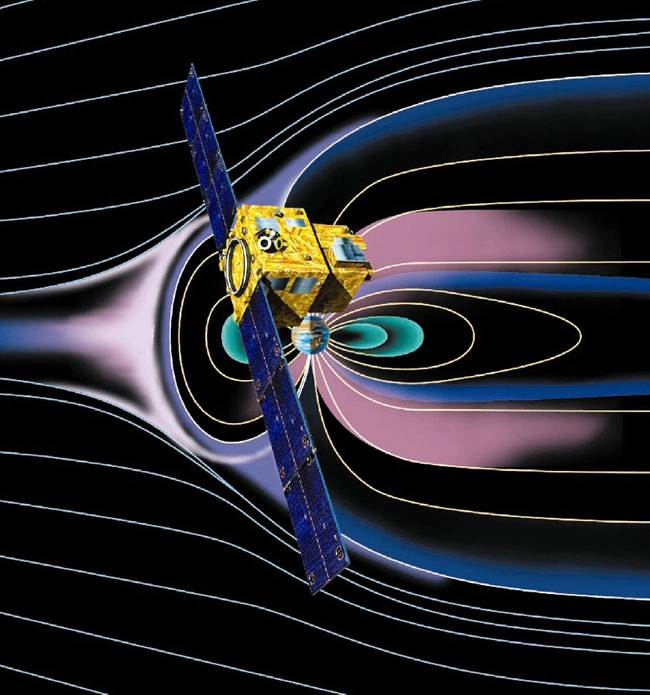
After deploying its solar panels and passinghealth checks, the SERVIS 2 spacecraft will enter service to test ninecommercial off-the-shelf payloads in the attitude control, electrictyproduction and computer systems.
The experiments include a lithium ion batteryand data management system using automobile technology, a fault-tolerant 64-bitcomputer, a remote terminal unit and a data compressor. SERVIS 2 also carriescommercial GPS receivers for orbit and attitude determination, a magneticbearing wheel and a satellite structure model containing electric modules tosimulate next-generation systems.
SERVIS 2 will expose the materials to theharsh environment of space to help establish a parts database, a partsevaluation guideline and an equipment design guideline to utilize thecomponents on future space missions, according to the mission's website.
Commercial off-the-shelf parts could helpmake future spacecraft less expensive.
SERVIS stands for Space EnvironmentReliability Verification Integrated System. The Tokyo-based Institute forUnmanned Space Experiment Free Flyer, or USEF, is managing the project.
USEF is overseeing the mission under contractwith the New Energy and Industrial Technology Development Organization and theJapanese Ministry of Economy, Trade and Industry. Mitsubishi Electric Corp.manufactured the SERVIS 2 spacecraft.
A similar SERVIS satellite launched onanother Rockot vehicle in 2003 and completed a two-ye