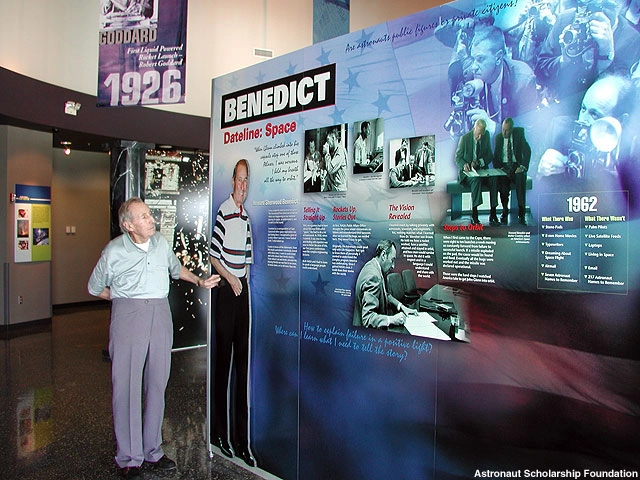
HowardBenedict, 77, known as the "dean" of space reporting and formerExecutive Director of the Astronaut Scholarship Foundation, died Monday, April25, at his Floridahome.
Inthe early years of the United States space program, Benedict introducedgenerations to space exploration, covering more than 2,000 missile and rocketlaunches as the senior aerospace writer for The Associated Press.
Hecovered the first 65 U.S.human space flights, from Alan Shepard's Mercury mission in 1961 to the 34thSpace Shuttle mission in 1990, for 31 of the 37 years he worked for the wireservice.
"HowardBenedict's professional life recorded the manned space program from itsearliest days. Always fair and objective, his coverage became the standard for America andindeed for the world," said former U.S. Senator John Glenn and the firstastronaut to orbit the Earth. "Howard became a loyal and wonderful,personal friend to me and to all the astronauts."
Benedictauthored three books about the space program (NASA: A Quarter Century of Space Achievement in 1984; NASA: The Journey Continues in 1989; andAt Home in Space in 1995) and in 1994co-wrote Moon Shot: TheInside Story of America's Race to the Moon with fellow reporter Jay Barbree and astronauts Alan Shepard and DekeSlayton.
In1992, Benedict began inspiring a new generation by providing educationalopportunities for college engineering and science students offered through theAstronaut Scholarship Foundation. He retired as Executive Director of the ASFin 2004, but continued to serve on their Board of Directors.
"Howard'sunwavering devotion and support of the foundation is a tribute to a man thatthat will live on for years. ASF is what it is today in great part to Howardand his steadfast dedication to the astronauts, their legacy and the scientistsof the future that benefited from his many years of work," said astronautJames Lovell, ASF Chairman Emeritus. "We have not only lost a friend butwe have lost a true champion."
Onehundred and ninety six students reaped the benefit of Benedict's work. Underhis tenure, the ASF disbursed over $2 million in scholarships.
"Hiswork will live on as we continue with the programs that he and the otherMercury astronauts have initiated," said astronaut Owen Garriott, the Foundation Chairman.
Benedictis survived by his wife, Joy. Memorial service arrangements were pending.
Copyright 2005 collectSPACE.com. All rights reserved.