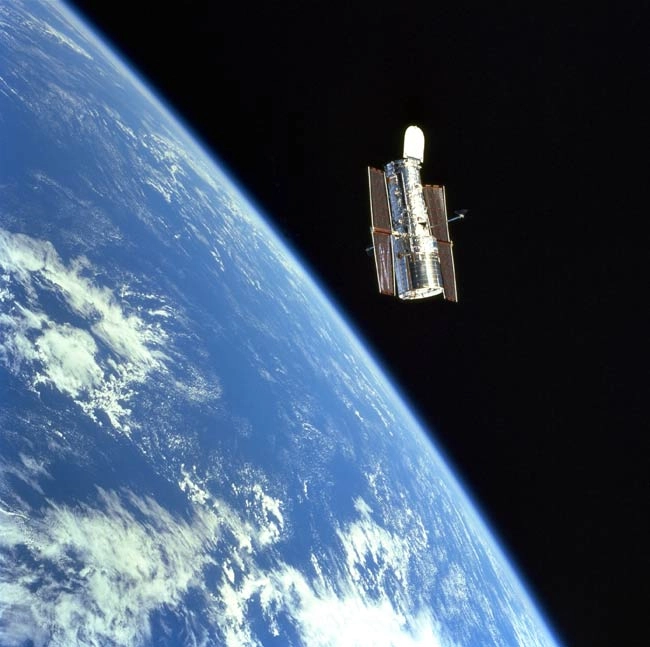
The fate ofthe Hubble Space Telescopewill be announced today by NASA chief MichaelGriffin after months of debate over whether the payoff from one last shuttle mission to the orbitalobservatory is worth the risk to an astronautcrew.
"It's oneof the greatest scientific instruments of all time," Griffin has said ofHubble. "It needs some refurbishment and repair. If we can do it safely, wewant to do it."

"We're veryhopeful that the decision will be positive," Mario Livio, a senior astronomerat the Space Telescope Science Institute (STScI) thatoversees Hubble, told SPACE.com. "We will, of course, accept and respectthe decision, whatever it is."

NASAofficials initially canceledplans for one last Hubble servicing mission in 2004, a decision that prompted wide disapprovalamong scientists and the public.The space agency later discussed plans for a potential robotic missionto make necessary Hubble upgrades and repairs, but studies found the plan too costly and theagency later reverted back to an astronaut-crewedspaceflight.
A 2008shuttle servicing mission would include five spacewalks to install a newcamera, replace faulty attitude control gyroscopes, deliver a new spectrometer,make an unprecedented repair to another instrument and boost the telescope intoa higher orbit.

| Hubble's Best Images Gallery 1 | Hubble's Best Images Gallery 1 | Hubble's Best Images | Gallery 1 | Row 0 - Cell 4 |
| Hubble's Best Images Gallery 1 | Hubble's Best Images | Gallery 1 | Row 1 - Cell 3 | |
| Hubble's Best Images | ||||
Gallery 1 | ||||
| Row 4 - Cell 0 |
NASA haslaunched fourshuttle missions to service Hubble since the observatory's April 1990launch, first to repair a mirror defect and later to upgrade and maintainthe space telescope. Left as is, Hubble could function through 2009-and maintainbasic functions until 2011-but a servicing mission could add up to five yearsto space telescope's lifetime, NASA officials have said.
Hubble'smission results from a collaborative effort between NASA and the European Space Agency.
During its morethan 16 years of observation, Hubble found the firstevidence of an atmosphere around an extrasolar planet, aided in the searchfor darkenergy and proven a vital tool in determining a clear agefor the universe, astronomers said.
"I don'tthink there's a field in astronomy that it hasn't touched," said University ofTexas astronomer J. Craig Wheeler, who serves as president of the AmericanAstronomical Society (AAS) and has depended on Hubble for his studies of the supernovaSN 1987A, in a telephone interview.
Wheelersaid he is confident that today's decision will turn out to be positive for Hubbleand its astronomical audience, if only because his colleagues continue to applyfor research time on the telescope and NASA has put the servicing mission'sastronaut crew on standby for a press conference later today. But despite thoseodds, Wheeler continues to hope for the best.
"I've gotmy fingers crossed," Wheeler said.
TheHubble story so far:
- NASA Cancels Shuttle Mission to Service Hubble
- Public Bombards Operators to Save Hubble
- NASA Chief: 'Let's Go Save the Hubble'
- Canadian Robot Top Choice for Hubble Servicing Mission
- Study: Hubble Robotic Repair Mission Too Costly
- NASA Prepares for Possible Shuttle Mission to Save Hubble
- NASA Review: Hubble Headed For Deorbit-Option Only
- Health Checkup: Engineers Work to Stall Hubble's Death
- Hubble Puzzle: How Safe is a Shuttle Servicing Mission?
