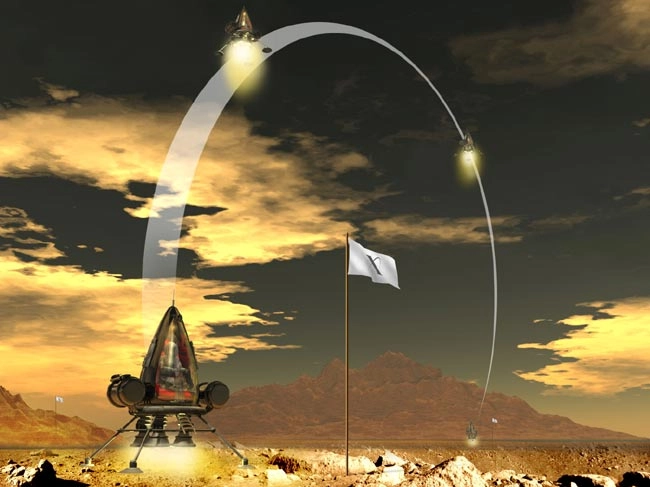
Thefuture will take to the skies over New Mexico next month as teams compete in theLunar Lander Challenge sponsored by NASA under their Centennial Challengesprogram.
Thiseffort uses prize contests to stimulate creativity and competition in solarsystem exploration, tapping the talents of non-traditional sources ofinnovation in academia, industry and the public.
Teamsof rocketeers are readying their vehicles for the Lunar Lander Challenge to beheld live October 20-21 at the Las Cruces International Airport in southern NewMexico.
TheVertical Lander Challenge (VLC) and Lunar Lander Challenge (LLC) presented byNASA are designed to speed up the commercial development of a vehicle capableof ferrying cargo or humans back and forth between the surface of the Moon andlow lunar orbit.
Thecomplete Lunar Lander Challenge purse of $2,500,000 -- NASA's contribution is$2 million -- is divided into two levels. Level One is worth a total of$500,000. The more difficult Level Two is valued at a sum of $2,000,000.
Degree of difficulty
Whathas to happen to win prize money in either level?
Arocket-propelled vehicle with an assigned payload must takeoff vertically,climb to a defined altitude, fly for a pre-determined amount of time...then landvertically on a target that is a fixed distance from the liftoff point. Afterremaining at this location for a period of time, the vehicle must takeoff, flyfor the same amount of time, and land again on its original launch pad.
Theprimary differences between the Vertical Lander Challenge and the Lunar LanderChallenge are the minimum time of flight -- 90 seconds versus 180 seconds --the surface terrain at the landing sites -- flat compared to rocky -- and thedegree of difficulty presented for precision landing.
Forboth Level One and Level Two, the vehicle has the option to refuel before conductingthe required return level to the original starting point.
Quick turnaround
Afterthe smoke clears, NASA's hope is that the prize will spur the design andfabrication of quick turnaround vertical take-off, vertical landing vehicles.That ability can help cultivate the commercial launch procurement market - notonly for future operations on the Moon but here on Earth too.
"Weare extremely impressed by the way that the teams have responded to ourChallenge and built their vehicles literally from scratch in a matter of just afew months," said William Pomerantz, Director of Space Projects for the X Prize Foundation, headquarteredin Santa Monica, California.
TheLunar Lander Challenge was first announced in May of this year, Pomerantzadded, with several teams now signed up to fly their respective vehicles inOctober.
"TheX Prize Cup is the ideal venue for this kind of prize. It's a unique event. Idon't know of any other similar 'rocket show' in the world," Pomerantz told SPACE.com."Planning and operating these events is a demanding and difficult task, and bycollaborating with us, NASA can save the taxpayers money by taking advantage ofthe infrastructure we are building."
Level playing field
Withonly weeks away before the challenge, competitors are moving into high gear.
"Weare looking pretty good," said John Carmack, chief rocketeer at ArmadilloAerospace of Mesquite, Texas. His team has been busy at work readying hardwarefor qualification flights.
"Thelevel 2 prize is quite challenging," Carmack said. "No rocket vehicle has everbeen built that could complete it," underscoring the required length of flight,let alone refueling such a craft in the allotted time.
Thereal lunar lander, Carmack said, "even if it was equipped with an engine thatcould support its weight on Earth, wouldn't make the entire flight. That isn'tto say that it requires a level of efficiency that hasn't been demonstratedbefore. [But] of the small list of vertical takeoff/vertical landing rocketsthat have actually flown, none of them would be able to do it."
Small and light vehicles
TheLunar Lander Challenge and the reduced duration of the Vertical RocketChallenge
competitionsare both very difficult pursuits, emphasized Richard Speck, President ofMicro-Space, Incorporated of Denver, Colorado.
TheMicro-Space efforts are restricted this year to the shorter duration, VerticalRocket class, Speck noted. "This is not actually a limitation of the propulsionsystem, but of the 'rough surface' landing needs, and a few other factors whichcould not be developed in the available time."
Nevertheless,Speck's group plans to enter the long duration competition next year with avery similar vehicle, fitted with a larger cluster of fuel tanks, but havingthe same dimensions and only slightly greater empty weight.
Theemphasis at Micro-Space has always been on the smallest and lightest vehiclesusable for manned flight or unmanned research, Speck said.
Affordable space travel
Today,most space vehicles resemble flying submarines, Speck observed. "Jules Verne's"Nautilus" submarine could make undersea exploration pleasant, but it was JackCousteau's 'aqualung' which made it affordable," he said.
Sincein virtually every way, space is less dangerous than undersea, Speckemphasized, similarly, minimized systems will make orbital and interplanetaryspace travel "affordable".
"Micro-Spaceefforts have included the development of operational, light-weight life
support,oxygen regeneration and water reprocessing systems which will drasticallyreduce the costs of even Mars missions," Speck predicted.
XPrize Chairman, Peter Diamandis, said the $2.5 million Lunar Lander Challengewill require a vehicle to mimic a trip between the Moon's surface, to lunarorbit and back to the lunar landscape.
"NASA'sexploration vision calls for putting humans back on the Moon in the nextdecade. The vehicles to land on the Moon no longer exist," Diamandis observed."We believe that entrepreneurial companies can build these lunar spaceships,and a Lunar Lander Challenge can stimulate the required technology in anefficient and rapid fashion."
LIVE Complete Coverage of the X Prize Cup
- Rocket Racing League: Spreading Its Wings
- Sky High Plans For UP Aerospace
- Countdown to X Prize Cup Ends on a High Note
- Virgin Galactic Partners With New Mexico On Spaceport
- Rocket Racing: New League Promotes High-Flying Contest
- Countdown to X Prize Cup Ends on a High Note