


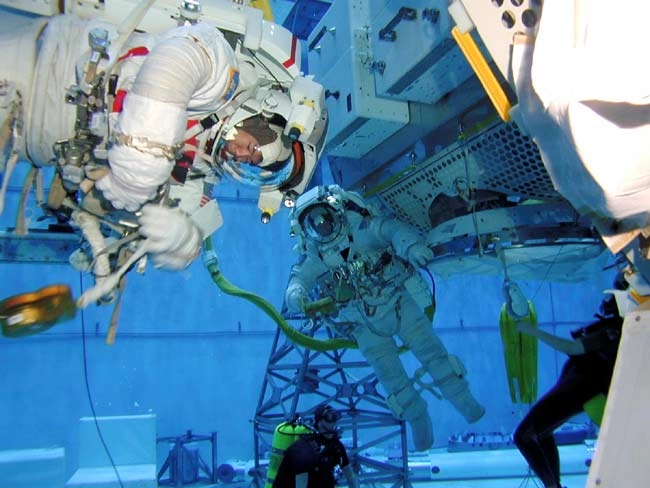
HOUSTON -- Two astronauts took the plunge today during a trainingexercise for one of three critical spacewalks to repair the International SpaceStation (ISS) and test new techniques for fixing heat-resistant tiles during NASA's first shuttle launch since the Columbiaaccident.
NASAastronaut Stephen Robinson and Soichi Noguchi, of theJapanese Aerospace Exploration Agency (JAXA), spent more than five hoursunderwater at the Neutral Buoyancy Center near Johnson Space Center here rehearsing the spacewalk.
Today'stest run - the goal of which was to replace a broken gyroscope with a freshunit - went smoothly, but Discovery astronauts said more training is stillneeded before Noguchi and Robinson will be ready totest two methods to repair damaged shuttle tiles and cracks in the thermalprotection panels made of reinforced carbon carbon.
"Most of the EVA you saw today is practicingand rehearsing stuff we've done before," said STS-114 pilot James Kelly, whoparticipated in today's rehearsal from the spacewalk control room. "On our EVA1 and 3, we still have some things that are unknown, mostly things to do with tilerepair and RCC repair."
Training for repairs
It wasdamage to the space shuttle Columbia'sRCC panels along a wing leading edge - sustained during launch when a chunk offoam broke of the orbiter's external tank - that allowed hot gases to enter thewing and destroy the spacecraft during reentry on Feb. 1, 2003. Since theaccident, researchers and engineers have been working to develop in-spacemethods to detect and repair such damage should it be necessary.
Veteranastronaut Eileen Collins, commander of the STS-114 mission, told reporters thatwhile she is fully confident that Discovery's spaceflight will be the safestever to fly, she does not believe that the tile and RCC repair techniques aremature enough to rely on should the flight require putting them in practice.
"Until weactually fly them in space and test them will [the repair techniques] really becertified," Collins said.
During theSTS-114 spaceflight, Noguchi and Robinson are slated to test the a black,putty-like substance that can be slathered onto cracks in RCC panels, as wellas another technique called Emmitance WashApplication, where a gray substance is dabbed onto damaged tiles to shore uptheir heat protection qualities.
ButRobinson agreed with his flight commander that those initial tests should notbe pressed into action if repairs prove necessary aboard Discovery.
"We don'twant to have the first test be with us inside," he said.
Otheruntested methods of tile and RCC repair may be on hand during Discovery'smission, but will not be tested by the spacewalking duo, NASA officials said.
A smooth, wet rehearsal
For today'sspacewalk rehearsal - one of many for Noguchi and Robinson - the two astronautsdonned training versions of U.S. spacesuits and entered the mock-spaceenvironment of NASA's Neutral Buoyancy Laboratory - a vast pool containing largemodels of the ISS and shuttle payload bay - at about 9:55 a.m. EST (1455 GMT).
Five hoursand 20 minutes later, they emerged after a long day of faux-spacewalking.
"Thanks forthe great work guys," Noguchi told EVA controllers near the end of the rehearsal.
Thespacewalk is set to be the second of a trio of extravehicular activities (EVAs) for Robinson and Noguchi during the STS-114 mission aboardthe Discovery orbiter, NASA's first shuttle flight since the 2003 loss of Columbia and its
During thespacewalk rehearsal, Noguchi and Robinson practiced replacing a device called acontrol moment gyroscope (CMG) used by the ISS to maintain its position inspace. The space station relies on four such gyroscopes for orientation, withtwo serving as spares. One of the devices - the one Noguchi and Robinson expectto replace - failed in 2002.
While theSTS-114 spacewalkers had run through the gyroscope repair before, today'srehearsal was the first time they staged their EVA from Discovery's airlock,rather than the space station airlock as originally planned.
"We'vebasically been learning more and more," Robinson said. "It helps to have morethings in our bag of tricks."
