





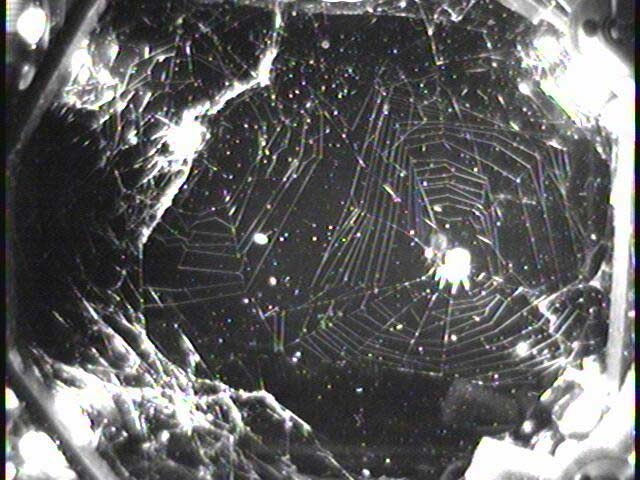
An intrepidspider may have survived the long months at the International Space Station,with scientists eager to know for sure once it returns to Earth aboard thespace shuttle Discovery.
Thearachnid, one of twoorb weaving spiders sent to the station last November, is due to land withDiscovery?s astronaut crew in Florida on Saturday afternoon. The spiders, and somebutterfly larvae, are part of an educational experiment with students on Earthto compare their developmentin zero gravity with their counterparts on Earth.
?Everybodyis rooting for the spider,? NASA?s station program scientist Julie Robinsontold SPACE.com Thursday.
Spacestation astronauts named the spiders Elmo and Spiderman and checked in on themfrom time to time during their months in orbit. The arachnids are the same asthe spider "Charlotte" in the children's book "Charlotte'sWeb" by E.B. White.
?The spiderhabitat was very hard to see inside because there were quite a bit of fruit flycarcasses, as you might expect from a hungry spider,? station commander MichaelFincke radioed Mission Control this week as he packed the spider and butterflylarvae habitats for Discovery?sWednesday departure. ?Spiderman and Elmo are on their way home.?
As ofFebruary, scientists knew that at least one of the spiders was still alivebecause they saw it in a camera that was watchingthe two arachnids, Robinson said. But it was hard to see through the websinside the enclosure to learn the second spider?s fate, she added.
The PaintedLady butterfly larvae did not fare as well.
Of the manylarvae sent to the station - in a different enclosure than the spiders - onlytwo managed to form a chrysalis but neither emerged as a butterfly, Robinsonsaid. In the months since they launched, the nectar provided as their food hadturned moldy, Fincke said.
?That?s notnecessarily surprising because developmental biology is affected by microgravity,?Robinson said. But even on Earth, trying to cultivate butterflies is tricky, soit is difficult to know for sure, she added.
BioServeSpace Technologies of the University of Colorado in Boulder is overseeing thespider and butterfly experiment, with scientists planning to open the twohabitats for the first time on Sunday. It is one of several efforts to encourage studentinterest in science, technology and math by through space station science,Robinson said.
There isalso an added bonus, she added.
Anothergroup of scientists is interested in the dead fruit flies used to feed Elmo andSpiderman. Initially launched as spider chow, the flies appeared to havemultiplied over time to give the spiders a steady food supply.
Robinsonsaid it turned into an accidental experiment in long-duration,multi-generational fruit fly spaceflight.
?Theremight be a possibility that there may be a live fruit fly alive in there andthey?ll be looking for that,? she said.
Discovery undockedfrom the space station on Wednesday and is poised to land Saturday at NASA?sKennedy Space Center in Cape Canaveral, Fla., to end a 13-day mission. Whilethe spiders spun their webs inside the station, the astronauts performed threespacewalks to add thelast pair of U.S. solar arrays to the station, boosting it to full power.
They alsoswapped out one crewmember, NASA astronaut Sandra Magnus, who arrived at thestation last November with the spiders. It was students from Magnus?s hometownof Belleville, Ill., who suggested the names Elmo and Spiderman.
As for thespiders themselves, scientists are hopeful but only time will tell.
?A spidercan live a long time,? Robinson said, adding that arachnids can also slow theirmetabolism to survive. ?They can hang in there.?
SPACE.comis providing continuous coverage of STS-119 with reporter Clara Moskowitz and senior editor Tariq Malik in New York. Click here for shuttlemission updates and SPACE.com's live NASA TV video feed.
- New Video - See the Space Station From Earth
- Video - Meet the Expedition 19 ISS Crew
- Spider Success! Weightless Webs Spun in Space
