


HOUSTON - NASA engineers are studying the potentiallyserious contamination of a vital joint used to turn solar arrays aboard theInternational Space Station (ISS) after a spacewalking astronaut collectedsamples of the grit on Sunday.
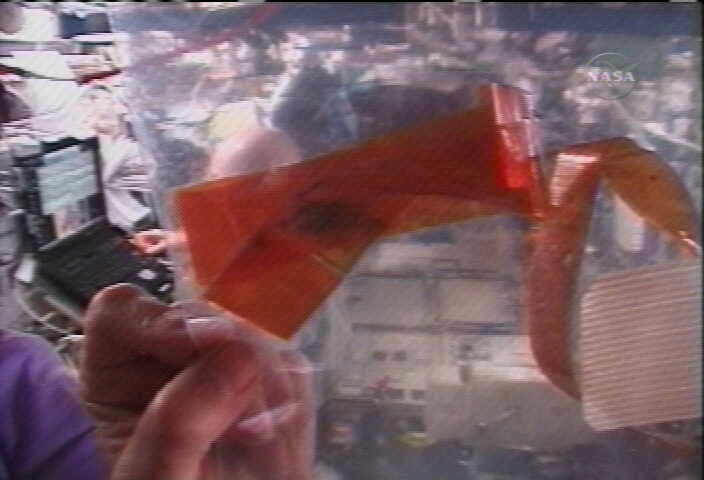
U.S. astronaut Daniel Tani used orangetape to pick up what he described as metal shavings from the surface of themassive joint, which rotates the station?s starboard solar arrays like apaddlewheel to track the Sun. While mission managers are unsure if the bits areactually metal, one thing is certain: they shouldn?t be there at all.
?With this kindof contamination in the system, you don?t want to see it anywhere,? MikeSuffredini, NASA?s ISS program manager, told reporters after today?sspacewalk.
The material could force the joint to draw too much power and stall, or cause significant damage to its internal mechanism if left unchecked, he added.
Tani foundthe debris while inspecting the starboard Solar Alpha Rotary Joint (SARJ), a10-foot (three-meter) wide gear that sits between two massive girders on theright side of the side of the station?s backbone-like main truss. The sampleshe collected will be returned to Earth aboard the shuttle Discovery once itsSTS-120 astronauts completetheir construction mission.
?There?squite a bit,? Tani said of the material adding that one of the joint?s gearteeth-bearing rings appeared to be discolored. ?I?d almost say that it lookslike it?s been corroded in some way.?
Suffredinisaid that the ring?s appearance could be the normal state of its surfacecoating or the result of some material rubbing against it, such as metal or an aluminumfoil-like Mylar attached to insulation just a half-inch (1.27-centimeters)above the device.
The starboardsolar arrays are parked for the time being, and may be moved into a better Sun-facingposition every few days while engineers decide whether to send spacewalkersback out to inspect afflicted joint while Discovery?s STS-120 crew remains atthe ISS.
It is stilltoo early to tell whether the joint?s contamination could affect plans tolaunch the European Space Agency?s Columbus laboratory to the ISS in Decemberor deliver components of Japan?s Kibo laboratory next year, Suffredini said.
Any lengthyclean up or repairs, if required, could be deferred until sometime after theDecember launch of Columbus, he added.
?We?ve gotlots of time to work this problem, it?s not an immediate issue,? Suffredinisaid.
Astronautsinstalled the space station?s starboard solar arrays and rotary joint during aJune shuttleflight, but it only began experiencing slight current spikes and vibrationsover the last 50 days. An engineer discovered the vibration almost by accidentafter noticing the view from an ISS video camera shake, station managers said.
A similar rotary joint on the port side of the station's main truss is performing as designed to rotate its own solar wings, NASA said.
Flightcontrollers hoped the glitch stemmed from a slight obstruction, such as bolt ofthermal blanket, and sent Tani to investigate during a spacewalk primarilyaimed at removing a separate solar array from atop the ISS and outfitting the station?snew Harmony node with handrails and other equipment.
?It?sgotten more attention than just your average anomaly has,? he said. ?Noweverybody is probably kicked into a slightly higher gear.?
While ISS engineers study the joint contamination, Discovery's own mission managers hit a major flight milestone: they cleared the spacecraft's heat shield of any concern from its Oct. 23 launch.
"We have unequivocally cleared the thermal protection system of Discovery for entry," mission management team chair LeRoy Cain said Sunday.
NASA is broadcastingDiscovery's STS-120 mission operations live on NASA TV. Click here for mission updatesand NASA TV from SPACE.com.
- SPACE.com Video Interplayer: Delivering 'Harmony' with NASA's STS-120 Mission
- Explore the Skies Tonight: SPACE.com Sky Calendar
- Complete Space Shuttle Mission Coverage
