


Thisstory was updated at 11:59 p.m.
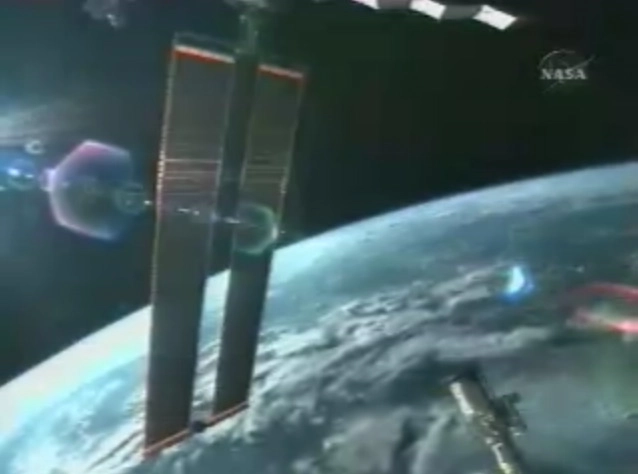
HOUSTON --The International Space Station (ISS) unfurled a shiny new set of solar wingsTuesday to increase its power supply and support future construction.
Astronautsaboard the ISS and NASA?s shuttle Atlantis watched as the new solar arrays atthe tip of the station?s newStarboard 3/Starboard 4 (S3/S4) truss unfolded like window blinds asthe two spacecraft flew 214 miles (344 kilometers) above Earth.
?Everythingworked as expected and we ended up with two brand new solar arrays,? Atlantisastronaut Jim Reilly II said after the successful deployment.
The newsolar wings are the third of four U.S.-built arrays to be installed at theISS and were attached to the orbital laboratory during a Monday spacewalk. Theywill allow the orbital laboratory to power new modules andinternational laboratories from Europe and Japan, which are slated tolaunch towards the ISS later this year and in early 2008.
"Sothey need electricity for those new modules, and that's part of our job, toallow them to have that," said Atlantis astronaut Steven Swanson, anSTS-117 mission specialist, in a NASA interview.
The solararrays? S4 truss is designed to rotate its power-generating wings like apaddlewheel so they can track the Sun and maximize electricity production. Butfirst, an older solar array wing extending over the new S3/S4 trusses from thestation?s mast-like Port 6 (P6) truss willhave to be retracted to clear the area.
That solararray retraction is planned during a Wednesday spacewalk by Swanson and fellowSTS-117 astronaut Patrick Forrester. The astronauts launched towards the ISSaboard Atlantis on June 8 to deliver the new starboard solar arrays, trussesand a new crewmember to the ISS during their 13-day mission.
Slow andsteady
The space station?snew solar wings began to unfold in earnest at about 4:03 a.m. EDT (0803 GMT),while the ISS and shuttle astronauts slept, when flight controllers on Earthcommanded the first of the two solar wings to extenda single mast section, or bay, of its 31.5-bay length.
?It?sreally good to look out and see the solar array blankets extended one bay,?STS-117 mission commander Rick Sturckow said.
By 1:58p.m. EDT (1759 GMT), both solar arrays were fully deployed.
Each ISSsolar wing is made up of two 115-foot (35-meter) panels attached to a centralmast. When fully unfurled, their wingspan reaches 240 feet (73 meters) from tipto tip.
Both arrayswere deployed in stages, which allowed sunlight to warm them up and avoid theirpaper-thin photovoltaic cells from sticking to one another too strongly -- aphenomena known as ?stiction? -- after years of being packed in a box about 20inches (50 centimeters) deep.
When NASAdeployed its first pair of U.S. solar arrays from the station?s P6 truss duringthe STS-97 mission in 2000, the panels encountered severe stiction and atension line came off its spool, prompting a spacewalk repair.
Tuesday?ssolar array deployment, by comparison, appeared to go smoothly.
A navigationcomputer issue in the station?s Russian-built segment forced the orbitallaboratory to switch between its own U.S. gyroscopes and the Atlantis shuttle?sthrusters to maintain attitude control, leading to some delays in fullycharging the new solar wings and impacting the power produced by their olderport-side counterparts. But by late Tuesday, the system was back online and thenew arrays charging properly, NASA officials said.
Meanwhile,the Atlantis astronauts had some free time Tuesday before gearing up forWednesday?s spacewalk.
Swanson andForrester will perform the second of four planned spacewalks for the STS-117mission during the excursion, and will spend the night in the station?sQuest airlock to cut down on the time required to prepare their bodies for theplanned 6.5-hour excursion.
NASA isbroadcasting the space shuttle Atlantis' STS-117 mission live on NASA TV. Click here for mission updates andSPACE.com'svideo feed.
- SPACE.com Video Interplayer: Space Station Power Up with STS-117
- STS-117 Power Play: Atlantis Shuttle Crew to Deliver ISS Solar Wings
- Complete Shuttle Mission Coverage
