CAPE CANAVERAL, Fla. -- Seven astronautsand NASA’s shuttleDiscovery are home for the holidays after a successful mission to rewirethe InternationalSpace Station (ISS).
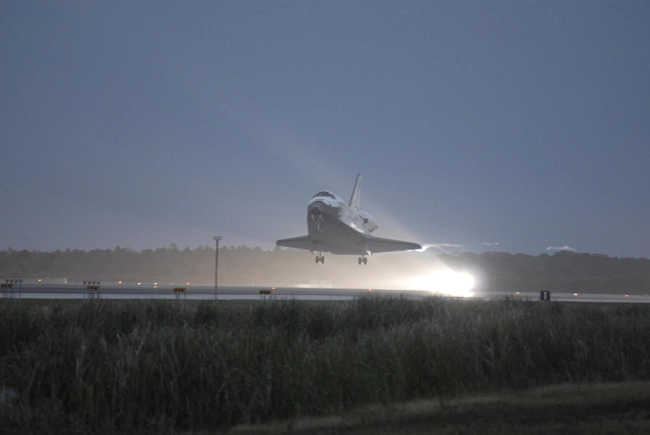
Despite a grimforecast of low clouds and rain, Discovery swooped down out of the Florida sky and loosedtwo sonic booms before making a twilight touchdown at NASA’s ShuttleLanding Facility at the Kennedy Space Center (KSC).
The sunset landing came at about5:32 p.m. EST (2232 GMT), ending a complex 13-dayspaceflight for Discovery’s STS-116 crew after 5.3 million mile (8.5million kilometer) trip around their home planet.

"I think it's going to be agreat holiday," said veteranspaceflyer Mark Polansky,Discovery’s commander, as he thanked mission control after landing."We're just really proud of the entire NASA team and thank you."
Returning to Earth alongside Polansky were Discovery pilot WilliamOefelein, mission specialists NicholasPatrick, RobertCurbeam, JoanHigginbotham and European Space Agency (ESA) astronauts Christer Fuglesang and ThomasReiter. The astronauts had to wait one extra orbit to land at KSC due tothe weather, NASA said.
“It’s been a funmission,” Patrick, one of five first-time spaceflyerswho launchedaboard Discovery, told reporters Thursday. “And I think a successfulone.”
The astronauts worked in concertwith the space station’s Expedition 14 crew during their 13-daymission to overhaulthe orbital laboratory’s power grid, add a newpiece to its portside truss and stage an extraspacewalk to help fold astubborn solar array. Their success leaves the ISS poised for the arrivalof new solar wings, a module and international laboratories slated to launch inupcoming shuttle flights.
Reiter, a formerISS resident and Europe’s first long-duration member of stationmission, replaced STS-116mission specialist Sunita Williams, who took hisplace on the orbital laboratory’s Expedition 14 crew.
“We wish all the best tothe people on Earth that we have ahealthy New Year,” Reiter said before landing.
Mission controllers awoke the Discovery’s astronautcrew early Friday with Christmas music to celebrate their holiday return after204 orbits around Earth.
Mission success
Discovery’s astronaut crewcompleted what mission managers largely believed to be among the mostcomplex shuttle flights ever attempted. Their STS-116 mission marked thethird shuttle flight of 2006 and the second dedicated to ISS assembly sinceconstruction stalled after the 2003Columbia accident.
“We’d been trainingfor this flight for over six years, so I can’t even begin to explain toyou what it feels like to finally accomplish what we set out to do,” JohnCurry, NASA’s lead ISS flightdirector for STS-116, said after Discovery’s crew met all their stationconstruction goals this week. “Cathartic is a good word, I guess, becauseI’ve been scared of this flight for a very long time.”
The mission’s ISS powerreconfiguration alone prompted concerns over whether the station’slong-dormant primary electrical system and cooling pump hardware would performas planned. Discovery’s flight marked the first time astronauts retracteda U.S.solar array -- and not without issues -- which called for an additionalspacewalk.
“I’m very, veryproud and relieved and thankful that things worked out the way they did,”Curry said.
Bringing Discovery’s crewhome proved an exerciseof sorts for mission managers, who traded a spare weather day for a Mondayspacewalk outside the ISS. Twoalternate landing sites, Edwards Air Force Base in California and Northrup Strip at New Mexico’s White Sands SpaceHarbor, were also available since the shuttle carried only enough suppliesto stay aloft until Saturday.
Busyyear awaits
As 2006 nears its end, shuttleand ISS officials are already looking ahead to what promises to be an even morechallenging series of joint construction missions.
“You’re going to seesignificant changes to the pressurized volume and also to the truss next year,Kirk Shireman, NASA’s deputy ISS programmanager, said of next year’s shuttle and space station missions.“So it’s a really exciting year.”
Atlantis’ STS-117 mission– commanded by NASA shuttle veteran RickSturckow – is slated to launch spacewardaboard Atlantis no earlier than March16, 2007 to deliver a new pair of solar arrays for installation on thespace station’s starboard side.
Sturckow and his crew will kick off the first of what NASAexpects to be a busy year of ISS construction, with five station-bound shuttlesand ambitious flights that also include the delivery of a newconnector node, the European ESA’s Columbus moduleand a logistics component of Japan’s Kibo laboratory.
The European Automated Transfer Vehicle isalso due to make its first cargo flight to the ISS in May, and Russian Soyuzcrew change missions and Progress resupply flightsalso abound.
“So, big changes coming tothe ISS,” Shireman said. “I look forwardto a very exciting year next year.”
But for Reiter, who is now aveteran of two long-duration spaceflights, the road ahead has more near-termgoals and include reacquainting himself with life in gravity’s embrace.
“I trained a lot, and veryhard, on the space station to minimize that time so I can feel normal and walkand hopefully start jogging again,” Reiter told students in Alaska Thursday.“My previous flight, it was about a week to feel a little bit normal, andI hope it will be a little less now.”
The STS-116 crew’s safereturn concluded NASA’s 117th shuttle flight and the orbiter’s 33rdspaceflight. It also marked NASA’s 20th orbiter mission to the ISS, andthe agency’s 15th December shuttle touchdown.
“I think this is a reallygreat way to see the end of the year,” Polanskysaid earlier this week.
- Images: The Spacewalks of NASA’s STS-116
- Images: Discovery’s STS-116 Launch Day Gallery
- Mission Discovery: The ISS Rewiring Job of NASA’s STS-116
- Complete Space Shuttle Mission Coverage
- The Great Space Quiz: Space Shuttle Countdown
- All About the Space Shuttle
