





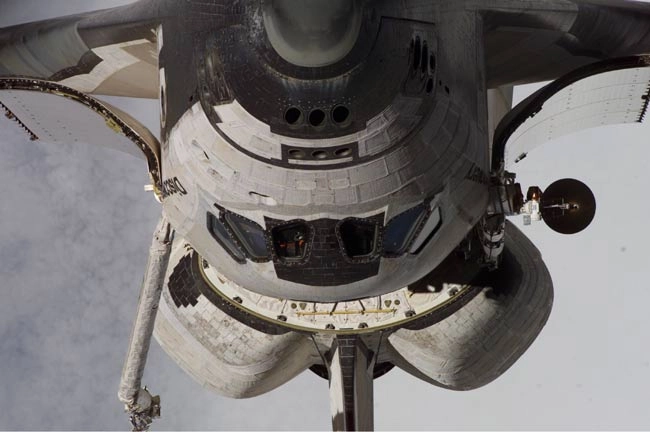
CAPE CANAVERAL, Fla. -- NASA’s space shuttle Discovery ispoised to ferry sevenastronauts back to Earth later today, but much depends on Mother Nature.
The shuttle’s STS-116 crew isdue back on Earth at about 3:56 p.m.EST (1856 GMT) after a successful 13-day construction flight to the International SpaceStation (ISS), but only if a bleak weather forecast eases at NASA’sShuttle Landing Facility here at the Kennedy Space Center (KSC).
“Currently the Kennedy Space Centeris forecast ‘no go,’” Norm Knight, NASA’s entry flightdirector for Discovery’s STS-116mission, said lateThursday.
A low cloud layer and rain showersare expected at touchdown time at KSC, Knight said, adding that high windsanticipated at Discovery’s prime backup landing strip on California’sEdwards Air Force Base also afflict that site’s potential for theshuttle’s return.
Discovery shuttlecommander Mark Polansky and his fellow crewmateshave a good chance—weather wise—of setting down at NASA’sthird landing alternative, WhiteSands Space Harbor in New Mexico, should KSC and Edwards prove untenable,NASA officials said.
“My wife cares where we land.I believe she and the other families are going to be in Florida,” Polanskytold reporters Thursday. “But the real answer is, no I really don’tcare where we land.”
Polansky said he and shuttlepilot William Oefelein have trained exhaustivelyto handle landing Discovery—effectively a 100-ton glider duringreentry—at KSC, Edwards or Northrup Strip atWhite Sands.
“I’m not concerned atall about the ability of the crew to safely get the orbiter on theground,” Polansky said.
Discovery carries enough supplies tostay in orbit until Saturday, but NASAflight rules call for reserving that day in case of an unanticipated orbitersystems glitch or malfunction.
Mission managers sacrificed an extraweather day for Discovery’s STS-116 flight earlier this week in order tostage an unplannedfourth spacewalk to subdue a stubbornISS solar array and fold it away. The decision prevented the solar arrayfrom impacting the station’s assembly sequence, but runs the risk ofadding two extra months to Discovery’s turnaround time should it land atWhite Sands.
“We decided that that was fairtrade,” Shannon said, adding thatDiscovery is not scheduled to fly again until October 2007, and that theinformation learned in wrangling the solar array willbe vital for the STS-117mission in March when another solar wing must be furled.
Knight said that should weatherpreclude a KSC landing on Discovery’s first return attempt the plan willthen be to try for Edwards or KSC on the next orbit, which would placetouchdown around 5:30 p.m. EST (2230 Dec. 23 GMT). On the third orbit, bothEdwards and White Sands are available with landing slated for around 7:00 p.m.EST (0000 Dec. 23 GMT) followed by a later Edwardsopportunity.
Rookies no more
Accompanying Polanskyand Oefelein to Earth aboard Discovery are STS-116mission specialists NicholasPatrick, RobertCurbeam, JoanHigginbotham and European Space Agency (ESA) astronauts Christer Fuglesang and ThomasReiter. Polansky, Curbeamand Reiter aside, all of the shuttle astronauts made their first spaceflightduring the STS-116mission.
“We’ve bonded on theground,” Higginbotham said Thursday. “I think we’ve growneven closer here in space.”
Higginbotham and her crewmates notonly staged three spacewalks to installa new section of the station’s main truss and rewireits power grid, but performed the extraspacewalk, delivereda fresh load of cargo and performed the orbital laboratory’s firstpartial crew change.
NASA touted the mission as its mostcomplicated shuttle flight to date, though it will likely be eclipsed infuture ISS construction missions.
“I am extremely proud of theteam,” Shannon said, adding that a lackof major shuttle glitches contributed to the mission’s success. “Wegot a little bit lucky in how well everything performed.”
Discovery’s crew change comesin the form of Reiter, who is returning home after spending almost six monthsaboard the ISS as part of its three-astronautcrew.
“I’m really lookingforward to come back after almost half a year,” Reiter said during hisspaceflight, and said Thursday that he hopes that he will be able to quicklyrecover from the toll such a long-duration spaceflight took on his body.“I hope it doesn’t take too long, maybe three of four days.”
NASA astronaut Sunita Williams, who launchedaboard Discovery on Dec. 9, has taken Reiter’s place with thespace station’s Expedition 14 crew and will stay on to join the orbitallaboratory’s Expedition15 mission next year.
“We wish here well with therest of her increment and we’ll miss here,” Polanskytold Williams before leaving her aboard the ISS Monday.
Reiter will return to Earth in aspecial recumbent—or laid back—seat to ease the stresses of thereturn to gravity on his body. His STS-116 crewmates, by comparison, sit in anupright position during reentry.
Looking ahead towards landing, Polansky said Thursday that he his crew is fully aware ofthe weather woes plaguing flight controllers on Earth.
“Beamer and I flew together onSTS-98and we waved off two times and landed in California,”Polansky said of himself and crewmate Robert Curbeam. “So these things happen and we just have toroll with the punches.”
- Images: The Spacewalks of NASA’s STS-116
- Images: Discovery’s STS-116 Launch Day Gallery
- Mission Discovery: The ISS Rewiring Job of NASA’s STS-116
- Complete Space Shuttle Mission Coverage
- The Great Space Quiz: Space Shuttle Countdown
- All About the Space Shuttle
