





China'snext Shenzhou spacecraft to launch astronauts into orbit is under constructionas officials draw up plans for the 2008 space shot, the country’sstate-run media reported Friday.
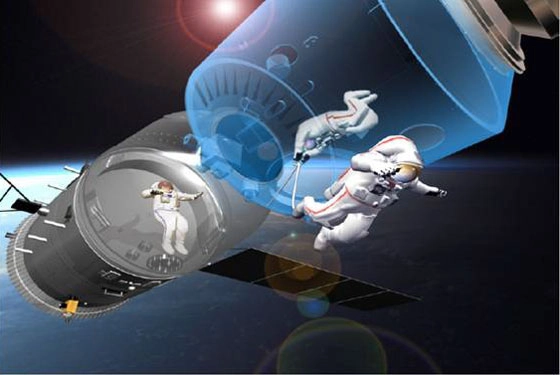
Thecountry's next crewed spaceflight, Shenzhou7, is slated to launch three astronauts spaceward and include at least onespacewalk as China moves forward with plans to build an orbital space station.
“Allthe equipment of the separate systems has been delivered to China’s spaceaviation center for assembly,” Qi Faren, chief designer of China’sfirst five Shenzhou spacecraft, was quoted as saying by the Xinhua NewsAgency.
Qispoke at China’s Sixth China International Aviation and AerospaceExhibition held this week at the southern city of Zhuhai in the Guangdongprovince.
YangLiwei, China’s firstastronaut, also spoke at the air show, where he announced that he and theShenzhou 6 spaceflyers—FeiJunlong and Nie Haisheng—are in the running to fly the Shenzhou 7mission, state media reported.
“Currently,we three—Fei, Nie and I—and some other astronauts are being trainedfor the third space mission,” Yang was quoted as saying by Xinhua.
Yangmade history when he orbited the Earth 14 times in 21 ½ hours duringChina’s Shenzhou5 mission in 2003 as part of the country’s first crewed spaceflight.Fei and Nie launchedaboard Shenzhou6 for a five-day mission in October 2005, marking China’sfirst two-astronaut crew.
China’sShenzhou 7 mission is expected to launch three astronauts into orbit and tofeature the nation’s first spacewalk, which may in include one or twospaceflyers and run about 30 minutes in length, according to past reports.
Accordingto the Shanghai Daily newspaper, the Shenzhou 7 spacecraft will featurea “pressure cabin” so that spacewalkers can adjust toweightlessness before their planned spacewalk. Chinese spacewalkers will don$20 million spacesuits, which weigh about 220 pounds (100 kilograms) on Earth,and are different from those used during the Shenzhou 5 and 6 spaceflights, theShanghai Daily reported.
Yangreportedly said that Shenzhou 7 spacewalkers will perform a series of tasksoutside their spacecraft, including tightening screws and installing equipment,according to a Xinhua report.
Chinais only the third nation, after the former SovietUnion and the U.S. [video],to independently launch astronauts into space.
Thecountry’s Shenzhou (Divine Vessel) spaceships [image]are basedon Russia’s three-segment Soyuz vehicles,but have been extensively modernized and modified by Chinese spacecraftdesigners.
Onemajor difference is the Shenzhou’s ability to leave its solar array-equippedorbitalmodule in space for months at a time. Such modules could serve as a dockingtarget for future spacecraft, or as the foundation of a small space station, spaceexperts have said.
“Chinawill build a space laboratory after the Shenzhou 7 spacecraft is successfullylaunched, and eventually build its own space station to resolve the problemsrelated to large-scale space-based scientific experiments and technologicalapplications,” Yang was quoted as saying by Xinhua in a separatereport.
Shenzhou8 is expected to mark China’s first orbital dockingbetween two spacecraft, a vital step forward for any planned space station.
“Shenzhou8, Shenzhou 9 and Shenzhou 10 are all being planned and the intervals betweenthem will become shorter,” Xinhua quoted Qi as saying.
ButChina will apparently have to wait awhile before seeing its first femaleastronaut reach orbit.
“China’sspace program has no missions for women astronauts yet, so we haven’tstarted selecting women astronauts,” Yang—who also serves as deputydirector of the China Astronaut Research and Training Center—was quotedas saying by Xinhua.
- China Unveils Ambitious Space Plans at National Space Symposium
- Shenzhou Rising: China’s Second Manned Spaceflight
- Making History: China’s First Human Spaceflight
- Special Report: Emerging China, Engaging China
