





Thisstory was updated at 4:21 p.m. EDT.
HOUSTON - The International SpaceStation (ISS) unfurled a new set of solarwings Thursday despite a software glitch that cast early doubt on theentire activity.
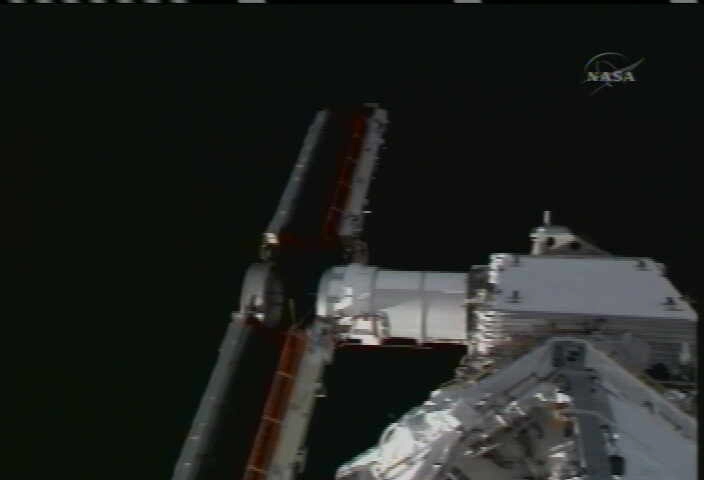
Twoshimmering solar arrays reached their full wingspan of about 240 feet (73meters) at 8:44 a.m. EDT (1244 GMT) as they extended from the space station'snew Port4 (P4) truss.
"We're veryhappy to get the array out today," said Atlantisshuttle commander Brent Jett after the solar arrays deployed. "The teamobviously did a great job."
That jobincluded a late night scramble by engineers on Earth to first diagnose, thenfix, a software command issue with a gear assembly between the space station's Port 3(P3) truss and the Port 4 (P4) segment which includes the newpower-generating solar arrays. Jett and his STS-115 crewmates installedboth portside segments to the ISS on Tuesday.
The gearassembly, known as a Solar AlphaRotary Joint, will rotate the entire P4 truss - and eventually futureoutboard segments - to keep its solar arrays aimed at the Sun while the ISSorbits the Earth. One of the SARJ motors did not appear to be properly engagedin the gear's teeth. The issue was resolved late Wednesday, delayed today'ssolar array deployment by several hours.
"We arequite a few hours behind the timeline for the [solar array wing] deploy, itdefinitely is not going to happen on time today," NASA astronaut Kevin Ford,serving as spacecraft communicator, told the ISS crew early Thursday.
JohnMcCullough, ISS flight manager for Atlantis' mission, said the SARJ glitchdelayed today's solar array deployment by about three hours, but gave theSTS-115 crew a bit of extra time for chores planned for later today.
Bymid-afternoon, the joint ISS-shuttle crews were just 15 minutes behindschedule, he said.
Nosticky issues
NASA's planto reel out the station's two new U.S.-built solar arrays in stages to preventsevere sticking - dubbed "stiction"by engineers - of the paper-thin layers of photovoltaic cells workedflawlessly.
Both newsolar wings were reeled out first a few feet, then to the halfway mark to warmin the Sun for 30 minutes before extending to their full length. At the sametime, tension lines were kept in a high-tension mode to separate any stickypanels.
"Thehigh-tension mode did its job and released the panels successfully," Jett toldmission control.
About 11panels appeared to stick together on each array as they deployed, but theyeasily unfolded once the solar wings reached their full extension, Jett said.
Jett commandedNASA's STS-97mission in 2000 to deliver the first U.S.-built solar arrays now in useatop the space station's Port 6 (P6) truss.
During thatflight, astronauts - including current STS-115spacewalker Joseph Tanner - deployed the first array in a low-tension modewithout warming the arrays, leading to severestiction that caused one tension line to pull free from its spool. Aspacewalk was later required to repair the spool.
JohnMcCullough, lead ISS flight director for Atlantis' mission, said flightcontrollers and engineers took the lessons learned from the STS-97 mission andwould apply them to today's solar array deployment.
"We'relooking forward to solar array deploy," McCullough said Wednesday.
Newpower plant
The P4trusses port and starboard solar arrays - individually known as 4A and 2A,respectively - were built by Lockheed Martin and will generate about 23kilowatts of usable power, enough for six average homes, using 64,000 solar cells.
"It'sreally a very stunning sight to see," McCullough said of the solar arraydeployment.
The P4arrays represent one-fourth of the final power grid for the ISS, and will notbe brought fully online until December, when spacewalkers are expected torewire power and data cables between the new solar wings and the ISS.
Twoadditional solar array modules, destined for yet-to-fly starboard ISS trusses,await launch on Earth.
STS-115mission specialist HeidiemarieStefanyshyn-Piper said before launch that today's solar array deploymentwould be one of the highlights of her spaceflight.
"That'sgoing to be another exciting moment to look at the cameras and say, 'Wow,' asthese giant arrays fold out," Stefanyshyn-Piper said.
Stefanyshyn-Piperand Tanner are now preparing to head back outside for the thirdand final spacewalk of the STS-115 mission on Friday to complete the newsolar arrays' installation.
Thatspacewalk is slated to begin at 5:15 a.m. EDT (0515 GMT) Friday morning.
NASA isbroadcasting Atlantis' STS-115 mission to the ISS live via NASA TV. You areinvited to follow the shuttle's progress using SPACE.com's NASATV feed, which is available by clickinghere.
- New Gallery: STS-115: Atlantis's Launch Day
- Complete Space Shuttle Mission Coverage
- NASA's STS-115: Shuttle Atlantis to Jump Start ISS Construction
- The Great Space Quiz: Space Shuttle Countdown
- Complete Coverage: ISS Expedition 13
