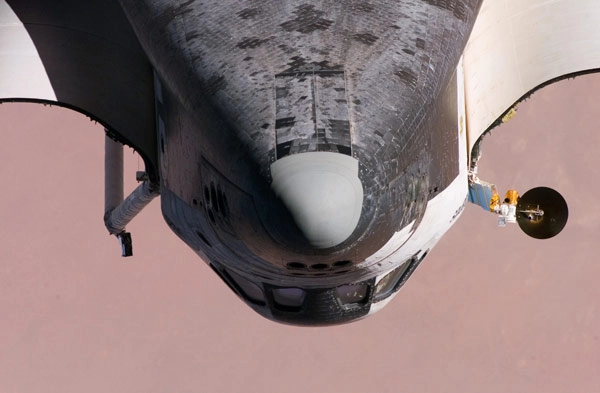
HOUSTON - NASA engineers have cleared the space shuttle Atlantis' heatshield of any concern pending one last inspection by the orbiter'ssix-astronaut crew, mission managers said Tuesday.
JohnShannon, NASA's deputy shuttle program manager, said engineering teams clearedtwo final issues prompted by orbital photographyand a detailedinspection of Atlantis' heat-resistant tiles, wing edges and nose cap.
"We wereable to clear all of the thermal protection system in 60 hours [and] my best estimatewas always five days, about 120 hours," Shannon, who also chairs Atlantis'STS-115 Mission Management Team, told reporters in a briefing here at NASA'sJohnson Space Center. "So we did it in half the time."

Atlantis isdocked at the InternationalSpace Station (ISS), where its six-astronaut crew delivered a massivepair of trusses and new solar arrays in a spacewalkearlier today. The mission is NASA's first ISS construction flight since late2002.
The onlytwo shuttle heat shield issues of any note included a slightly puffed thermalblanket on the dome of Atlantis' starboard - or right - Orbiter ManeuveringSystem (OMS) pod and a bright bit of orange plastic known as shim stock.
The thermalblanket represented no debris or excessive heating threat to Atlantis onreentry and the plasticshim - once thought to be a ceramiccloth gap-filler - will melt well before the orbiter experiences itsmaximum heating during landing.
Shuttletiles withstand temperatures of about 2,300 degrees Fahrenheit (1,260 degrees Celsius)at the peak of atmospheric reentry. The plastic shim will soften at just 200degrees Fahrenheit (93 Celsius) and melt completely at 450 degrees (232Celsius), Shannon said.
One last inspection, to scan for any damage by orbital debris or micrometeorites, is scheduled once Atlantis undocks from the ISS next week.
The factthat NASA engineers cleared Atlantis' heat shield on Flight Day 4 of the shuttle'smission, rather than one or two days later as seen on the last two shuttleflights, is a sign that the engineering teams are streamlining and improvingtheir processes, Shannon added.
ISS AdditionsAlso Doing Well
In additionto Atlantis, the space station's new $372million trusses and solar arrays are also doing well after a swift spacewalktoday.
JohnMcCullough, NASA lead ISS flight director for Atlantis' STS-115mission, said some systems aboard the still-unpackedsolar arrays and a 45-foot(13-meter) pair of massive trusses were powered up following the spacewalkby astronauts JosephTanner and HeidemarieStefanyshyn-Piper.
Theastronauts attached 15 critical power and data lines, as well as two fluidlines, to bring the 17.5-ton Port 3/Port 4 (P3/P4) trusses into the ISS fold.The solar array boxes were poised in position to deploy their power-generatingpanels on Thursday morning, ISS Mission Management Team chairman Kirk Shiremansaid.
Flightcontrollers sent 1,631 commands to the ISS in a careful choreography with the spacewalkingcrew, more than eight times the standard 200 commands of any given eight hoursaboard the station, Shireman said.
The only hitchin the orbital construction job was the loss of a small 1.5-inch (3.8-centimeter)bolt, which lost a restraining washer and popped off a thermal cover Tannerremoved from a motor lock on the P3 element's SolarAlpha Rotary Joint (SARJ). Located between the P3 and P4 trusses, the SARJis a motor-driven wheel that will rotate P4 and future outboard segments sotheir solar arrays can track the Sun for maximum power generation.
"It'spretty trivial," McCullough said, adding that the bolts are likely no hazard tothe station, Atlantis or future spacecraft.
"I justhope that bolt is on its way to Mother Earth right now and not anywhere around theSARJ," Tanner said after today's spacewalk.
Shiremansaid a second STS-115 spacewalking team - mission specialists DanielBurbank and StevenMacLean of the Canadian Space Agency - are camping out in the space station'sQuest airlock tonight to purge their bodies of nitrogen for their mission'ssecond spacewalk on Wednesday.
Thatplanned 6.5-hour spacewalk callsfor Burbank and MacLean to remove 14 remaining launch locks on SARJ, wherethey will now keep an eye on all bolts in use, station managers said, addingthat the Atlantis crew's ISS construction work is a welcome challenge.
"I feltthat this is what NASA is supposed to do," McCullough said after overseeing thespacewalk. "Everything we do on the space station teaches us more about what todo to reach the Moon and Mars."
- VIDEO: First Tasks of NASA's STS-115 Mission
- Gallery: Prepping Atlantis
- Complete Space Shuttle Mission Coverage
- NASA's STS-115: Shuttle Atlantis to Jump Start ISS Construction
- The Great Space Quiz: Space Shuttle Countdown
- Complete Coverage: ISS Expedition 13
